
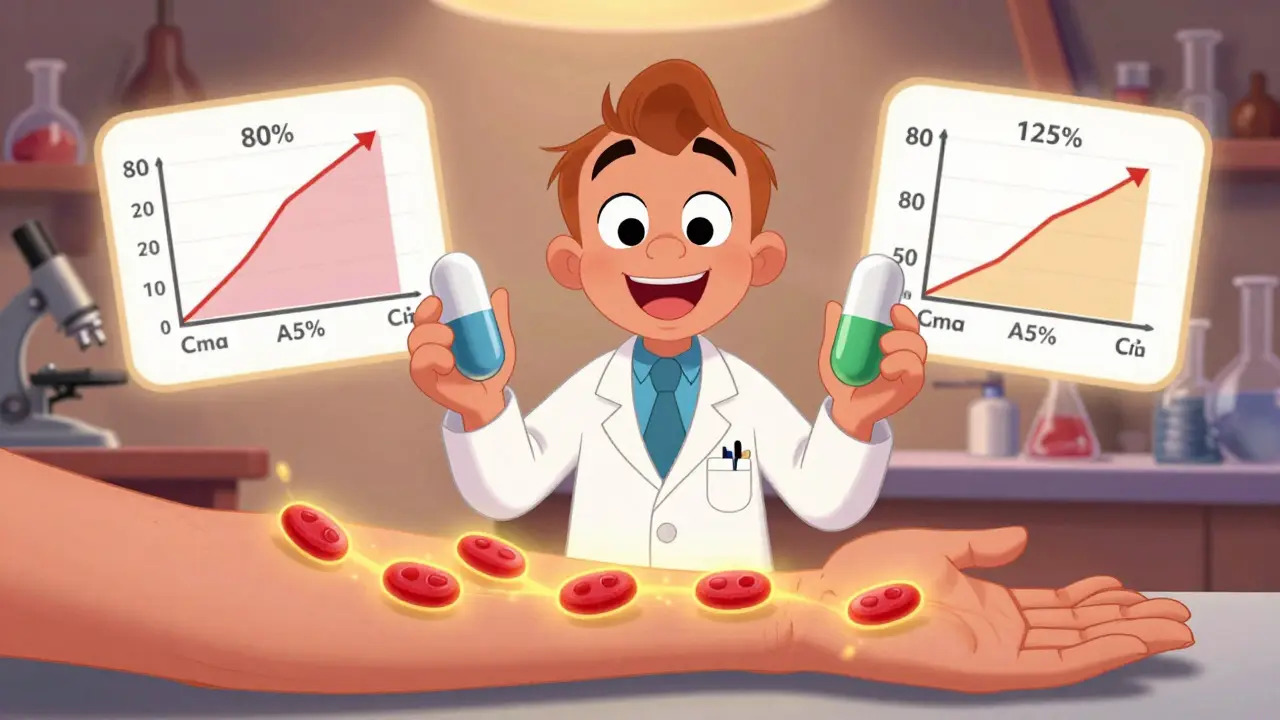
When you pick up a generic drug at the pharmacy, you expect it to work just like the brand-name version. That’s not luck-it’s the result of strict science and regulation. The FDA doesn’t just approve generic drugs because they look the same or cost less. They require manufacturers to prove bioequivalence-that the generic delivers the same amount of active ingredient into your bloodstream at the same rate as the original drug. Without this proof, a generic isn’t approved.
What Bioequivalence Really Means
Bioequivalence isn’t about how the pill looks or what’s in the coating. It’s about what happens inside your body. The FDA defines it as the absence of a significant difference in how quickly and how much of the drug enters your bloodstream when you take it. This is measured using two key numbers: AUC (area under the concentration-time curve) and Cmax (maximum concentration in the blood). If these values for the generic drug are close enough to the brand-name drug, regulators say they’re bioequivalent.
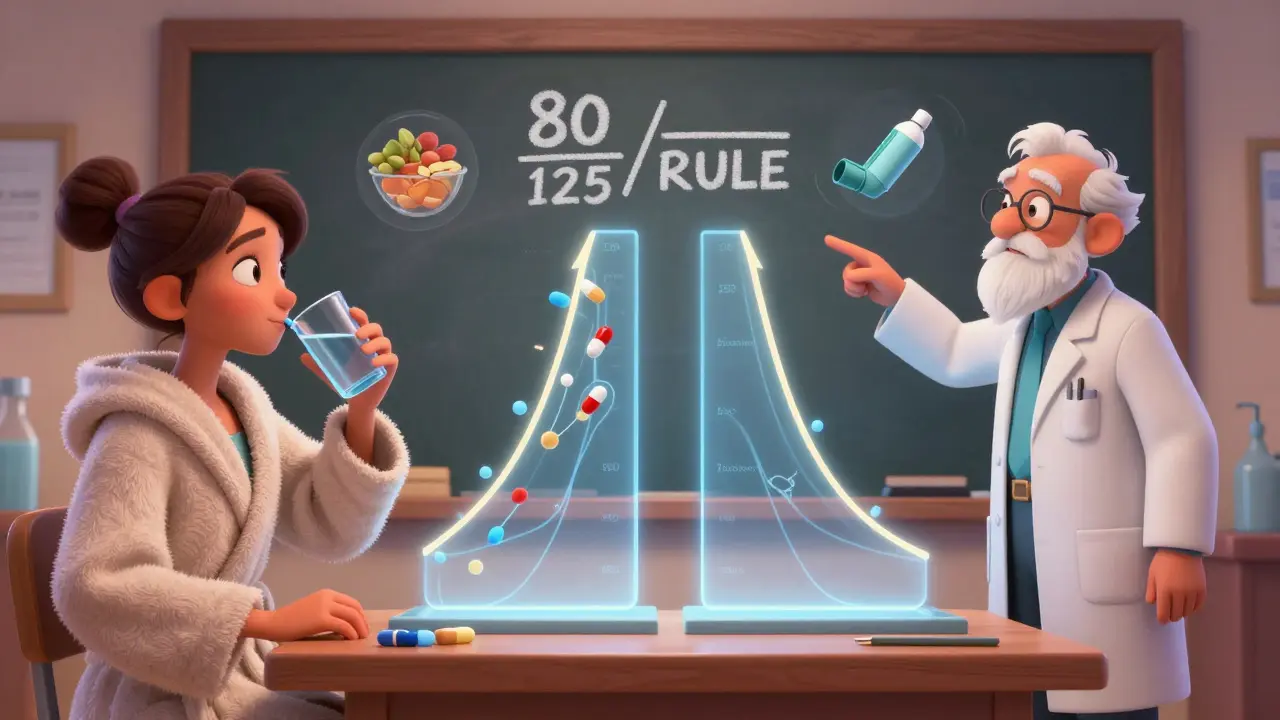
The standard rule is simple: the 90% confidence interval for the ratio of the generic to the brand drug must fall between 80% and 125%. This is called the 80/125 rule. It’s been used since 1992 and still holds today. For example, if the brand drug delivers 100 units of medicine into your blood, the generic must deliver between 80 and 125 units. Any more or less, and the FDA won’t approve it.
How Studies Are Done
Most bioequivalence studies happen in healthy volunteers-usually between 24 and 36 people. They fast overnight, then take either the generic or the brand drug. After a washout period, they switch. Blood samples are taken over several hours to track how the drug moves through the body. This is called a crossover design, and it’s the gold standard.
But not all drugs are tested this way. Some need a second study done after eating. If the drug is affected by food-like some antibiotics or cholesterol meds-the FDA requires a fed study. That’s because how the drug is absorbed can change dramatically when taken with a meal.
Studies must follow Good Laboratory Practice (GLP) rules. This means every sample is labeled, stored, and analyzed with precision. Labs can’t guess. They must use validated methods that are accurate, sensitive, and reproducible. If the analytical method is weak, the whole study fails.
When You Don’t Need a Human Study
Not every generic needs a full clinical trial. The FDA allows biowaivers-meaning manufacturers can skip human testing if certain conditions are met. This saves time and money, sometimes cutting development by a year or more.
Biowaivers apply to products where absorption is predictable. For example:
- Topical solutions for skin or eyes, if they have the same active and inactive ingredients as an approved product
- Oral solutions with identical pH and concentration
- Inhalant anesthetics that vaporize directly in the lungs
The criteria are called Q1-Q2-Q3:
- Q1: Same active and inactive ingredients
- Q2: Same dosage form and strength
- Q3: Same physicochemical properties (like pH, solubility)
If all three match, the FDA assumes the drug will behave the same way. No volunteers needed.
Special Cases: Narrow Therapeutic Index Drugs
Some drugs have a very narrow safety window. A little too much, and you risk toxicity. A little too little, and the drug doesn’t work. These are called narrow therapeutic index drugs (NTIDs). Examples include warfarin, levothyroxine, and phenytoin.
For these, the 80/125 rule is too loose. The FDA tightened the acceptance range to 90-111%. That means the generic must be much closer to the original. Even a 5% difference matters here. Studies for NTIDs often require larger sample sizes and more precise measurements.
Manufacturers who try to use the standard range for an NTID will get a complete response letter-meaning their application is rejected outright. There’s no room for error.
Why Some Applications Fail
The FDA approves only about 43% of generic applications on the first try. That’s not because the science is hard-it’s because submissions are often messy. Common mistakes include:
- Using outdated analytical methods
- Not enough volunteers to detect real differences
- Missing data on food effects
- Not following the product-specific guidance (PSG)
Companies that stick to the FDA’s product-specific guidances have a 68% first-cycle approval rate. Those that ignore them? Only 29%. These guidances-there are over 2,100 of them-are the cheat sheet for approval. They tell you exactly what study design, sample size, and endpoints to use for each drug.
For example, if you’re making a generic version of a topical cream, the PSG will say whether you need an in vitro permeation test, a clinical study, or both. Skip it, and you’ll get stuck in review limbo.
The Bigger Picture
Bioequivalence studies are the backbone of the generic drug system. Since the Hatch-Waxman Act of 1984, generics have gone from 19% of prescriptions to over 90%. They save the U.S. healthcare system over $1 trillion every decade.
But the system isn’t static. The FDA is now pushing new tools like physiologically based pharmacokinetic (PBPK) modeling. This lets manufacturers simulate how a drug behaves in the body using computer models-instead of always running human trials. It’s especially useful for complex products like inhalers or injectable suspensions.
The agency is also working on better standards for topical products, drug-device combos, and complex injectables. Draft guidances for 45 of these products are expected by mid-2024. The goal? To make approval faster without lowering safety.
And there’s a new push to bring manufacturing back to the U.S. The FDA’s Domestic Generic Drug Manufacturing Pilot Program gives priority review to generics made here with U.S.-sourced ingredients. It’s not a guarantee of approval-but it cuts through the red tape.
What Manufacturers Need to Remember
If you’re making a generic drug, here’s what you must do:
- Identify the correct reference listed drug (RLD)
- Find and follow the product-specific guidance for that drug
- Design your study to match the FDA’s requirements for Cmax and AUC
- Use validated methods and GLP-compliant labs
- Consider whether a biowaiver applies
- For NTIDs, use the tighter 90-111% range
There’s no shortcut. The FDA doesn’t approve generics because they’re cheaper. They approve them because the science proves they’re the same.
What is the 80/125 rule in bioequivalence studies?
The 80/125 rule is the FDA’s statistical standard for bioequivalence. It means the 90% confidence interval for the ratio of the generic drug’s Cmax and AUC compared to the brand drug must fall between 80% and 125%. If it does, regulators accept that the two drugs perform the same in the body. This rule applies to most systemic drugs and has been in place since 1992.
Do all generic drugs need human bioequivalence studies?
No. Some generics qualify for a biowaiver, meaning they don’t need human testing. This applies to products like oral solutions, topical treatments, and certain inhalants if they match the reference drug in active ingredients, concentration, and physicochemical properties. The FDA’s Q1-Q2-Q3 framework determines eligibility. Biowaivers can shorten development time by 6 to 12 months.
Why are narrow therapeutic index drugs treated differently?
Narrow therapeutic index (NTID) drugs, like warfarin or levothyroxine, have a very small window between an effective dose and a toxic one. A small difference in absorption can cause serious harm. Because of this, the FDA requires a tighter bioequivalence range: 90% to 111% for Cmax and AUC, instead of the standard 80%-125%. This ensures the generic is nearly identical in performance.
What happens if a generic drug doesn’t meet bioequivalence standards?
If a generic fails to meet bioequivalence criteria, the FDA issues a complete response letter, rejecting the application. The manufacturer must fix the issue-often by redesigning the study, improving the formulation, or switching to a better analytical method. Re-submitting can add months or even years to the approval timeline. About 43% of ANDA submissions fail on the first try, mostly due to poor study design or ignoring product-specific guidances.
How long does it take to get a generic drug approved by the FDA?
On average, it takes 14 to 18 months from submission to approval. Bioequivalence studies are often the biggest delay. If the application follows the FDA’s product-specific guidance, approval can happen 3.2 months faster. Companies that skip these guidances face longer reviews and higher rejection rates. The FDA’s Domestic Generic Drug Manufacturing Pilot Program can also speed up the process for drugs made and tested in the U.S.
William Minks
March 4, 2026
I work in pharma and can confirm this is spot on. The 80/125 rule isn't just a number-it's a lifeline for patients who can't afford brand names. I've seen companies try to cut corners with sloppy analytics and get slapped hard. FDA doesn't play.
Also, biowaivers are a game-changer. Took a topical acne cream from 18 months to 6 weeks by nailing Q1-Q2-Q3. No humans needed. Win-win.
Susan Purney Mark
March 6, 2026
I used to think generics were just cheaper versions... until my mom had a bad reaction to a generic levothyroxine. Turned out it was borderline out of the 90-111% range. She went from fatigue to full-on panic attacks. 😣
Now I check the manufacturer every time. Turns out, not all generics are created equal. The FDA's extra tight rules for NTIDs? Honestly? Lifesaving.
Amina Aminkhuslen
March 7, 2026
Let’s be real-most of these generic companies are just trying to get rich off our prescriptions. They don’t care if you live or die. They just want to slap a label on a pill and call it 'equivalent'.
And don’t get me started on those 'biowaivers'. You think a cream that looks the same ACTUALLY does the same thing? LOL. I’ve seen people break out in rashes because the 'same' generic had different emulsifiers. FDA’s a joke sometimes.
Roland Silber
March 8, 2026
This is one of the clearest explanations I’ve seen on bioequivalence. Really appreciate the breakdown of Q1-Q2-Q3 and NTID thresholds. One thing missing though-what about bioavailability differences in pediatric or elderly populations? The studies are all on healthy adults. Is that a blind spot?
Also, how often do labs get audited? I’ve heard horror stories about data manipulation.
Patrick Jackson
March 9, 2026
I just want to say-this entire system is a miracle. 💯
Think about it: we live in a world where a $400 brand drug can be replicated for $4 and it works. Not 'kinda works'. Not 'usually works'. It WORKS. The science behind this is so precise, so rigorously enforced, it’s almost poetic.
And yet, people still think generics are 'inferior'. Bro. The FDA has more integrity than most of our politicians. This is science at its finest. 🙌
Bridget Verwey
March 10, 2026
Oh wow. So the FDA doesn’t approve generics because they’re cheap? They approve them because they’re scientifically identical? Who knew?
Meanwhile, my cousin’s insurance still denies generic prescriptions because 'the brand is better'. 🙄
Time to send this article to every insurance rep I know. Maybe then they’ll stop treating patients like lab rats.
Andrew Poulin
March 12, 2026
80-125 rule is nonsense. If it’s not 100% identical, it’s not the same. Period.
NTID drugs need 90-111? Still too loose. Should be 95-105. No excuses. People die over 2% differences. Stop pretending math is magic.
Weston Potgieter
March 14, 2026
Why are we even doing human trials? Just run a simulation. Everyone knows the science. We’re wasting time and money. FDA’s stuck in the 90s. Biowaivers? Still too slow. Just trust the chemistry. Let’s get real.
Ferdinand Aton
March 14, 2026
I dunno, maybe the 80/125 rule is fine. Maybe the FDA’s being too strict. Maybe generics should be allowed to be a little different. Not everything has to be identical. Maybe variation is natural. Just saying.
Jeff Mirisola
March 16, 2026
This is why I love science. Not because it’s perfect, but because it’s honest. The FDA doesn’t care if you’re a startup or a giant pharma corp. If you don’t meet the numbers, you don’t get approved. No favors. No lobbying. Just data.
And yeah, 43% first-pass approval? That’s not failure. That’s a filter. It’s keeping us safe. Thank you, FDA.