
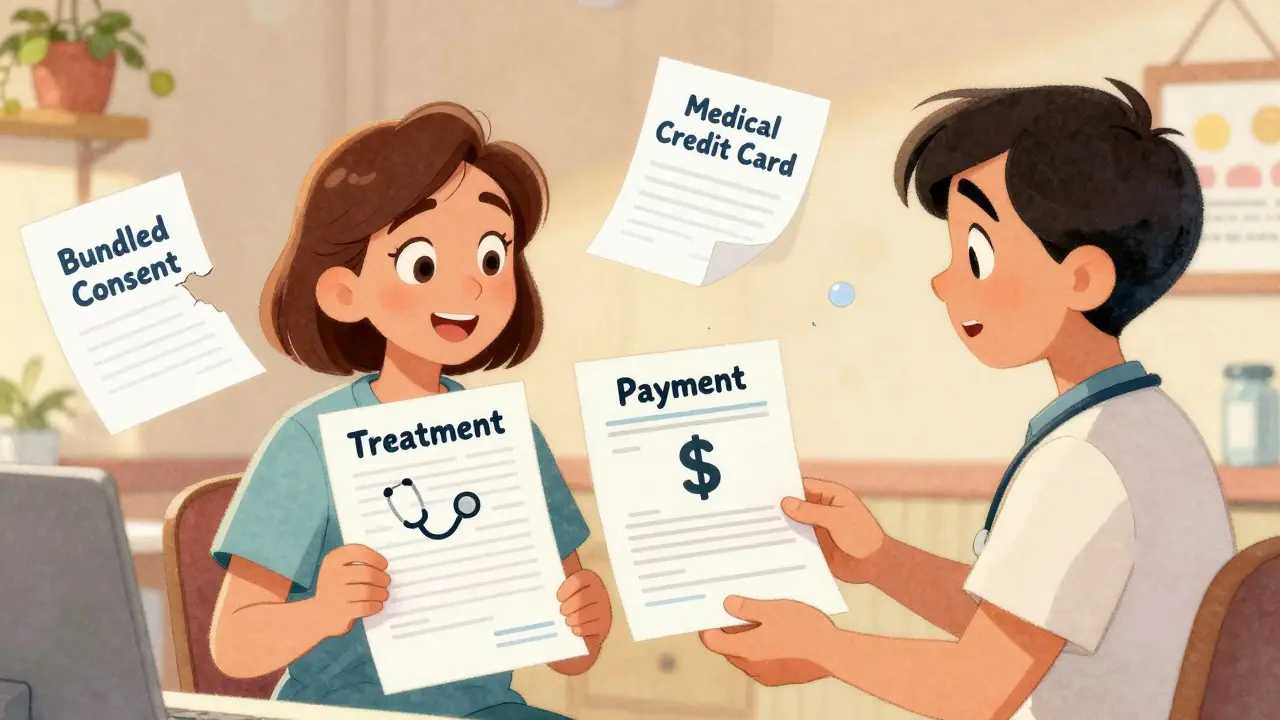
Every time you walk into a doctor’s office, you’re not just handing over your medical history-you’re also handing over your financial trust. In 2026, that trust is protected by some of the strongest patient rights laws in U.S. history. If you’ve ever been surprised by a bill, asked to sign a stack of papers you didn’t read, or felt pressured to use a medical credit card, these laws were made for you.
Separate Consent for Treatment and Payment
For years, patients signed one form that bundled consent for treatment and consent to pay. That’s over. As of October 20, 2024, New York State law requires healthcare providers to get two separate signatures: one for medical care, and another for payment. You can’t sign one document and accidentally agree to finance your surgery or MRI.
This change, under Public Health Law Section 18-c, means clinics and hospitals can no longer hide payment terms inside intake paperwork. You now have the right to say yes to your appointment without saying yes to a payment plan. Violations carry a $2,000 fine per incident. That’s not a warning-it’s a penalty.
But here’s the catch: as of August 2025, enforcement of Section 18-c has been suspended. That doesn’t mean the law is gone. It means providers are waiting for clearer guidance from the state. Until then, you should still ask for separate forms. If they say they can’t give you one, push back. You’re not being difficult-you’re exercising a right that’s still legally protected, even if enforcement is paused.
No More Medical Credit Card Pushing
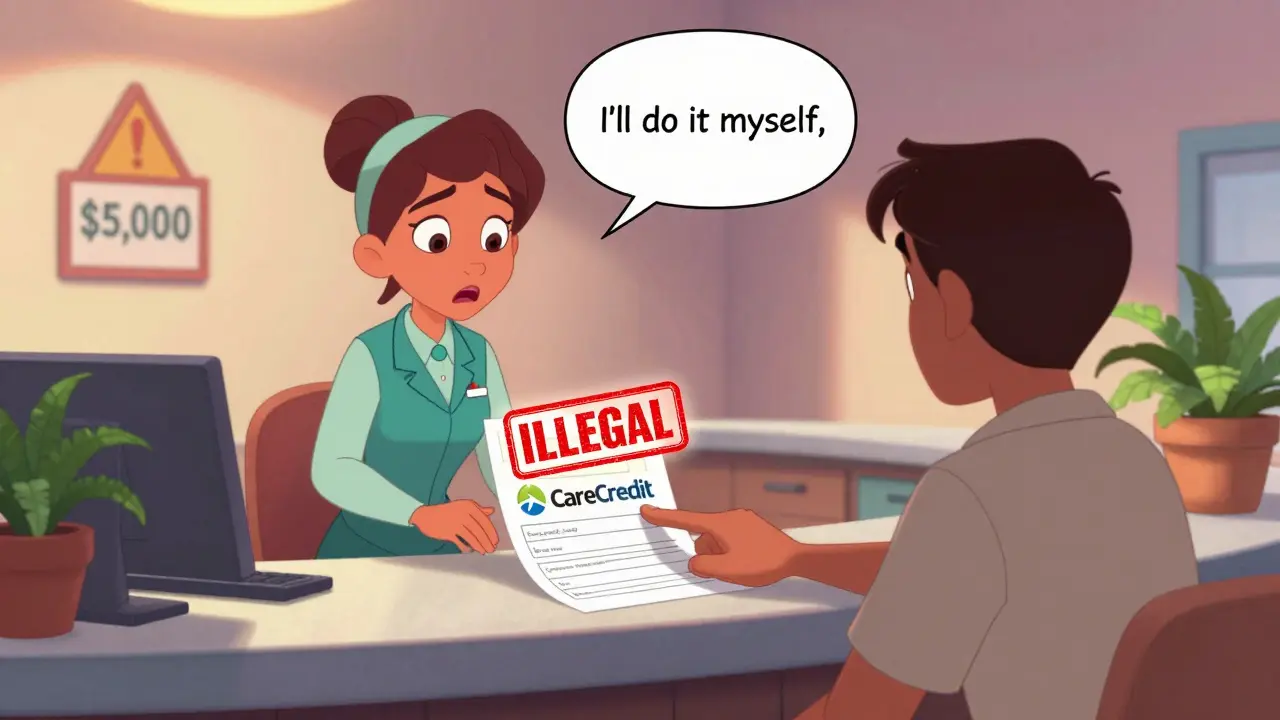
Ever had a receptionist say, “We can help you apply for CareCredit right now”? That’s illegal under New York’s General Business Law Section 349-g. Providers can no longer fill out any part of a medical financing application-not even helping you pick a repayment term or pre-filling your name.
You can ask questions. You can get help understanding interest rates. But the application? You have to do it yourself. The law is clear: if a provider touches the form, they risk a $5,000 fine per violation.
Why does this matter? Medical credit cards like CareCredit often come with deferred interest. If you don’t pay the full balance by the deadline, you get hit with all the accumulated interest-back to day one. That’s how a $3,000 procedure turns into a $4,500 debt overnight. These laws stop providers from steering you into traps they don’t have to pay for.
Don’t Give Your Credit Card Before Emergency Care
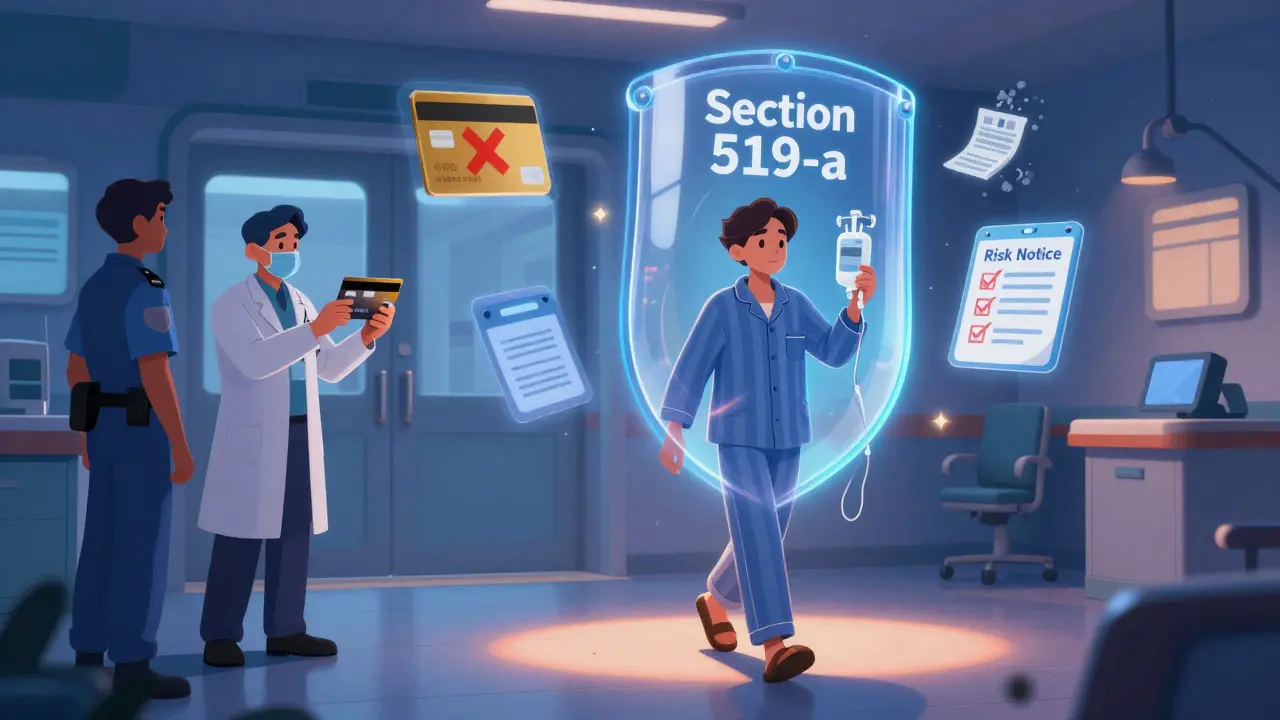
Emergency rooms used to ask for credit card numbers before treating you-even if you didn’t have insurance. That’s now banned under General Business Law Section 519-a. No provider can require you to hand over your card, pre-authorize a charge, or keep your card on file before giving you emergency or medically necessary care.
This isn’t just about convenience. It’s about power. When you pay with a regular credit card, you lose access to federal and state protections that apply only to healthcare-specific financing. Medical debt on CareCredit might be removed from your credit report under CFPB rules. Medical debt on your Visa? Still there. Still can lead to wage garnishment. Still can trigger liens on your home.
And here’s another rule: every time you use a credit card to pay for medical services, the provider must give you a written notice explaining the risks. That notice isn’t optional. It’s required by law. If you didn’t get one, ask for it. If they refuse, file a complaint with the New York State Department of Health.
Federal vs. State: What’s Really Protecting You?
The No Surprises Act, which took effect in January 2022, stops surprise bills from out-of-network providers. That’s huge. But it doesn’t touch what happens inside your doctor’s office. New York’s laws go further. They protect you from financial pressure even when you’re seeing an in-network provider you trust.
Here’s the difference:
- No Surprises Act: Stops surprise bills from specialists you didn’t choose.
- New York Laws: Stops providers from pressuring you into financing, hiding payment terms, or demanding your card before treatment.
Together, they form a safety net. But the state laws are where the real power lies. They’re the only rules that force providers to be transparent about money-not just about care.
Medical Debt Is a National Crisis
More than 100 million Americans carry $195 billion in medical debt, according to the Consumer Financial Protection Bureau (2023). In 2022, 9.2% of Americans under 65 had medical debt in collections. That’s not rare. That’s normal.
These laws didn’t come out of nowhere. They came from real stories: people choosing between insulin and rent, families draining savings to pay for a child’s surgery, seniors paying off decades-old bills that never should’ve been billed in the first place.
New York isn’t alone. The CFPB’s 2024 rule removing medical debt from credit reports was a national wake-up call. But New York is the first state to directly tie provider behavior to financial harm. Other states are watching. If you live outside New York, don’t assume you’re safe. These rules are coming to you next.
What You Should Do Right Now
You don’t need a lawyer to protect yourself. You just need to know your rights.
- Ask for separate consent forms. If they give you one form for treatment and payment, say no. Ask for two.
- Never let a provider fill out a medical financing application for you. Even if they say, “It’s easier this way.” It’s not. It’s illegal.
- Never give your credit card before emergency care. If they ask, say, “I’m protected under New York law Section 519-a.”
- Ask for the risk notice before using a credit card. If they don’t give it to you, note the date, time, and provider’s name. File a complaint at health.ny.gov.
- Keep copies of everything. Consent forms, payment notices, and billing statements. If something goes wrong, you’ll need proof.
What’s Next?
These laws are just the beginning. The suspension of Section 18-c is temporary. Legal experts expect it to return with clearer rules. Other states-California, Illinois, Colorado-are already drafting similar bills. The federal government is watching. Medical debt is no longer seen as a personal failure. It’s seen as a systemic problem that requires legal fixes.
For now, your power is simple: say no to bundled consent. Say no to pre-filled applications. Say no to handing over your card before treatment. You’re not being difficult. You’re being smart. And you’re not alone.
These laws exist because people spoke up. You can too.
Lydia H.
January 20, 2026
Finally, someone wrote this out clearly. I had no idea about the separate consent forms until I got billed for a $1200 MRI I didn't even agree to pay for. Turns out, they slipped it into the same form as my physical exam. I fought back and got a refund. This isn't just legal-it's survival.
Phil Hillson
January 21, 2026
LMAO so now we gotta be lawyers just to get a damn X ray
Jacob Hill
January 21, 2026
That’s actually brilliant. I’ve seen so many people get trapped by CareCredit-especially older folks who just want to get it over with. The fact that providers can’t even help fill it out? That’s a win. I’m printing this out and giving it to my mom.
sujit paul
January 22, 2026
It is fascinating, is it not, how the State of New York, in its infinite wisdom, has chosen to impose such regulatory burdens upon healthcare providers, while simultaneously ignoring the structural decay of the public health infrastructure? One must wonder: are these laws truly protective, or merely performative gestures designed to appease the middle class, while the truly vulnerable remain abandoned?
Tracy Howard
January 24, 2026
Oh honey, you think this is progress? In Canada we just have single-payer and nobody gets bled dry by billing departments. New York’s laws are like putting a Band-Aid on a hemorrhage. You want real protection? Get rid of the entire for-profit medical industrial complex. Until then, you’re just rearranging deck chairs on the Titanic while the bills pile up like dead bodies.
Jake Rudin
January 25, 2026
There’s an irony here, isn’t there? The law demands separation-between consent and payment, between care and finance-yet the entire system is built on their entanglement. We’ve created a legal fiction that says, ‘You are free to choose,’ while the architecture of choice is rigged. The real revolution isn’t in the form you sign-it’s in the refusal to participate in a system that commodifies suffering.
Josh Kenna
January 25, 2026
Wait so if they ask for my card in the ER I just say 'Section 519-a' and they back off? That's wild. I'm trying this next time I go in-my last visit they tried to swipe me before they even checked my vitals. I freaked out and left. No regrets.
Astha Jain
January 27, 2026
fr tho why is this even a thing? like why do we need laws to stop people from being greedy? it's 2026 not 1999. also i think the carecredit thing is sus bc i got a 0% for 24 months and it was fine??
Aman Kumar
January 28, 2026
These so-called 'consumer protections' are merely the bureaucratic camouflage of a system that still extracts blood from stone. The suspension of Section 18-c? A tactical retreat. The fines? Token gestures. The real power resides in the algorithmic debt engines that quietly reclassify medical expenses as unsecured liabilities-bypassing legal safeguards through semantic loopholes embedded in billing codes. You think you're protected? You're being optimized.
Erwin Kodiat
January 29, 2026
I’m from Texas and honestly didn’t think this would ever spread here. But I’ve been telling my friends to ask for separate forms ever since I read this. One of them just got her bill corrected because she had the paperwork. Small wins, y’all. Keep speaking up.
Valerie DeLoach
January 29, 2026
These laws are a start, but they’re reactive, not preventive. We need systemic change: price transparency at the point of service, capped out-of-pocket costs, and a public option for medical financing. Until then, yes-ask for the forms, refuse the card, demand the notice. But don’t stop there. Advocate. Organize. This isn’t just about your rights-it’s about reclaiming dignity from a broken system.
Christi Steinbeck
January 31, 2026
YOU CAN DO THIS. Seriously. The next time someone tries to push you into CareCredit, look them in the eye and say, 'I know my rights.' You’re not being difficult-you’re being brave. And if they push back? File the complaint. You’re not just protecting yourself-you’re making it harder for them to do this to the next person. I believe in you.