
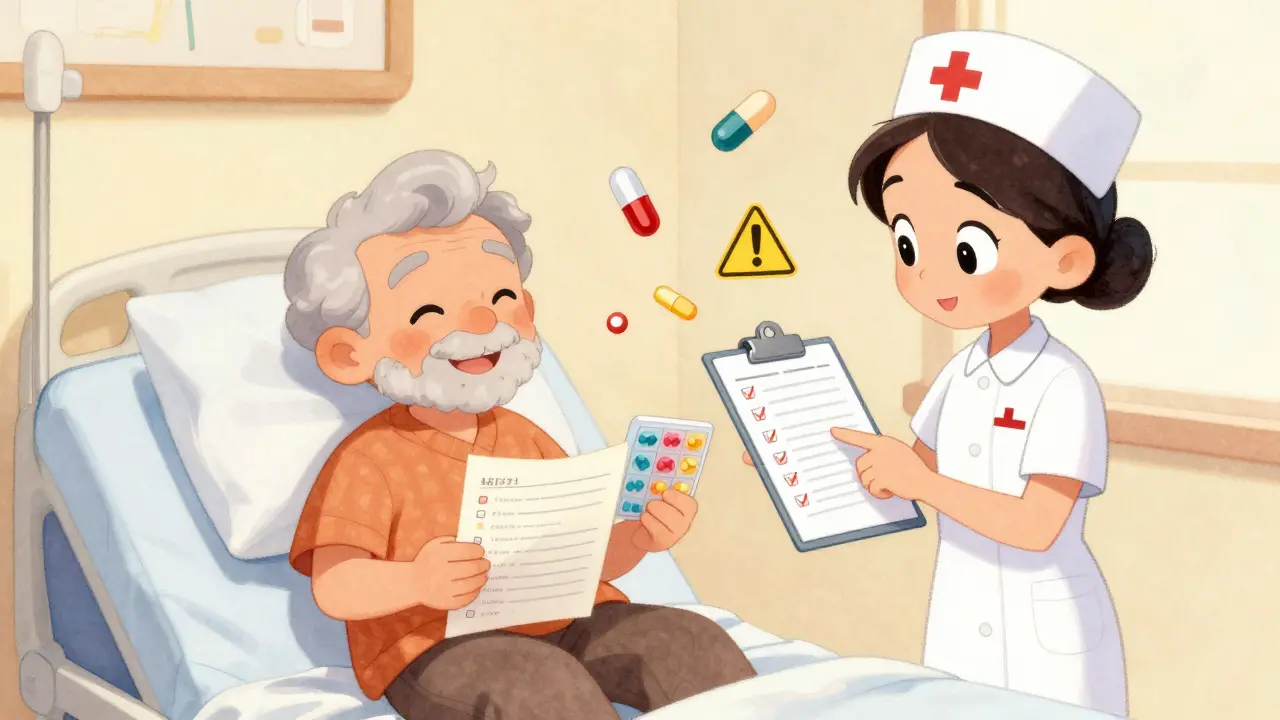
Leaving the hospital should mean you’re on the road to recovery-not scrambling to figure out what pills you’re supposed to take, or worse, taking something that could make you sicker. Every year, tens of thousands of people end up back in the hospital because of medication mistakes after discharge. And a huge chunk of those mistakes? They happen because no one took the time to compare what you were taking before you got admitted to what you’re leaving with.
What Medication Reconciliation Actually Means
Medication reconciliation isn’t just a checklist. It’s the process of making sure your home medication list matches exactly what the hospital decided you need after discharge. That means comparing every pill, patch, injection, or supplement you were taking before you got sick to the new list they gave you when you left.
Why does this matter? Because hospitals often change your meds during your stay. Maybe they stopped your blood pressure pill because your numbers dropped too low. Maybe they added a new antibiotic. Maybe they switched your painkiller. But when you go home, those changes don’t always get communicated clearly-or at all.
According to the Agency for Healthcare Research and Quality (AHRQ), proper medication reconciliation cuts adverse drug events by 30% to 50%. That’s not a small number. It means fewer trips to the ER, fewer readmissions, and fewer dangerous interactions-like mixing blood thinners with new NSAIDs or forgetting to restart your statin after surgery.
Where the System Usually Breaks Down
Here’s the reality: even though hospitals are required by law to do medication reconciliation, it often doesn’t happen right. A 2022 study by the American Society of Health-System Pharmacists found only 65% of hospitals consistently get it right at discharge.
Why? Time. The average nurse or pharmacist has about 7.3 minutes per patient to review a full medication list. But experts say you need at least 15 to 20 minutes to do it well. That’s not enough time to ask the right questions, especially if the patient is tired, confused, or in pain.
Another big problem? Sources. The most accurate list comes from the hospital’s discharge summary. But too often, staff rely on what the patient says they take-or what their primary care doctor’s office says. And that’s risky. Studies show patient self-reports have a 42% error rate. People forget. They don’t know the names of their meds. They think “the little white pill” is just a vitamin. They stop taking something because it made them feel weird and never told anyone.
And here’s the kicker: if you were in the ICU, your risk of having a medication accidentally dropped at discharge goes up by 2.3 times. Same if you’re on five or more medications. That’s not a coincidence. More meds = more chances for something to slip through the cracks.
What You Should Do Before You Leave the Hospital
You can’t wait for the hospital staff to catch everything. You need to be part of the process. Here’s exactly what to do:
- Bring a complete list of everything you take-even if you think it’s not important. Include prescription drugs, over-the-counter painkillers, vitamins, herbal supplements, and even eye drops or creams you use daily. Write it down. Don’t rely on memory. If you have a pill organizer, bring it with you.
- Ask for a copy of your discharge medication list before you sign out. Don’t wait for someone to hand it to you. Ask for it in writing. Make sure it’s printed and includes the name, dose, frequency, and reason for each medication.
- Compare it line by line with your own list. Are any of your regular meds missing? Are there new ones you don’t recognize? Are the doses different? If something doesn’t match, ask why. Don’t be shy.
- Ask three key questions for every change: Why was this added? Why was this stopped? What should I watch for?
- Get a verbal explanation. Ask the nurse or pharmacist to walk you through the list out loud. Say: “Can you please read this back to me and tell me what each one is for?” If you’re still unsure, ask for a family member or caregiver to be there.
One real case from a Reddit user: someone had warfarin stopped before surgery and never restarted after discharge. Two weeks later, they had a pulmonary embolism and had to be readmitted. That could’ve been caught if someone had asked, “Was your blood thinner supposed to come back?”
What Happens After You Get Home
Getting home doesn’t mean the job’s done. In fact, that’s when the risk spikes.
First, don’t start taking anything until you’ve reviewed the list with your primary care doctor within 7 days. That’s not just a suggestion-it’s part of a Medicare billing code (99495 or 99496) that requires medication reconciliation to be part of a follow-up visit. If your doctor hasn’t contacted you, call them. Say: “I was just discharged and need to go over my meds.”
Second, if you’re on anticoagulants, diabetes meds, seizure drugs, or heart meds, you’re at higher risk. These are the drugs that cause the most dangerous interactions. Make sure your doctor checks your labs if needed-like INR for warfarin or blood sugar levels for insulin.
Third, watch for warning signs. If you feel dizzy, nauseous, unusually tired, confused, or notice bruising or bleeding you didn’t have before, call your doctor or pharmacist immediately. These aren’t normal side effects-they could be signs of a drug interaction.
How Technology Is Helping-But Not Fixing Everything
Hospitals are starting to use electronic systems that pull your medication history from your primary care provider’s records. Epic and Cerner systems now share discharge data electronically. As of January 2024, hospitals are required to send your updated medication list to your outpatient provider within 24 hours via FHIR APIs.
Some places are even using AI to scan discharge summaries and flag potential omissions. Mayo Clinic’s system picks up 94% of missed meds automatically. But here’s the catch: AI doesn’t know if you stopped taking your blood pressure pill because you couldn’t afford it. Or if you’ve been using a neighbor’s leftover antibiotics. That’s why human verification still matters.
Pharmacist-led follow-up calls-made at 48 hours and 7 days after discharge-are showing real results. In pilot programs, they’ve cut emergency visits for medication issues by nearly 20%. But not every hospital has that program. If yours doesn’t, be your own advocate.
What to Do If Something Feels Off
Don’t wait. If you’re confused, if your symptoms changed after discharge, or if you’re taking more pills than you remember, act fast.
- Call your pharmacist. They see your full medication history and can spot interactions you might miss.
- Use a free tool like Medscape’s Drug Interaction Checker or the FDA’s MedWatch portal to look up your meds.
- If you can’t reach your doctor, go to an urgent care center. Say: “I just got out of the hospital and I think my meds might be conflicting.”
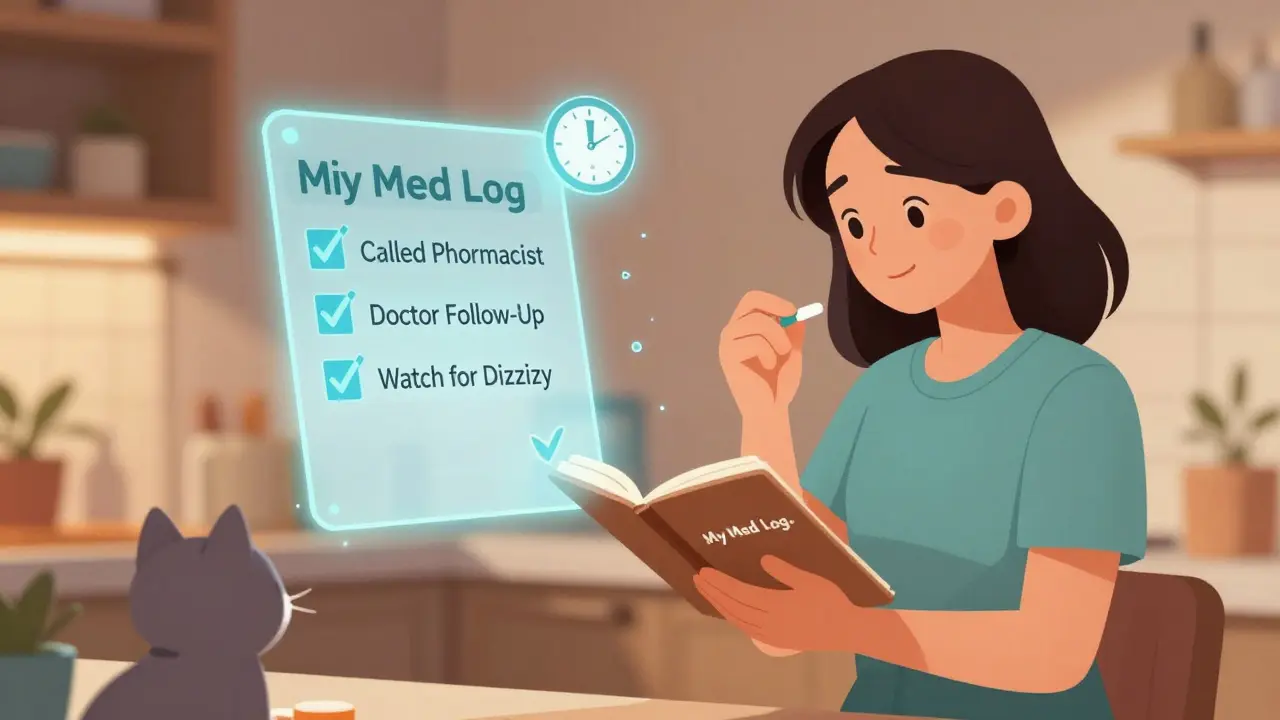
- Keep a written log of every pill you take, when, and how you feel. Bring it to every appointment.
Medication reconciliation isn’t just a hospital policy. It’s your safety net. And if no one else is holding onto it, you have to.
Why This Matters More Than You Think
Eight hundred thirty-six thousand adverse drug events are prevented every year in the U.S. because someone caught a mistake. That’s more than the population of Edmonton. And it’s not magic. It’s done by someone asking, “Did you take your blood thinner?”
Patients who take five or more medications are nearly three times more likely to have a dangerous interaction after discharge. That’s not a statistic-it’s a warning. If you’re one of them, you can’t afford to assume anything.
The system isn’t perfect. Staff are stretched thin. Technology isn’t foolproof. But you have more power than you think. You’re the only one who knows what you’ve been taking, how you’ve been feeling, and what’s changed.
Don’t wait for someone else to fix it. Be the person who asks the questions. Be the person who writes it down. Be the person who calls back.
What if I don’t remember all the meds I was taking before the hospital?
Start with your pharmacy. Call them and ask for a printout of your current prescriptions. If you use a pill organizer, take a picture of it. Check your medicine cabinet for empty bottles or labels. Even if you’re unsure, bring everything you think you’ve taken-even vitamins or herbal supplements. It’s better to have extra info than to miss something important.
Can I just rely on my primary care doctor to fix my meds after discharge?
No. Your primary care doctor may not get your discharge summary for days-or sometimes not at all. Hospitals are required to send it within 24 hours, but delays happen. Don’t wait. Review your discharge meds yourself before your next appointment. If you’re on five or more meds, schedule a follow-up within 7 days and bring your list with you.
Are over-the-counter drugs and supplements really that risky?
Yes. Common OTC drugs like ibuprofen or naproxen can increase bleeding risk if you’re on blood thinners. St. John’s Wort can interfere with antidepressants, heart meds, and even birth control. Many people think supplements are safe because they’re “natural,” but they’re not regulated like prescription drugs. Always tell your doctor and pharmacist about everything you take-even if you think it’s harmless.
What if I can’t afford my new meds after discharge?
Don’t skip doses or substitute with old meds. Tell your discharge team or pharmacist right away. Many hospitals have social workers who can help you find patient assistance programs, coupons, or generic alternatives. Some pharmacies offer $4 generic lists. Skipping meds because of cost is one of the most common reasons for readmission-and it’s preventable.
How do I know if I’m having a drug interaction?
Watch for sudden changes: extreme dizziness, confusion, unusual bruising or bleeding, rapid heartbeat, trouble breathing, swelling, or severe nausea. These aren’t normal side effects-they’re red flags. If you notice any of these after discharge, call your doctor or pharmacist immediately. Don’t wait until your next appointment. It could be life-threatening.
Next Steps: Your Action Plan
Here’s what to do today:
- Find your pre-hospital medication list. If you don’t have one, make one now.
- Get your discharge medication list in writing.
- Compare the two side by side. Highlight every change.
- Call your pharmacist and read them your list. Ask: “Are there any interactions here?”
- Schedule a follow-up with your doctor within 7 days. Bring your list and your questions.
- Keep a simple log: Medication | Dose | Time | How I feel.
Medication reconciliation isn’t something that happens to you. It’s something you do. And doing it right could save your life.
Glen Arreglo
December 18, 2025
I had a family member get discharged last year and they missed their blood thinner restart. Two weeks later, they were back in the ER. This post saved our lives. I printed the checklist and went through it with the nurse myself. No one else was going to do it for us.
Don’t wait. Bring your pill organizer. Write everything down. Even the ‘harmless’ supplements. Your life isn’t a guess game.
benchidelle rivera
December 20, 2025
It’s unacceptable that hospitals treat medication reconciliation like an afterthought. Nurses are overworked, yes-but that’s not an excuse. This is a systemic failure, not a personal one. The law mandates this process. If they can’t do it right, they shouldn’t be allowed to discharge patients. Period.
Isabel Rábago
December 20, 2025
People think ‘natural’ means safe. That’s why I see so many elderly patients on St. John’s Wort while on SSRIs. Or mixing turmeric with warfarin because they read a blog. It’s not just ignorance-it’s arrogance. You wouldn’t take a stranger’s advice on your car’s engine, but you’ll trust a YouTube video with your heart?
Medications aren’t hobbies. They’re precision tools. Treat them like it.
Moses Odumbe
December 21, 2025
AI is catching 94% of missed meds at Mayo? That’s wild 😎
But yeah, the real issue is cost. My aunt got prescribed a $400/month med after surgery and just stopped taking it. No one asked. She ended up back in the hospital. Pharmacies have $4 generics. Hospitals should have a list of those ready to go. No one should choose between food and their heart meds.
Also-emoji alert 🚨 if you’re on 5+ meds, you’re basically playing Russian roulette with your liver.
bhushan telavane
December 23, 2025
India has the same problem. Elders often take 10+ pills and forget names. Family members don’t know what’s what. We use WhatsApp to send photos of pill bottles to doctors. Works better than paper lists.
Also, pharmacists here are way more involved than in US hospitals. They call patients after discharge. Maybe we should copy that.
Connie Zehner
December 24, 2025
Why do people think they’re too busy to read their own discharge papers? I’ve seen it a hundred times-patients sign out, walk out, and then call their kids 3 hours later saying ‘I think I’m dying’ because they didn’t know what the new pills were for.
You think it’s hard to ask a nurse a question? Try being the one who has to clean up the mess when they’re back in ICU. This isn’t rocket science. It’s basic accountability.
And yes, I’m talking to YOU, the one who thinks ‘I’ll remember’.
You won’t.
Jedidiah Massey
December 25, 2025
The systemic failure here is not merely operational-it’s epistemological. The biomedical model operates under the assumption of patient compliance as a binary variable, when in reality, adherence is a complex sociocultural construct mediated by health literacy, economic precarity, and institutional distrust.
Furthermore, FHIR APIs, while technically elegant, fail to account for polypharmacy in geriatric populations where cognitive fragmentation renders self-reporting unreliable. The solution isn’t more tech-it’s embedded clinical pharmacists in discharge workflows, with mandatory 72-hour follow-up protocols, audited via HL7 v3-compliant data streams.
Also, if you’re taking NSAIDs with anticoagulants, you’re already on a one-way ticket to GI bleed city. Just sayin’.
Alex Curran
December 25, 2025
My dad got discharged after a bypass and the list they gave him had his statin removed. He didn’t know until his cholesterol spiked. We called the pharmacy and they caught it immediately. They’re the unsung heroes here.
Always call your pharmacist first. They see every med you’ve ever taken. The hospital? They only see what’s in their system right now.
Also bring a notebook. Write down the reason for each med. It helps you remember why you’re taking it when you feel weird.
And yes, St. John’s Wort is a sneaky one. I didn’t know it messed with blood pressure meds until I almost passed out on a hike.
Allison Pannabekcer
December 27, 2025
I work with seniors and this is the most common reason for readmission. They’re overwhelmed. They’re tired. They don’t trust the system. And they’re afraid to ask questions because they think they’ll be judged.
We started having family members sit in on discharge meetings. Even if it’s just a Zoom call. It changes everything. One daughter told me, ‘I didn’t know my mom was taking fish oil for her heart until I saw the bottle.’
Don’t shame people for forgetting. Help them. Bring the list. Ask the questions. Be the calm voice in the chaos.
Dikshita Mehta
December 27, 2025
My grandmother was on 8 medications before hospitalization. After discharge, they gave her 12. She didn’t know which was which. We sat down with her pill organizer, took pictures of each bottle, and made a color-coded chart. She still uses it.
Pharmacies in India give you a printed sheet with the medicine name in English and your local language. We should do that here. Language matters.
And yes, over-the-counter painkillers are dangerous. I once saw someone on warfarin take ibuprofen for a headache. They ended up in the ER with internal bleeding. It was preventable.
Sahil jassy
December 28, 2025
Just got out of the hospital last month. They gave me 7 new meds. I didn’t know what half of them were for. Called my pharmacist at 11pm. He walked me through every one. Saved my life.
Don’t wait. Call them. They’re paid to help you.
Also-emoji alert 🩺💊 if you’re on blood thinners. Double check everything.