

When you’re pregnant and have asthma, every decision feels heavier. You’re not just thinking about your own breathing-you’re thinking about your baby’s. Is that inhaler safe? Will it cause birth defects? Should you stop it just in case? These aren’t hypothetical worries. They’re real, daily fears for thousands of women. The truth is, uncontrolled asthma is far more dangerous to your baby than the medications used to treat it.
Why Asthma Gets Worse During Pregnancy
Asthma doesn’t act the same in every pregnancy. About one-third of women see their symptoms improve, one-third stay the same, and one-third get worse. The worst time? Between weeks 24 and 36. That’s when hormones shift, your uterus grows, and your lungs have less room to expand. If your asthma isn’t well managed, you’re at higher risk for preeclampsia, preterm labor, and having a baby with low birth weight. Studies show women with uncontrolled asthma are up to 7 times more likely to face serious complications than those whose asthma is under control.What Medications Are Safe?
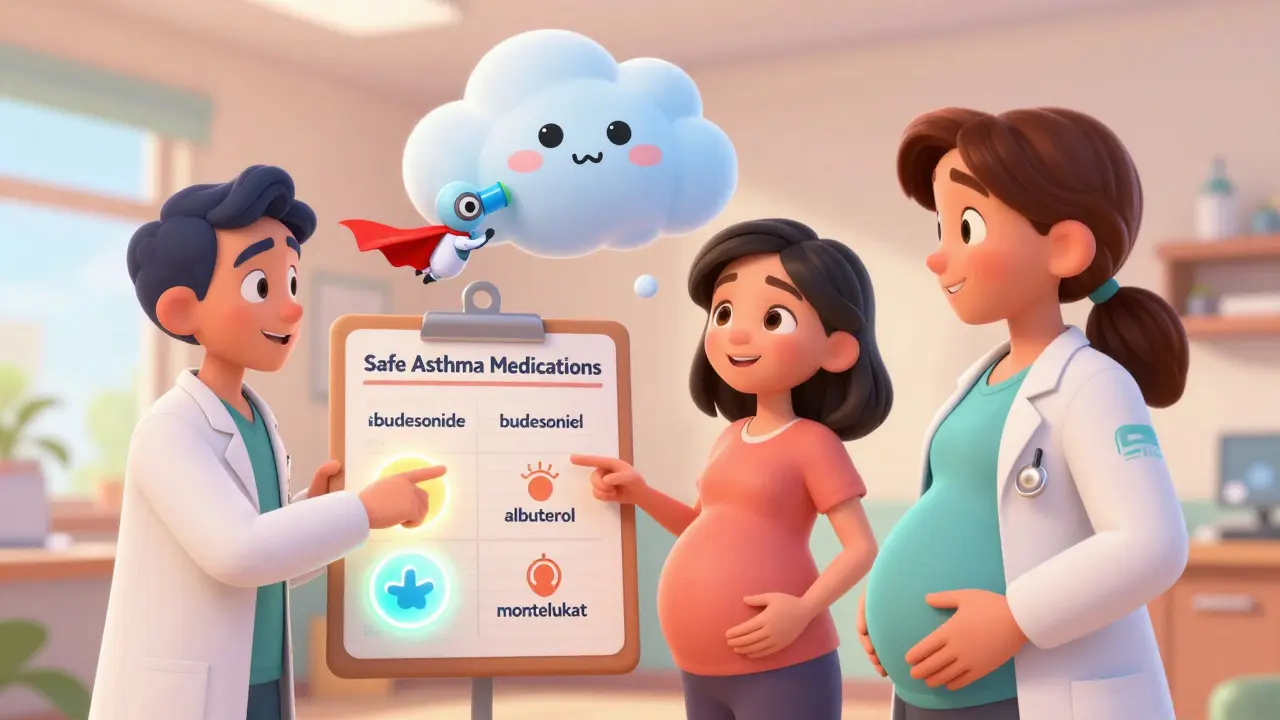
The good news? Most asthma medications are safe during pregnancy. The key is using the right ones the right way. Inhaled medications are the gold standard because they target your lungs directly, with almost no drug reaching your baby.Inhaled corticosteroids (ICS) are the first-line treatment. Among them, budesonide has the strongest safety record. Over 1,000 documented pregnancies show no increased risk of birth defects. Beclomethasone and fluticasone propionate are also well-supported by data. These aren’t just opinions-they’re backed by reviews of more than 120,000 pregnancies. In fact, a 2021 meta-analysis found no link between budesonide and major congenital malformations. The adjusted odds ratio? 1.01. That’s essentially the same risk as if you weren’t taking anything at all.
Short-acting beta-agonists (SABAs) like albuterol (salbutamol) are your rescue inhalers. They’re safe for quick relief during an attack. Data from 1.2 million pregnancies confirm no increased risk of birth defects. If you feel tightness in your chest, don’t hesitate. Delaying treatment puts both you and your baby at risk.
Long-acting beta-agonists (LABAs) like formoterol and salmeterol are only used in combination with an ICS. They’re not for daily rescue-they’re for long-term control. Fifteen studies involving nearly 38,000 pregnancies found no increased risk of harm to the fetus. But never use them alone. Always pair them with an inhaled steroid.
Leukotriene modifiers like montelukast (Singulair) are also considered safe. The European Network of Teratology Information Services tracked over 1,000 pregnancies and found no significant rise in major birth defects. It’s not the first choice, but if your doctor recommends it and you’ve been on it before pregnancy, continuing is usually fine.
What to Avoid
Not all asthma meds are created equal when you’re pregnant. Some carry real risks.Oral corticosteroids like prednisone are powerful, but they’re not safe for routine use during pregnancy. A 2023 study of 1.8 million pregnancies found that taking them in the first trimester increases the risk of cleft lip or palate by 56%. There’s also a higher chance of preterm birth and low birth weight. These are reserved for severe flare-ups-never for daily maintenance.
Fluticasone furoate and ciclesonide don’t have enough pregnancy data to be recommended. The FDA labels them as having “insufficient human data.” Stick with the ones that have been studied for decades.
Theophylline used to be common, but it’s rarely used now. It requires blood tests to make sure the dose is right, and it interacts with many other medications. If you’re on it, talk to your doctor about switching to an inhaled steroid.
LAMA inhalers like tiotropium (Spiriva) have almost no safety data in pregnancy-only 324 documented cases. GINA doesn’t recommend them as first-line treatment during pregnancy.
What Happens If You Stop Your Medication?
This is where fear does the most damage. Many women stop their inhalers because they’re scared. But the consequences are real.A 2021 Canadian registry tracked over 1,200 pregnant women with asthma. Those who stopped their inhaled corticosteroids were more than twice as likely to have a severe asthma attack needing emergency care. Forty-one percent had at least one major flare-up. In contrast, only 17% of women who kept taking their meds had the same issue.
And it’s not just about breathing. Uncontrolled asthma means less oxygen for your baby. That can lead to slower growth, early delivery, or even stillbirth in extreme cases. A 2022 statement from the American College of Allergy, Asthma, and Immunology put it bluntly: “The risk of uncontrolled asthma is 5 to 7 times greater than any theoretical risk from asthma medications.”
How to Monitor Your Asthma During Pregnancy
You can’t manage what you don’t measure. Here’s what works:- Use a peak flow meter daily. Keep your reading above 80% of your personal best.
- Track symptoms with the Asthma Control Test (ACT). A score of 20 or higher means your asthma is under control.
- Keep a symptom diary. Note triggers, nighttime symptoms, and how often you use your rescue inhaler.
- See your doctor every month. If you have moderate or severe asthma, joint visits with your OB and pulmonologist at 8, 16, 24, and 32 weeks are recommended.
During an asthma attack, use 4 to 8 puffs of albuterol through a spacer. If your peak flow drops below 70% of your best, or if you’re still struggling after the inhaler, seek help immediately. Oxygen levels should stay above 95%. Don’t wait until you’re gasping.
Environmental Triggers to Avoid
Medication alone isn’t enough. Reducing exposure to triggers makes a huge difference.- Use allergen-proof mattress and pillow covers-they cut dust mite exposure by 83%.
- Keep indoor humidity between 30% and 50%. That stops mold from growing.
- Remove carpets. Hard floors reduce allergen buildup by 55% to 80%.
- Avoid smoke, strong perfumes, and cleaning sprays.
- If you have pets, keep them out of the bedroom.
These aren’t just suggestions. They’re proven ways to reduce the need for medication and keep your asthma stable.

What About Newer Treatments Like Biologics?
Biologics like omalizumab (Xolair) are used for severe asthma. There’s some reassuring data: over 700 pregnancies exposed to omalizumab show no increase in birth defects. But for newer ones-mepolizumab, benralizumab, dupilumab-there’s almost no data. Experts agree: don’t start them during pregnancy. If you’re already on one and find out you’re pregnant, talk to your doctor. Don’t stop abruptly. You may be able to continue under close supervision.What Women Are Really Saying
Online forums are full of anxious voices. On the Asthma and Allergy Foundation of America’s site, 78% of pregnant women posted about fear of birth defects. On Reddit, one thread titled “Pregnant with asthma-terrified of inhalers” got 287 comments. Most said their doctors told them to cut back or stop meds.But here’s what the data says: women who stuck with their pre-pregnancy asthma plan were 89% more likely to have a smooth pregnancy than those who changed their treatment. The ones who stopped meds? They paid for it in ER visits, hospital stays, and stress.
Final Thoughts: Your Baby Needs You to Breathe
You don’t have to choose between being healthy and protecting your baby. The science is clear: managing your asthma with the right medications keeps both of you safer. Budesonide, albuterol, and montelukast have been studied in thousands of pregnancies. The risks are minimal. The benefits? Life-changing.Don’t let fear make the decision for you. Talk to your doctor. Get a plan. Monitor your symptoms. Avoid triggers. And if you’re ever unsure-use your inhaler. It’s better to be safe than sorry.
Is it safe to use my asthma inhaler while pregnant?
Yes, most asthma inhalers are safe during pregnancy. Inhaled corticosteroids like budesonide, beclomethasone, and fluticasone propionate have strong safety data from over 100,000 pregnancies. Rescue inhalers like albuterol are also safe and should be used as needed. The biggest risk comes from not using them-uncontrolled asthma is far more dangerous to both you and your baby.
Can asthma medications cause birth defects?
The vast majority of asthma medications do not increase the risk of birth defects. Budesonide, the most studied inhaled steroid, shows no increased risk in large studies. Oral steroids like prednisone, however, can raise the risk of cleft lip or palate if taken during the first trimester. Always use inhaled medications as directed-they deliver the drug straight to your lungs with minimal exposure to your baby.
Should I stop my asthma meds if I’m trying to get pregnant?
No. If your asthma is well-controlled before pregnancy, continue your current regimen. Stopping medication increases your risk of flare-ups, which can lead to complications like preterm birth or low birth weight. Talk to your doctor before conception to review your treatment plan, but don’t stop your inhaler unless advised.
What if I have a severe asthma attack while pregnant?
Use your rescue inhaler immediately-4 to 8 puffs through a spacer. If you don’t feel better within 15 minutes, or if your peak flow drops below 70% of your personal best, go to the emergency room. Low oxygen levels can harm your baby. Don’t wait. Emergency treatment with oxygen and systemic steroids is safe and necessary.
Are there any asthma medications I should avoid completely during pregnancy?
Yes. Avoid oral corticosteroids like prednisone unless absolutely necessary for a severe flare-up, especially during the first trimester. Also avoid newer inhaled steroids like fluticasone furoate and ciclesonide due to insufficient pregnancy data. Long-acting muscarinic antagonists (LAMAs) like tiotropium are not recommended as first-line therapy. Always check with your doctor before starting or stopping any medication.
Christina Bischof
December 17, 2025
Just wanted to say I was terrified too until my OB told me the same thing - uncontrolled asthma is way scarier than the meds. I’m 28 weeks and on budesonide and albuterol. Baby’s growing fine. Don’t stop breathing for fear.
Nupur Vimal
December 17, 2025
People keep saying budesonide is safe but nobody talks about the long term effects on the kid’s immune system. I read a paper once where prenatal steroid exposure was linked to higher asthma rates later in life. So yeah maybe it’s ‘safe’ for birth defects but what about 10 years down the line?
Cassie Henriques
December 19, 2025
OMG YES THIS. I was on montelukast before preg and my doc was like ‘maybe switch?’ but I kept it. No issues. My kid’s 2 now and runs like a cheetah 😊
Raj Kumar
December 19, 2025
As an asthma patient from India, I’ve seen so many women stop meds because of family pressure. ‘Why take chemicals?’ they say. But then they end up in the ER with oxygen masks. Budesonide is cheaper than hospital bills here. Stick with the science, not the gossip.
Jake Sinatra
December 21, 2025
The data presented here is statistically robust and aligns with current GINA guidelines. Discontinuation of inhaled corticosteroids during gestation is an evidence-based error that increases perinatal morbidity. I urge all clinicians to reinforce this message.
RONALD Randolph
December 22, 2025
STOP LISTENING TO DOCTORS WHO ARE IN THE POCKET OF BIG PHARMA!!! I read a blog by a naturopath who said asthma is just ‘toxic air’ and ‘emotional blockage’ - and guess what? Her daughter is 7 and never had an attack. Just breathe clean air and pray. No chemicals needed.
Michelle M
December 23, 2025
It’s funny how we’re scared of chemicals in a pill but not scared of the oxygen deprivation we cause our babies when we hold back. We fear the cure more than the disease. What does that say about us? We’re not protecting our children - we’re protecting our own guilt.
Lisa Davies
December 25, 2025
Just had my 24-week checkup and my pulmonologist said I’m doing great with my inhalers 😭 I cried. I’ve been so scared. Thank you for writing this. I’m sharing it with my mom who thinks inhalers = baby damage. 💪❤️
Benjamin Glover
December 25, 2025
Typical American medical propaganda. In the UK, we’ve had decades of real-world data. Budesonide? Fine. But the rest? Overhyped. Stick to the basics. Less is more.
Melissa Taylor
December 26, 2025
My sister stopped her inhaler during her pregnancy because her aunt said ‘it’ll make the baby lazy.’ She had two ER visits and ended up on prednisone for a week. Baby was fine but she’s still traumatized. Please don’t let fear win.
John Brown
December 28, 2025
My wife is 30 weeks, uses albuterol and fluticasone, and just did a 5K walk. No issues. The real danger is the silence - women not talking about this because they feel guilty. We need more real stories like this.
Jocelyn Lachapelle
December 29, 2025
I used to think I could ‘meditate my asthma away’ until I nearly passed out on the subway at 26 weeks. Now I use my inhaler like a seatbelt. Just because it’s invisible doesn’t mean it’s not saving lives.
Mike Nordby
December 30, 2025
While the data on budesonide is compelling, one must consider confounding variables such as socioeconomic status, access to prenatal care, and maternal comorbidities. The conclusion that medication adherence alone reduces complications may be oversimplified.
John Samuel
December 31, 2025
Imagine your baby’s tiny lungs gasping for air because Mom didn’t use her inhaler - not because the medicine was dangerous, but because she believed a myth. That’s the real tragedy. We owe our children more than fear. We owe them courage. And science.
Sai Nguyen
January 1, 2026
India doesn’t need your Western drugs. We’ve been breathing clean air for centuries. Just avoid pollution and stop taking poison. Your baby will thank you.