
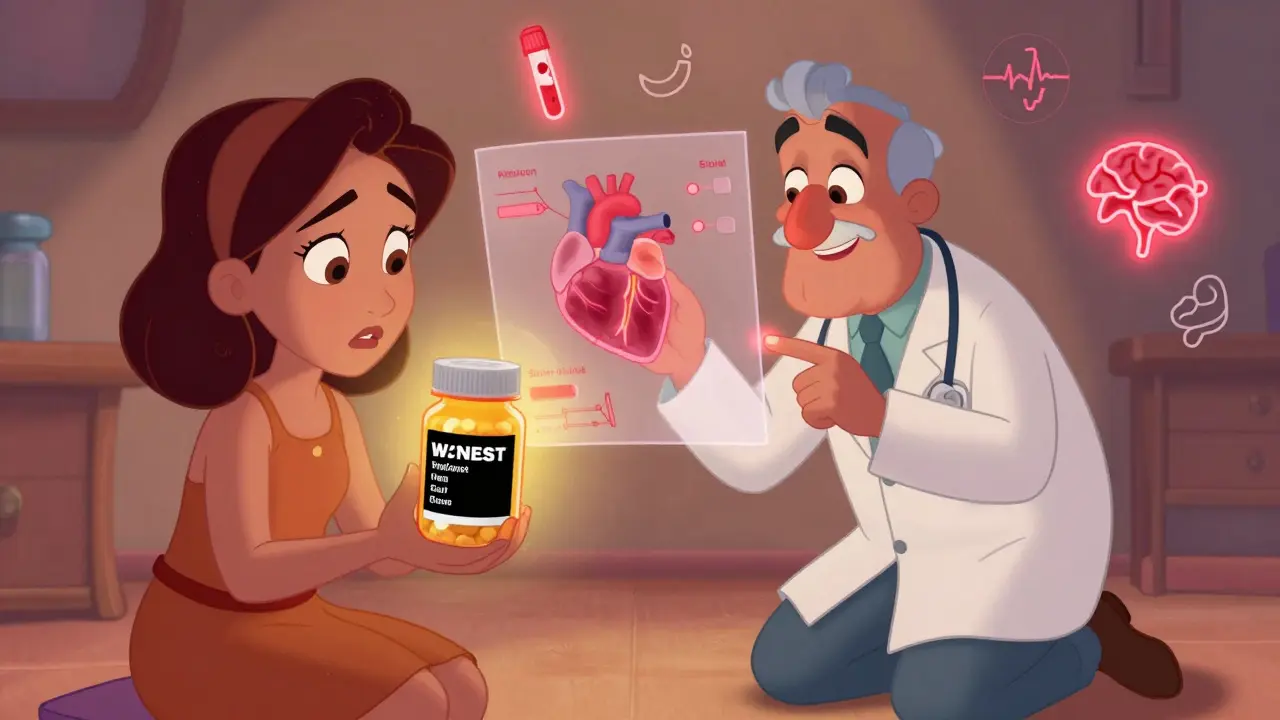
When your doctor hands you a prescription with a boxed warning, it’s not just another label. It’s the FDA’s strongest signal that this drug carries a real risk of serious harm-or even death. You might see it as a thick black border on the pill bottle’s insert or in the online pharmacy’s drug info page. But what does it actually mean for you? And what should you do next?
What Is a Boxed Warning, Really?
A boxed warning, also called a black box warning, is the most serious safety alert the U.S. Food and Drug Administration (FDA) can require on a medication. It’s not a suggestion. It’s a legal requirement built into the drug’s official labeling. The warning gets its name from the bold, black rectangle that surrounds the text on prescribing documents, patient information sheets, and sometimes even the drug’s packaging. These warnings don’t appear randomly. They’re added when evidence shows a drug can cause life-threatening side effects-like heart failure, liver damage, suicidal thoughts, or severe bleeding. As of 2022, over 400 prescription drugs carry this warning. That’s about 1 in 10 of all medications on the market. And it’s not just old drugs: nearly 70% of these warnings were added years after the drug was approved, based on real-world use by millions of patients, not just the few thousand in initial clinical trials.Why Do These Warnings Exist?
The system started after the thalidomide tragedy in the 1960s, when a drug meant to help with morning sickness caused severe birth defects in thousands of babies. That disaster pushed Congress to pass the Kefauver-Harris Amendments in 1962, requiring drug makers to prove their products were not just effective, but safe. The black box format itself came later, in the 1970s, as a way to make critical warnings impossible to miss. Today, the FDA has strict rules for how these warnings are written: they must be clear, specific, and include details like which patient groups are most at risk, what symptoms to watch for, and whether special monitoring is required-like monthly blood tests or pregnancy tests. For example, the antidepressant fluoxetine (Prozac) carries a boxed warning for increased suicidal thoughts in children and young adults under 25. The diabetes drug rosiglitazone (Avandia) warns of heart attack risk. And isotretinoin (Accutane), used for severe acne, requires enrollment in a strict pregnancy prevention program because it can cause devastating birth defects.How Is a Boxed Warning Different From Other Warnings?
Not all drug warnings are created equal. The FDA uses a hierarchy:- Boxed warnings - The highest level. Legally required. Must appear in the first section of prescribing info.
- Drug Safety Communications - Public alerts issued after a drug is on the market. These are important, but not part of the official label.
- Label changes - Updates to the drug’s safety info without a black box.
- Medication Guides - Handouts given to patients, written in simpler language.
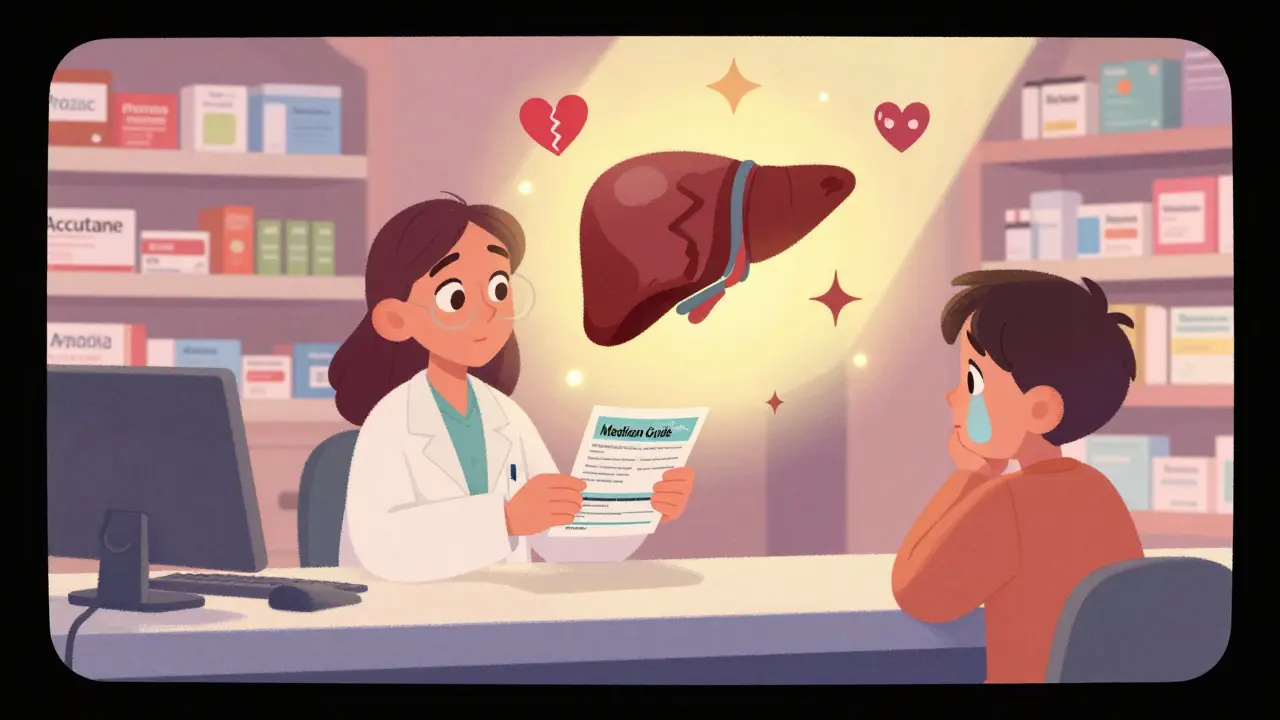
What Should You Do If Your Medication Has a Boxed Warning?
Don’t panic. Don’t stop taking it. But do ask the right questions. Here’s what you need to know before you start:- What’s the exact risk? Don’t settle for “it’s dangerous.” Ask: “Is this about liver damage? Heart problems? Suicide risk?” Get the specific side effect named.
- Am I in the high-risk group? Some warnings apply only to certain people-like pregnant women, older adults, or those with kidney disease. Your doctor should tell you if your personal health profile increases your risk.
- What signs should I watch for? What symptoms mean you need to call your doctor right away? For example, with blood thinners like warfarin, it’s unusual bruising or dark stools. With antipsychotics, it’s fever, stiff muscles, or confusion.
- What monitoring do I need? Many boxed warnings require regular tests-liver function, blood counts, EKGs. Ask how often, where, and who will follow up.
- Are there safer alternatives? Sometimes, yes. Ask if there’s another drug in the same class without the same warning. Or if lifestyle changes or non-drug treatments could help.
What If You’re Still Worried?
It’s normal to feel uneasy. Medications with boxed warnings are often the most effective options for serious conditions-like depression, epilepsy, cancer, or autoimmune diseases. Stopping them without guidance can be just as risky as the side effects. If you’re unsure, get a second opinion. Talk to a pharmacist. Many pharmacies now offer free medication reviews. You can also check trusted, independent sources like Consumer Reports’ Best Buy Drugs or the Drug Effectiveness Review Project (DERP). These groups compare drugs based on real-world evidence-not marketing. And if you’ve had a bad reaction, report it. The FDA’s MedWatch program lets patients report side effects directly. In 2022, over 2 million reports came in from people like you. Your report could help prevent harm to others.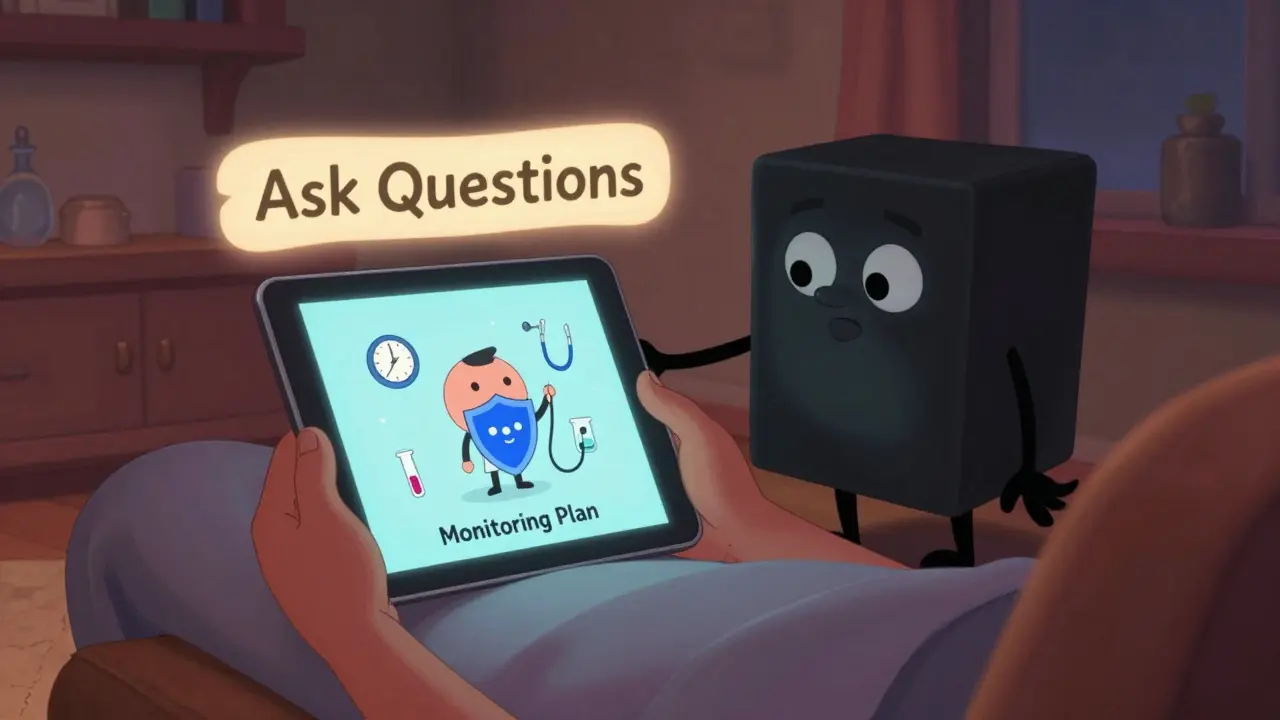
Are Boxed Warnings Working?
The system isn’t perfect. Some experts argue the warnings are too broad. A warning about “increased risk of death” doesn’t tell you whether your risk is 1 in 100 or 1 in 10,000. That can lead to doctors avoiding useful drugs altogether-especially for patients who would benefit. Studies show boxed warnings reduce inappropriate prescribing by 15-25%, but they also reduce appropriate use by 10-20%. That’s a real problem. For example, some doctors won’t prescribe certain antidepressants to teens, even though the benefits often outweigh the risks when monitored properly. The FDA is trying to fix this. In 2023, they launched a pilot program to rewrite warnings in plain language-no jargon, no legalese. They’re also using real-time data from electronic health records to spot problems faster. Their goal? Move from one-size-fits-all warnings to personalized risk alerts.Final Thought: Knowledge Is Power
A boxed warning doesn’t mean a drug is bad. It means it’s powerful. And powerful things need careful handling. If you’re on a medication with a black box, you’re not alone. Millions are. What matters isn’t the warning itself-it’s what you do after you see it. Ask questions. Get clear answers. Follow monitoring plans. Speak up if something feels wrong. Your health isn’t a gamble. It’s a partnership. And a boxed warning? It’s just the first page of that conversation.Does a boxed warning mean I shouldn’t take the medication?
No. A boxed warning doesn’t mean the drug is unsafe for everyone. It means the risk is serious enough that you and your doctor need to carefully weigh the benefits against the potential harm. Many people take these medications safely with proper monitoring. Stopping without medical advice can be more dangerous than the side effect.
How do I know if my doctor discussed the warning properly?
Your doctor should explain the specific risk (not just say “there’s a warning”), tell you if your personal health increases that risk, describe warning signs to watch for, and outline any required monitoring like blood tests. If they just handed you the prescription without talking through it, ask for a follow-up. You have the right to understand what you’re taking.
Can a boxed warning be removed?
Yes. If new evidence shows the risk is lower than originally thought-or if better monitoring reduces harm-the FDA can remove or modify the warning. For example, some older warnings for certain antidepressants have been updated to reflect that risks are mainly in younger patients, not adults. But removal takes years of real-world data and review.
Are boxed warnings the same in Canada or Europe?
No. Canada’s Health Canada and Europe’s EMA use similar systems, but they’re not identical. The EMA uses “special warnings and precautions for use,” which are detailed but don’t always use a black box format. If you’re taking a drug prescribed in the U.S. but living elsewhere, check local guidelines-your doctor may need to adjust how they interpret the warning.
What if I can’t afford the required monitoring tests?
Talk to your doctor or pharmacist. Many clinics offer low-cost or sliding-scale testing. Some drug manufacturers have patient assistance programs that cover monitoring costs. Never skip tests because you’re worried about cost-there are resources available. Your safety is worth the effort to find support.
How often are new boxed warnings added?
About 15-20 new boxed warnings are added each year, mostly after drugs have been on the market for several years. Between 2008 and 2018, the number of boxed warnings increased by 35% thanks to stronger post-market surveillance. The FDA now uses data from millions of patient records to spot problems faster than before.
Katie Schoen
January 7, 2026
So I got prescribed a drug with a black box last month and my doctor just handed me the script like it was a coupon for free coffee. I almost cried in the pharmacy aisle. Turns out, it’s for my autoimmune thing and yeah, it’s risky-but I’ve been on it 3 months and my joints don’t feel like they’re made of rust anymore. Don’t panic, just ask. Seriously. Ask everything.
Also, why do doctors treat these warnings like they’re secret club handshakes? It’s not a spoiler alert, it’s a safety manual.
Also also, I printed the FDA page and taped it to my fridge. My cat now stares at it like it’s a ghost. We’re all just trying to survive this system.
Also also also: I’m alive. Still taking it. Still annoyed. Still grateful.
Also also also also: If your doctor doesn’t explain it, fire them. Or at least Google it. I did. And now I know more than my last three PCPs combined.
Beth Templeton
January 8, 2026
Boxed warning means your doctor is legally liable if you die. Not you. Them.
So they’ll push it harder than a used car salesman with a 30% commission.
Tiffany Adjei - Opong
January 10, 2026
Actually, the FDA’s whole system is a glorified PR stunt. You think they care about you? They care about lawsuits. That’s why they slap on black boxes after the drug makes billions and 47 people die. It’s not safety-it’s damage control.
And don’t get me started on how they add warnings years later. That’s not science. That’s corporate insurance accounting.
Also, the ‘monitoring’ they demand? Most people can’t afford it. So they just stop taking it. And then they die quietly. And the FDA publishes a press release about ‘improved patient outcomes.’
Meanwhile, the same companies that made the drug are now funding the ‘patient education’ programs. Yeah. Real altruism.
Don’t trust the system. Trust your gut. And your pharmacist. Maybe.
Oh, and ‘safer alternatives’? Usually just cheaper. And less effective. But hey, at least the black box is gone.
Ryan Barr
January 12, 2026
Most patients lack the cognitive bandwidth to interpret pharmacovigilance data. The black box is a necessary heuristic for a population that conflates correlation with causation.
That said, the FDA’s one-size-fits-all labeling is a relic of the 20th century. We need risk stratification models integrated into EHRs, not static paragraphs written by lawyers.
Indra Triawan
January 13, 2026
I’ve been thinking about this a lot. The black box isn’t just a warning-it’s a mirror. It reflects how much we’ve outsourced our bodies to machines. We trust pills more than our intuition. We trust labels more than our pain.
What if the real danger isn’t the drug… but our surrender to authority?
Maybe the box is there to remind us we’re still human. Even if the system forgets.
Mukesh Pareek
January 13, 2026
Pharmacokinetic variability is the real issue here. Boxed warnings are population-level aggregates masking individual heterogeneity in CYP450 metabolism, renal clearance, and genetic polymorphisms like HLA-B*57:01.
Without pharmacogenomic screening, these warnings are statistically significant but clinically nonspecific.
And the FDA’s ‘plain language’ pilot? Pathetic. They’re not fixing the system-they’re dumbing it down for the masses who can’t parse a hazard ratio.
Real solution? Mandatory pre-prescription genotyping. Then we can tailor risk, not just warn.
Rachel Wermager
January 14, 2026
Did you know that 78% of boxed warnings are triggered by post-marketing surveillance? That means the clinical trials were underpowered to detect rare events. The FDA didn’t fail-they were set up to fail by design.
Phase III trials average 3,000 patients. But adverse events below 1:10,000? Invisible until millions are exposed.
So yes, the system works. It’s just slow. And painful. And expensive.
And no, ‘alternatives’ aren’t better. They’re just less studied. And often more expensive. And sometimes worse.
So we’re stuck. Between the devil and the deep blue pill.
But at least we know now. Knowledge isn’t power. It’s just… less ignorance.
Leonard Shit
January 15, 2026
i just wanna say i was scared to take my meds after the box warning too
but my doc sat with me for 20 mins and drew a little chart on a napkin about my liver numbers and how they’d check em every 2 months
and honestly? that’s all i needed
not the jargon
not the fear
just someone who cared enough to explain
also i cried a little
and then i took the pill
and i’m still here
so maybe we’re all just trying to be brave in our own way
Melanie Clark
January 16, 2026
They’re lying to you. All of them. The FDA. The doctors. The pharmacies. The drug companies. They want you to think this is about safety. It’s not. It’s about control. They need you afraid. So you’ll take the pill. But only if they say so. Only if you jump through their hoops. Only if you pay for the tests. Only if you sign the forms. Only if you don’t ask too many questions.
What if the real danger isn’t the drug?
What if the danger is the system that tells you you’re too weak to decide for yourself?
I don’t trust them. I don’t trust the box. I don’t trust the ‘guidelines’. I don’t trust the ‘experts’. I trust my body. And my gut. And the fact that I’ve survived this long without them.
Maybe I’ll stop. Maybe I won’t. But I won’t let them make me feel guilty for choosing.
They want you to be afraid.
Don’t be.
Be angry.
And then decide.
For yourself.
Not for them.