
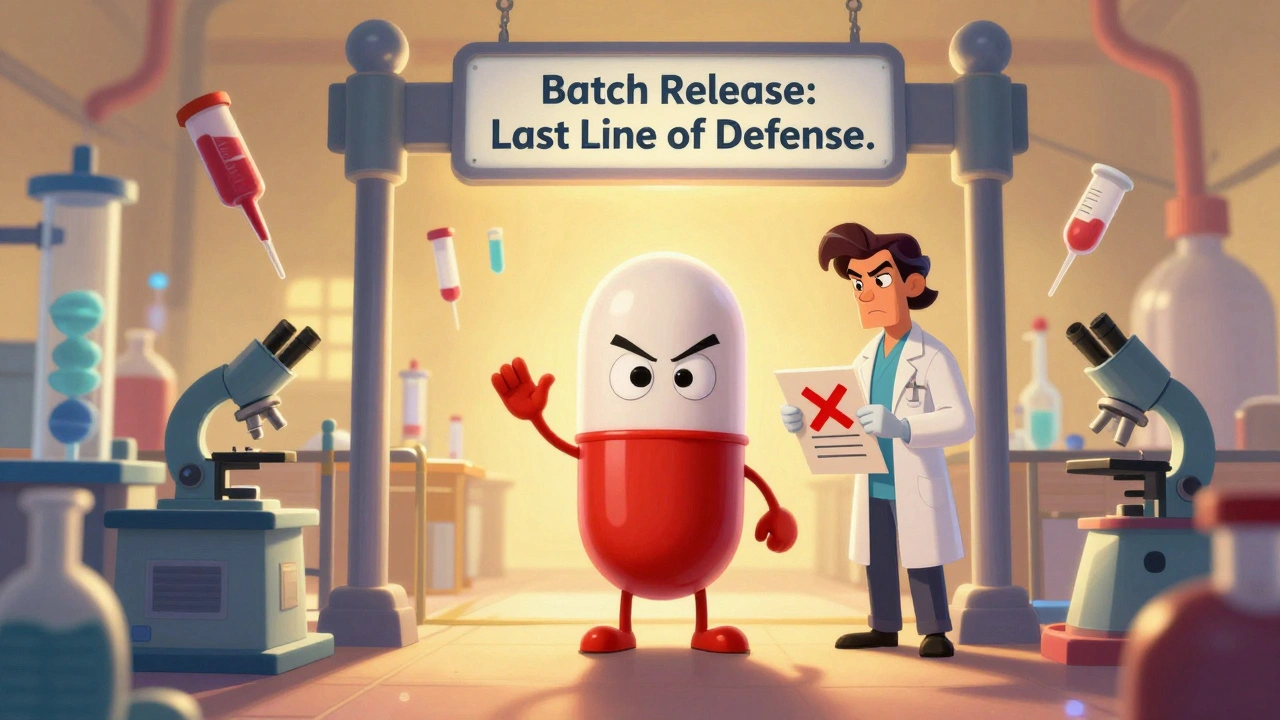
Every pill, injection, or capsule that reaches a pharmacy shelf has passed through one final, critical gate: batch release testing. This isn’t just paperwork or a formality. It’s the last line of defense between a patient and a potentially dangerous medication. If a batch fails here, it never leaves the facility. No recalls. No lawsuits. No harm. But if it slips through? The cost isn’t just financial-it’s human.
What Exactly Is Batch Release Testing?
Batch release testing is the final set of lab tests performed on every single batch of a drug before it’s approved for sale. Think of it like a final inspection on a car before it leaves the factory-but instead of checking for dents or faulty brakes, you’re verifying that the medicine contains the exact right amount of active ingredient, is free from harmful contaminants, and will break down properly in the body. This isn’t optional. It’s required by law in every major market: the U.S. (FDA), Europe (EMA), Japan (PMDA), and China (NMPA). The rules come from strict international standards like ICH Q6B for biologics and USP <711> for dissolution. These aren’t suggestions-they’re enforceable regulations backed by penalties, recalls, and even import bans. The core goal? To prove that every batch matches the approved profile: same strength, same purity, same performance. No exceptions. No shortcuts. Even if 100 previous batches were perfect, the 101st still gets tested from scratch.What Gets Tested? The Core Checks
Each batch goes through a checklist of tests, tailored to the type of drug but always including these non-negotiable items:- Identity: Is this actually the drug it claims to be? Tests like HPLC, FTIR, or NMR confirm the chemical structure matches the approved formula.
- Assay/Potency: Does it contain the right amount of active ingredient? The acceptable range is usually 90-110% of the labeled amount. Anything outside that gets rejected.
- Impurity Profile: Are there unwanted chemicals? ICH Q3 guidelines set limits-like 0.10% for unknown impurities in new drugs. Even tiny amounts can cause side effects.
- Microbial Limits: Is it clean? For non-sterile products, you can’t have more than 100 colony-forming units per gram. Sterile products? No microbes allowed at all.
- Endotoxins: These are toxic substances from bacteria. For injectables, especially those going into the spine, limits are as low as 5.0 EU per kg per hour.
- Dissolution: Will the pill dissolve properly in the body? Generic drugs must match the brand-name version with an f2 similarity factor of at least 50. If it doesn’t dissolve, it doesn’t work.
- Particulate Matter: For injections, you can’t have more than 6,000 particles larger than 10 microns per milliliter. Tiny glass or metal fragments can block blood vessels.
- Physical Checks: Tablet hardness (4-10 kp), appearance, color, and packaging integrity are all visually and mechanically inspected.
Stability Testing: Will It Last?
A drug isn’t just tested once-it’s tested over time. Stability testing predicts how the product will hold up under real-world conditions. The standard protocol follows ICH Q1A(R2):- Accelerated Conditions: 40°C and 75% humidity for 6 months. This simulates 2-3 years of aging in just half a year.
- Long-Term Conditions: 25°C and 60% humidity for 12 to 36 months, depending on the product’s shelf life.
The Human Factor: Who Signs Off?
In the U.S., a qualified quality unit reviews all test results, production records, and deviations. Two analysts must independently verify data. In Europe, it’s the Qualified Person (QP). This isn’t just any manager. A QP must have at least five years of pharmaceutical experience, specific GMP training, and legal responsibility for the batch. If something goes wrong, they’re personally accountable. There’s a crisis here. The EMA reports a 32% shortage of qualified QPs in Europe. Many companies struggle to find enough certified people to review batches in time. That’s why some batches sit for weeks-waiting for a signature.Where Things Go Wrong
Despite the rules, failures still happen. According to the Parenteral Drug Association’s 2024 report, 83% of batch rejections fall into three areas:- Dissolution (32%): Generic drugs often fail here because their formulation doesn’t match the original.
- Impurity Profiles (28%): Changes in raw materials or manufacturing processes can create new, unapproved impurities.
- Microbial Contamination (23%): Even a small breach in cleanroom protocols can ruin a batch.
Technology Is Changing the Game
Old-school batch testing relies on manual lab work, paper logs, and hours of human review. But that’s changing.- LIMS Systems: Companies using integrated Laboratory Information Management Systems report 22% faster release times. Thermo Fisher’s SampleManager is one of the most cited.
- AI and Predictive Release: Some manufacturers now use AI to predict batch success based on real-time process data. Companies using this see 34% fewer failures. But the FDA still requires full validation-taking up to 18 months. Only 12 companies are approved for this pilot as of October 2025.
- Continuous Manufacturing: Instead of making one batch at a time, some plants now produce medicine in a constant flow. The FDA’s 2023 guidance allows real-time release testing for these facilities-if 95% of critical quality attributes are monitored continuously.
How Long Does It Take?
The timeline varies wildly:- Small Molecule Generics: 7-10 days
- Complex Generics: 14-21 days
- Biologics (like monoclonal antibodies): 21-35 days
The Cost of Failure
A single recall costs pharmaceutical companies an average of $10.7 million, according to FDA 2023 data. That’s not just the cost of pulling product off shelves. It’s lost production time, legal fees, reputational damage, and lost trust. Dr. Jane Smith, former FDA drug review director, said in 2023 that batch release testing blocked about 1,200 unsafe batches from reaching U.S. patients that year alone-up 27% since 2018. That’s 1,200 chances for harm that never happened.What’s Next?
The future isn’t about eliminating batch testing-it’s about making it smarter. By 2028, McKinsey predicts 45% of release decisions will include AI-driven analytics. But regulators aren’t rushing. The EMA’s pilot showed AI was 78% accurate-but the FDA demands 99.9% confidence before full adoption. The ICH is working on Q2(R2), which will introduce quality-by-design principles to test selection. The FDA is also testing blockchain for batch traceability by 2028. But here’s the truth: even with all the tech, 97% of industry experts surveyed by ISPE in February 2025 agree-some form of discrete batch testing will still be required through 2040. Why? Because when it comes to human health, you don’t gamble. You verify. One batch at a time.Is batch release testing required for all drugs?
Yes. Every batch of every drug-whether it’s a simple aspirin tablet or a complex gene therapy-must pass batch release testing before it can be sold. This is mandated by law in the U.S., EU, Japan, China, and other major markets. Even if the same formula has been made for years, each new batch is tested individually.
What happens if a batch fails release testing?
The batch is quarantined and rejected. It cannot be sold, distributed, or released to pharmacies. The manufacturer must investigate why it failed-was it a raw material issue? A process error? A contamination event?-and either destroy the batch or, in rare cases, rework it under strict controls. If the same problem repeats, regulators may issue warnings, inspections, or import bans.
Who is responsible for signing off on batch release?
In the U.S., a designated representative from the quality unit reviews all test data and production records. In the European Union, it’s the Qualified Person (QP)-a legally appointed individual with at least five years of pharmaceutical experience and formal GMP training. The QP is personally liable if a faulty batch reaches patients.
How long do test results need to be kept?
Regulations require retention of all raw data-including chromatograms, instrument printouts, and analyst calculations-for at least one year after the product’s expiration date. For some biologics and regulated products, records may need to be kept for up to 30 years. Digital systems now store this data securely, but paper backups are still required in many cases.
Can AI replace human reviewers in batch release?
AI can help analyze data, flag anomalies, and predict outcomes-but it cannot replace the human reviewer. Regulators still require a qualified person to make the final decision. AI tools are used as assistants, not decision-makers. The FDA and EMA require full validation of any AI system before it can be used in release decisions, and even then, human oversight is mandatory.
Why does batch release testing take so long for biologics?
Biologics are made from living cells, making them inherently more complex and unstable than chemical drugs. They require specialized tests for potency, purity, and structure-like cell-based assays and mass spectrometry-that take days to run. Each test must be validated, and results often need confirmation from multiple labs. Environmental monitoring and stability data also take longer to analyze. That’s why biologics can take 3-5 weeks for release, compared to 7-10 days for simple pills.
iswarya bala
December 9, 2025
this is so cool 😍 i never realized how much goes into making sure a pill doesnt kill u. india makes a ton of generics and i always worried but now i feel better knowing they test every batch. keep doing ur thing pharma folks!
Rich Paul
December 9, 2025
lol so basically they're still doing 1980s lab work with 2025 budgets. HPLC? Dissolution? Come on. If we can land rovers on mars we can automate this. Why is everyone still using spreadsheets? It's 2025. The FDA needs to stop being a museum curator and start being a tech enabler.
Ronald Ezamaru
December 10, 2025
I've worked in QC for 18 years. What people don't realize is that the real bottleneck isn't the testing-it's the paperwork. Every single data point has to be signed off by two people, logged in triplicate, backed up in three formats, and reviewed by someone who hasn't slept in 36 hours. We're not fighting bad drugs. We're fighting bureaucracy. And honestly? It's working. Every time I see a recall, I know someone did their job right before it got out the door.
Asset Finance Komrade
December 12, 2025
Interesting. But let's be honest: if this system were truly bulletproof, we wouldn't have had 12,000 vials of subpotent monoclonal antibodies released. The system is only as good as the tired analyst who missed the outlier. AI isn't the future-it's the necessary correction. And no, human oversight won't save us. Humans are the flaw.
Iris Carmen
December 13, 2025
i read this while eating my tylenol and now i feel like a scientist. also why does every pharma article sound like a national security briefing? it's a pill. not a nuke. 🤷♀️
Ruth Witte
December 13, 2025
THIS IS WHY WE NEED TO SUPPORT LOCAL PHARMA! 🇺🇸💪 Every time a batch gets rejected, it’s a win for safety. We’re not just making medicine-we’re protecting families. Keep fighting the good fight, QA teams-you’re the real MVPs! ❤️🩺
Ryan Brady
December 13, 2025
China’s now requiring batch release for imported vaccines? LOL. So we’re outsourcing our medicine and now they get to play gatekeeper? We’re literally letting a country that spied on our mRNA tech decide if our drugs are safe. This isn’t regulation. It’s surrender.
om guru
December 14, 2025
The integrity of pharmaceutical supply chains is paramount to public health. Any deviation from established GMP protocols constitutes a material breach of regulatory trust. Quality assurance is not discretionary. It is a non-negotiable pillar of medical ethics. Failure to enforce is failure to protect.
Courtney Black
December 14, 2025
I used to think this was all just red tape until my mom got a batch of bad blood pressure meds. She ended up in the ER because the potency was 68%. They didn't catch it until after she collapsed. That's not a statistic. That's my mother. So no, I don't care if it takes 35 days. If it saves one life, it's worth every second. And yes, I know that's not the norm. But it happened. And it could happen again.
Raja Herbal
December 14, 2025
so you're telling me the guy who signs off on 200 batches a week has 5 years experience but hasn't seen a microscope since med school? and you're okay with that? the real problem isn't the testing. it's the fact that the QP is basically a glorified stamp collector.
Brianna Black
December 15, 2025
I just want to say-this is one of the most beautiful, terrifying, and profoundly human systems I’ve ever read about. We live in a world where we can stream movies from Mars, but we still hand-check pill dissolution with stopwatches and microscopes. That’s not outdated. That’s sacred. We don’t trust algorithms with our lives-we trust people who show up, day after day, to make sure the pill doesn’t kill you. That’s worth honoring.
Stacy Tolbert
December 16, 2025
I read this whole thing and I'm just... sad. Not because of the failures. But because of how much we take for granted. You pop a pill, no thought. But someone, somewhere, stayed up until 3am checking a chromatogram so you wouldn't die. And they probably got paid minimum wage and no one ever thanked them. That's the real tragedy.
Noah Raines
December 17, 2025
ai is coming for this job and honestly? good. i’m tired of people making typos in spreadsheets and missing outliers. let the machine flag it. let the human double-check. but stop pretending manual entry is ‘rigorous’. it’s just slow and error-prone. the system is broken. fix it with tech, not more paperwork.
Tiffany Sowby
December 18, 2025
Wow. So we’re spending billions to test pills while our hospitals can’t get basic supplies? And you call this 'safety'? This isn’t protection-it’s performance art. The real problem is that we treat medicine like a luxury good instead of a right. But hey, at least the pills are pure. 🤡
Delaine Kiara
December 18, 2025
Let me tell you about the time I worked in a lab that ran batch tests for a generic statin. We had a new analyst who didn't know how to calibrate the HPLC. She ran 17 batches with the wrong column temperature. All passed. All went out. One patient had a stroke. The company settled out of court. The analyst quit. No one was fired. The FDA didn't even notice. And now? We're talking about AI replacing humans? Please. The system isn't broken. It's just asleep. And we're the ones snoring.