
Nothing ruins a trip faster than realizing your medication won’t work. You packed your insulin, your EpiPen, your heart pills - but if they got too hot, too cold, or too damp, they might as well be candy. And it’s not just about effectiveness. In some cases, it’s about safety. A degraded asthma inhaler could mean a trip to the ER. A weakened antibiotic might not stop an infection. The good news? You can prevent this. You just need to know what to do.
Know Your Medication’s Temperature Limits
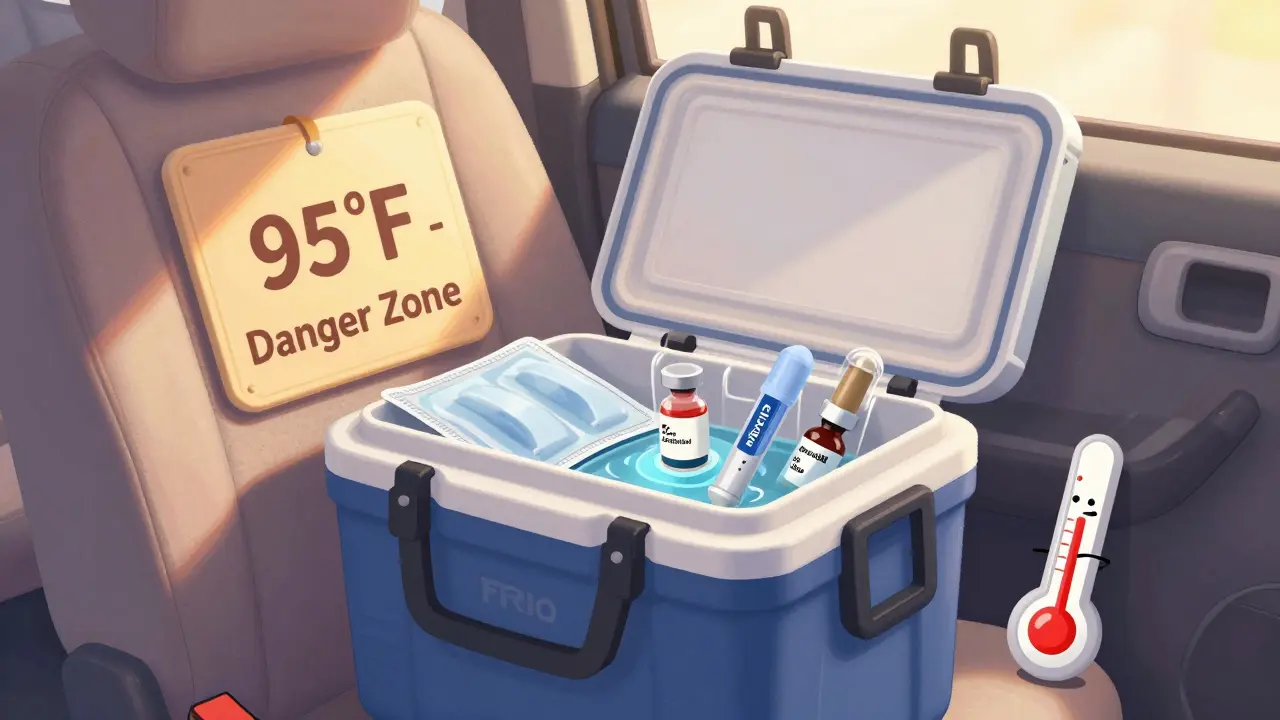
Not all meds are the same. Most pills - like ibuprofen, metformin, or blood pressure tablets - are fine at room temperature. The rule of thumb? If it doesn’t say otherwise, keep it between 68°F and 77°F (20°C to 25°C). You can handle brief spikes up to 86°F (30°C) without much risk. But don’t assume that applies to everything. Refrigerated meds are the real troublemakers. Insulin, EpiPens, certain biologics like Humira or Enbrel, and some antibiotics need to stay between 36°F and 46°F (2°C to 8°C). Leave them in a hot car for an hour, and you’re losing potency fast. Studies show insulin can drop 22% in effectiveness after just 12 hours at 95°F. That’s not a guess - that’s lab data from the University of Florida. And if you’re flying to Southeast Asia in July? That car seat is hitting 110°F. Your meds won’t survive. Light matters too. Epinephrine in EpiPens breaks down in sunlight. Just 15 minutes of direct sun can knock out 18% of its strength. Same goes for some migraine meds and thyroid pills. Keep them in their original opaque bottles. Don’t toss them into a clear ziplock on the dashboard.Use the Right Cooler, Not Just Any Insulated Bag
A regular lunch cooler? Not enough. Standard insulated bags lose cold for 12 to 24 hours, depending on the heat. For a 3-day hike or a long flight with a layover, that’s not safe. Medical-grade coolers - like Frio wallets or Bocapharmacy’s travel chillers - are built for this. They use water-activated gel packs that maintain 38°F to 42°F for up to 48 hours, even in 95°F heat. No ice. No freezing. Just steady, safe cooling. Why gel packs over ice? Because ice melts. And when it melts, it creates moisture. Moisture ruins pills. It can cause them to crumble, stick together, or even degrade chemically. Gel packs stay dry. They’re also TSA-friendly. You don’t have to explain why you’re carrying a bag of ice through security. Just show the cooler, and you’re good. If you’re carrying insulin or another refrigerated biologic, get a cooler with a temperature monitor. Devices like TempTraq stick to the outside of the pack and sync with your phone. They’ll alert you if the temp goes outside the safe range. One traveler in Thailand used one during a 14-day trip. The app pinged him when his bag sat on a hot train seat. He moved it. His insulin stayed strong.Never Pack Medications in Checked Luggage
This is the #1 mistake people make. Checked bags go through extreme conditions: unheated cargo holds in winter, scorching tarmacs in summer, pressure changes, and delays that last hours - or days. The CDC found that 67% of medication failures during travel happened because meds were packed in checked bags. Always carry your meds in your carry-on. That’s not just for safety - it’s for legality. Customs officials in countries like Thailand, Japan, and Australia require medications to be in original containers with prescription labels. If your pills are in a plastic bag with no name on them? You risk confiscation, fines, or even arrest. Keep your meds in their original bottles. Don’t transfer them to pill organizers unless you have to. And if you do use a pill organizer, keep the original bottles in your carry-on as proof. TSA and international customs need to see the prescription label. If you’re on a long-term trip, ask your pharmacist for a letter explaining your meds. Many will write one for free.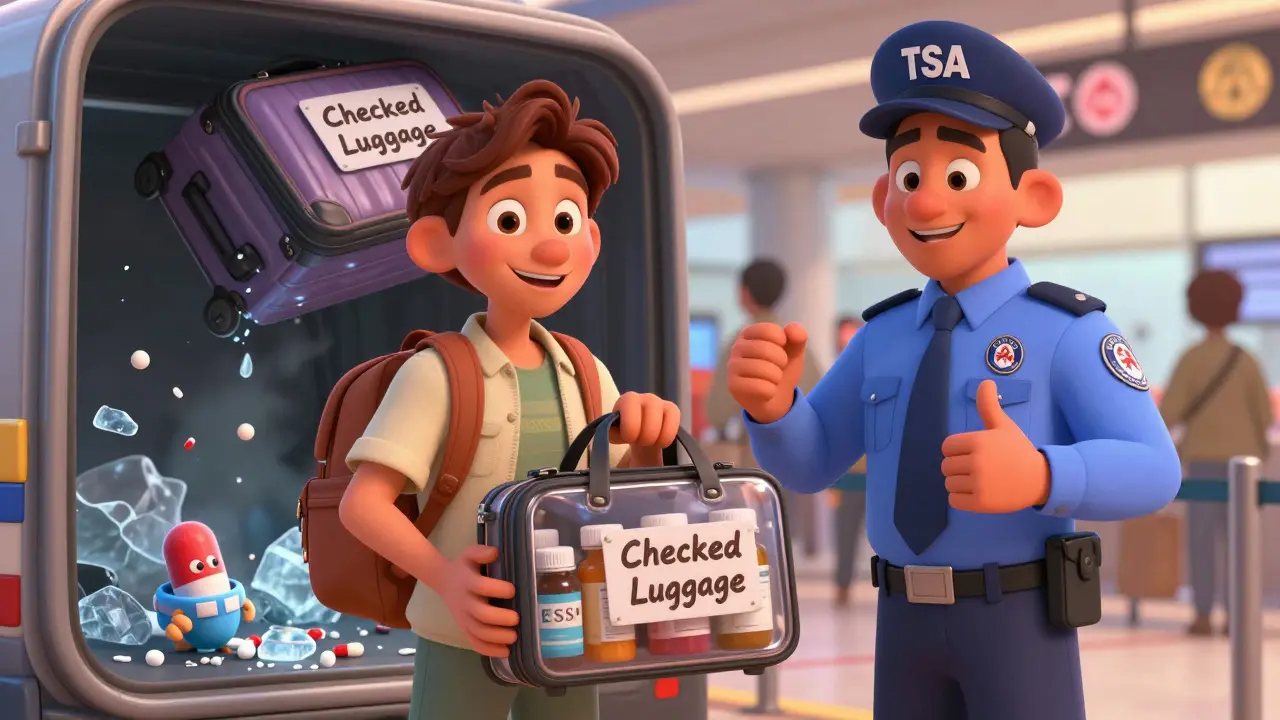
Protect Against Humidity - Yes, Even in Dry Places
You think humidity is only a problem in tropical climates? Think again. Bathrooms are the worst place to store meds - even at home. Steam from showers, sinks, and hair dryers can turn your pills into mush. On a trip, people often stash meds in the bathroom cabinet because it’s out of the way. Big mistake. A 2023 Enlyte.com survey of 1,247 travelers found that 22% of medication failures were due to humidity exposure. One woman took her asthma inhaler into the bathroom after a hot shower. By day three, the inhaler was clogged. She couldn’t use it. Another traveler left his antibiotics in a suitcase in a humid hotel room. The pills stuck together. He had to replace them - at triple the cost. Keep your meds in a dry, cool spot. A hotel room drawer. A suitcase compartment away from the bathroom. A ziplock with a silica gel packet (the little ones that come in new shoeboxes). They’re cheap, lightweight, and they absorb moisture. Throw one in with your meds. It’s a tiny thing that makes a big difference.Plan Ahead - Start 2 to 3 Weeks Before You Leave
Waiting until the night before your flight is how people end up in emergency rooms abroad. Don’t do that. Two to three weeks before you leave:- Call your pharmacist. Ask: “How long can this stay out of the fridge?” and “Is there a travel-friendly version?” Some insulin brands now come in temperature-stable pens that last up to 72 hours without cooling.
- Ask for extra prescriptions. If you’re gone longer than your prescription allows, get a refill before you go. Some countries won’t fill foreign prescriptions.
- Check if your meds are controlled substances. In places like Japan or Dubai, even common painkillers like oxycodone or Adderall are illegal without special permits. Your doctor can help you get the paperwork.
- Print out a list of your meds - generic and brand names, dosages, and storage requirements. Keep it with your passport.
What to Do If Your Meds Get Too Hot
Sometimes, despite your best efforts, something goes wrong. Your cooler fails. Your bag gets left in the sun. You’re not sure if your insulin still works. Here’s what to do:- Don’t panic. Most meds don’t instantly turn to waste. A few hours above temp might cause minor loss - not total failure.
- Check for visible changes. If pills are discolored, cracked, or smell weird (like vinegar), throw them out. Aspirin breaks down into salicylic acid, which can irritate your stomach.
- If you’re on insulin or an EpiPen and you’re unsure, use a backup if you have one. If you don’t, get to a pharmacy or clinic ASAP. Most major cities have pharmacies that can test potency.
- Call your doctor. Tell them what happened. They may advise you to get a new prescription or adjust your dose temporarily.
New Tech Making Travel Easier
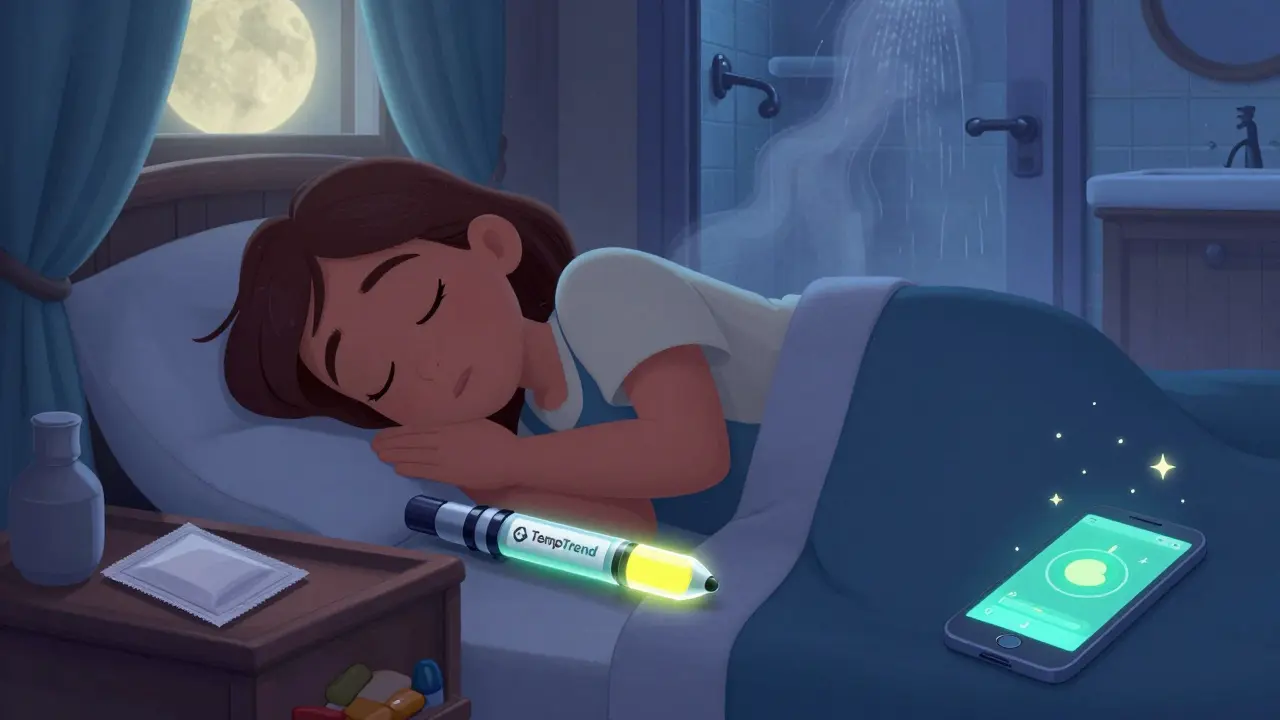
The good news? Things are getting better. In May 2023, the FDA approved the first temperature-indicating labels. 3M’s TempTrend labels change color if your meds get too hot or too cold. You just look at them - no phone needed. They’re already being used by some pharmacies for insulin and biologics. New coolers like the PharmaPort 360° can hold temperature for 120 hours - that’s five full days. And by 2026, experts predict 85% of temperature-sensitive meds will come in stable forms that don’t need refrigeration at all. You won’t need a cooler for insulin anymore. Just pack it in your pocket. Until then, stick to the basics: know your meds, use the right cooler, carry them with you, keep them dry, and plan ahead. It’s not complicated. But it’s critical.Can I leave my insulin in the car for a few hours while I shop?
No. Even on a cool day, a parked car can heat up to over 100°F within 30 minutes. Insulin loses potency rapidly at high temperatures - up to 22% after 12 hours at 95°F. Always carry it with you. Use a travel cooler if you need to be away from your bag for more than 15 minutes.
What if I’m flying and my meds need refrigeration?
You can bring refrigerated meds on a plane - no problem. Use a medical-grade cooler with gel packs. Declare them at security. TSA allows ice packs as long as they’re frozen solid. But gel packs are better - they don’t melt and leak. Keep your meds in original bottles with labels. Bring a doctor’s note if you have one.
Are pill organizers safe for travel?
Yes - but only as a supplement. Never rely on them alone. Always carry your original prescription bottles in your carry-on. Customs officials need to see the label. Pill organizers are fine for daily use, but they don’t prove the medication is yours or what it is. Use them for convenience, not as your primary storage.
Can I refill my prescription overseas?
Sometimes, but it’s risky. Many countries won’t fill foreign prescriptions, especially for controlled substances. Even common meds like Adderall or oxycodone are illegal without special permits. Always get enough for your entire trip - plus a few extra days - before you leave. Ask your pharmacist to write a letter explaining your need.
How do I know if my medication has gone bad?
Look for changes: pills that are discolored, crumbly, or sticky. Liquids that are cloudy or have particles. Inhalers that feel different when you use them. Insulin that looks cloudy when it should be clear. If you smell vinegar from aspirin or ibuprofen, it’s broken down. When in doubt, throw it out. Don’t risk using a degraded med - especially if it’s for heart, asthma, or anaphylaxis.
Raushan Richardson
December 27, 2025
Just packed my insulin for a trip to Costa Rica and used a Frio wallet-no issues. Seriously, this stuff is a game changer. No ice, no leaks, just chill. I didn’t even think about humidity until now, but silica gel packets? Genius. I threw three in my carry-on and slept like a baby.
Janice Holmes
December 27, 2025
OMG I CRIED WHEN MY EPINEPHRINE GOT LEFT IN THE BACKSEAT OF A RENTAL CAR IN ARIZONA. 110 DEGREES. I THOUGHT I WAS GONNA DIE. NOW I CARRY IT IN MY BRA. NOT LITERALLY. BUT IN A FROSTED GEL PACK TAPED TO MY BELT. I’M NOT KIDDING. YOU DON’T KNOW WHAT YOU’VE GOT TIL IT’S GONE.
Liz Tanner
December 27, 2025
This is such a necessary post. I used to stash my thyroid meds in the hotel bathroom because it was ‘convenient.’ Then one day, they turned sticky. I didn’t realize until I couldn’t swallow them. Learned the hard way-dry drawer only. Also, silica gel packets are cheaper than a new prescription. Always keep one in there.
Alex Lopez
December 28, 2025
Of course you’re not supposed to check your meds. But let’s be real-how many people actually do this? I’ve seen folks in airports with ziplocks full of pills in their checked bags. And they wonder why they get pulled aside. TSA doesn’t care if you ‘forgot.’ They care about labels. And if you’re flying to Dubai with Adderall? Good luck explaining that one.
Olivia Goolsby
December 28, 2025
Wait-so you’re telling me the FDA approved temperature-indicating labels… but only for some meds? And only since 2023? And yet, my pharmacy still gives me insulin in a plain vial with no warning? This is a MASSIVE PUBLIC HEALTH FAILURE. They’re letting people die because of cost-cutting and corporate negligence. And now they want us to trust ‘gels’ and ‘phone apps’? What’s next? A QR code that says ‘your meds are probably fine’? I’m not buying it. This is a slow-motion poison epidemic disguised as convenience.
James Bowers
December 29, 2025
It is imperative to underscore the fact that the degradation of pharmaceutical agents under thermal stress is not merely a matter of diminished efficacy-it is a direct threat to physiological homeostasis. The cited 22% potency loss in insulin following exposure to 95°F is corroborated by peer-reviewed literature from the University of Florida, Department of Endocrinology. One must therefore exercise due diligence in adherence to the International Council for Harmonisation guidelines for pharmaceutical storage during transit. Failure to do so constitutes a breach of medical responsibility.
Will Neitzer
December 30, 2025
I appreciate the depth of this guide. As a clinical pharmacist with 18 years in travel medicine, I’ve seen too many patients arrive in emergency rooms abroad because they assumed ‘room temperature’ meant ‘anywhere in a suitcase.’ The reality is far more nuanced. I always recommend my patients carry a printed copy of the FDA’s Medication Storage Guidelines, along with a letter from their prescriber-especially for controlled substances. And yes, gel packs are superior to ice. Not only for moisture control, but because they’re TSA-compliant without requiring explanation. This is not advice-it’s protocol.
Nicola George
December 31, 2025
Y’all really treat your meds like fragile porcelain dolls. I’ve had my blood pressure pills in a hot car, in a sweaty gym bag, and once in a beach towel. Still worked. Maybe it’s because I’m from South Africa and we don’t have the luxury of overthinking everything. But hey-if it works for you, great. Just don’t act like everyone else is dumb for not doing the same.
Satyakki Bhattacharjee
January 1, 2026
Medicines are not toys. They are gifts from God, given through science. But man, with his greed and laziness, makes them dangerous. Why do we need coolers? Why do we need labels? Why not just trust in God? He made the sun, He made the cold. He will protect those who are faithful. I do not carry a cooler. I carry prayer. And my pills. And they are fine.
Babe Addict
January 2, 2026
Let me break this down for you laypeople. Insulin degradation isn’t linear-it’s Arrhenius-dependent. The activation energy for hydrolytic degradation of human insulin is approximately 85 kJ/mol, which means every 10°C rise doubles the degradation rate. So yes, 95°F = ~35°C = 15°C above optimal = 4x faster breakdown. And don’t even get me started on epinephrine’s photochemical decomposition pathway. UV-A exposure induces radical cleavage of the catechol ring. That’s why you need amber glass. And no, silica gel doesn’t stop humidity-induced polymorphic transitions in aspirin. You need desiccant with <5% RH. This whole post is just surface-level fluff.
Kishor Raibole
January 4, 2026
It is a moral obligation of the modern traveler to understand the pharmacokinetic implications of environmental exposure. To neglect such knowledge is not merely negligence-it is an act of spiritual irresponsibility toward one’s own body and those who depend on one’s health. The world has become a place of convenience, and convenience has replaced wisdom. We carry our medicines in plastic bags as if they were snacks. We trust the sun, the heat, the chaos. But medicine is not chaos. Medicine is order. And order demands discipline.
Chris Garcia
January 4, 2026
As a Nigerian who’s traveled through Lagos heatwaves and Nairobi humidity, I’ve learned this: your pills don’t care about your itinerary-they care about temperature and dryness. I once had to buy a small cooler just to carry my antiretrovirals on a 3-day bus ride. People laughed. I didn’t care. I’m alive because I respected the science. And yes-silica gel packets? I keep them in my socks. Small, dry, and always with me. Don’t be the person who blames the pharmacy when your meds fail. Be the person who planned ahead.
John Barron
January 5, 2026
😂 I just read this whole thing and realized I’ve been storing my Adderall in my car’s cup holder for 3 years. 😅 My therapist is gonna lose it. But hey-still works, right? 🤷♂️ I mean, if it ain’t broke… 🤔 Also, can someone explain why gel packs don’t melt? I thought everything melts in heat? 🤯
Robyn Hays
January 6, 2026
What about the new temperature-stable insulin pens? I heard they’re approved for 72 hours at up to 86°F. Are those actually reliable? I’ve been using them on weekend trips and haven’t had issues-but I’m paranoid. Is there any third-party data on how long they really last? I’d love to see a comparison study between traditional vials and these new pens under real-world conditions-like a hot train in India or a desert road trip. I’m not just asking for fun-I need to know before my next big trip.