
Imagine spending two million dollars and waiting a year just to prove that a slight change in a pill's coating doesn't change how it works in the body. For pharmaceutical companies, that's the reality of traditional bioequivalence (BE) studies. But there's a shortcut that is becoming the gold standard for complex drugs: IVIVC is a mathematical model that links a drug's dissolution rate in a lab to its actual performance in a human patient. By establishing this link, companies can apply for a biowaiver-essentially a regulatory "hall pass" that lets them skip expensive human trials in favor of lab tests.
The Core Goal: Why Replace Human Trials?
Traditional bioequivalence studies are a grind. They usually require 24 to 36 healthy volunteers, precise blood sampling over long periods, and massive budgets. When a company makes a minor tweak to a formula or moves production to a new factory, regulators often demand another human study. This can stall a product launch by 6 to 12 months.
IVIVC changes the game by treating the lab beaker as a proxy for the human gut. If a company can prove that the way a drug dissolves in the lab perfectly predicts how it enters the bloodstream, the FDA or EMA will often allow them to use dissolution data instead of new human trials. This isn't just about saving money-though saving $1 to $2 million per study is a huge perk-it's about getting necessary medications to patients faster.
The Four Levels of Correlation
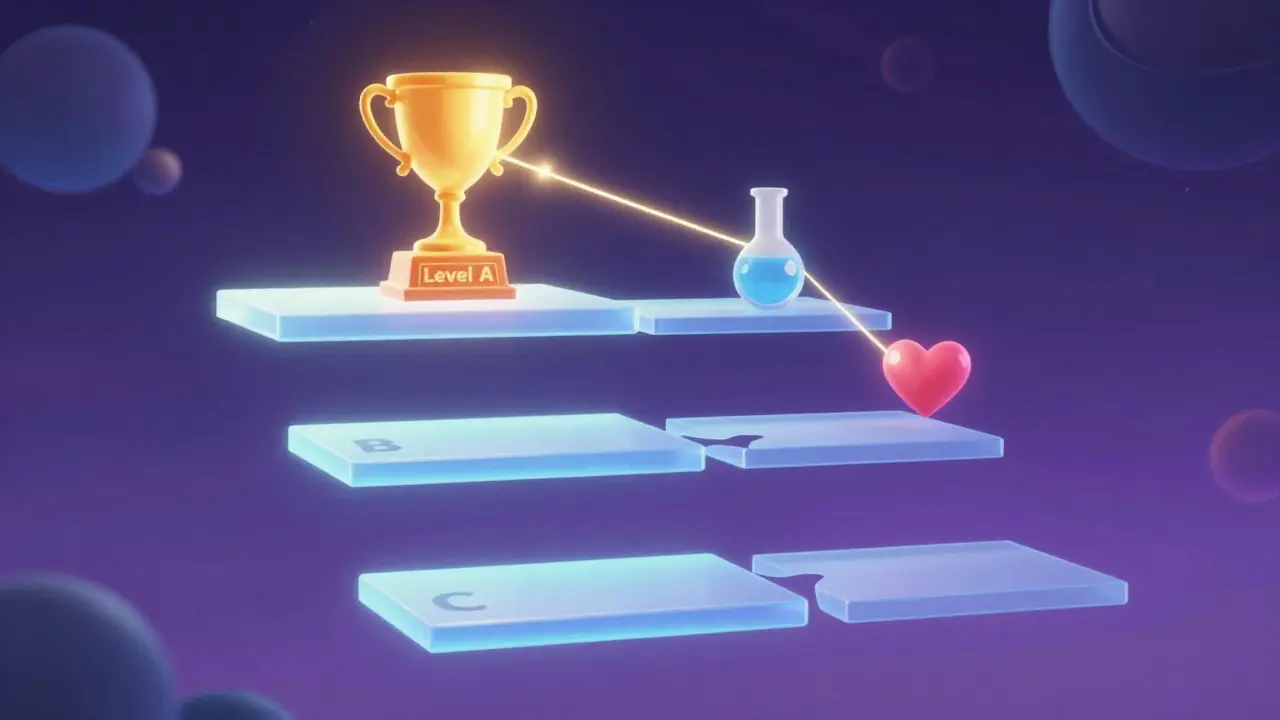
Not all correlations are created equal. The regulatory world divides IVIVC into four levels, and the level you achieve determines whether you actually get that biowaiver.
- Level A: The "Holy Grail." This is a point-to-point relationship. It means every single single point of drug release in the lab corresponds to a specific point of absorption in the body. If you have a Level A correlation, you can predict the entire pharmacokinetic profile without a single human subject.
- Level B: A bit broader. This focuses on the average. It links the mean dissolution time to the mean residence time of the drug in the body. It's useful, but it doesn't give you the detailed "map" that Level A does.
- Level C: A single-point snapshot. For example, if 50% of the drug dissolves at hour two in the lab, the peak plasma concentration (Cmax) in the body will be X. It's easier to build but only predicts one specific outcome.
- Multiple Level C: A combination of several Level C correlations. While more descriptive than a single point, regulators still view these as less reliable than Level A for granting full waivers.
| Level | Relationship Type | Predictive Power | Biowaiver Potential |
|---|---|---|---|
| Level A | Point-to-point | Full PK Profile | Very High |
| Level B | Mean-to-mean | Average Performance | Moderate |
| Level C | Single point | One parameter (e.g., Cmax) | Low (needs support) |
| Multi-Level C | Multiple points | Limited parameters | Moderate |
The Challenge of Getting it Right
If it's so great, why isn't everyone doing it? Because building a valid model is incredibly hard. Most companies don't have the in-house expertise-only about 15% do. You can't just run one test and call it a day. To satisfy the FDA's 2014 guidance , you need a "discriminatory" dissolution method. This means the test must be sensitive enough to fail if the drug formula is slightly off. If your lab test is too "forgiving," the regulator will reject the model because it doesn't actually prove the drug is stable.
Many attempts fail because the lab environment is too simple. Real guts have pH gradients and bile salts. This is why biorelevant dissolution testing is becoming the new standard. By mimicking the actual physiology of the gastrointestinal tract, scientists can create a model that the FDA actually trusts. Without this realism, about 64% of submissions fail due to a lack of physiological relevance.
When Biowaivers Actually Work
The most common use for these waivers is in modified-release products . These are drugs designed to leak into the system slowly over 12 or 24 hours. For these, the Biopharmaceutics Classification System (BCS) doesn't always provide an easy out, making IVIVC the primary tool for success.
For example, if a company wants to scale up production from a small pilot batch to a massive industrial lot, they can use an IVIVC model to prove the drug still releases at the same rate. According to the SUPAC-MR guidelines, as long as the dissolution profiles stay similar (using a similarity factor known as f2 > 50), the company can skip the human trial entirely. In one real-world case, Teva Pharmaceutical used this approach for a generic oxycodone product, avoiding five separate bioequivalence studies for post-approval changes.
The Limits of the Model
IVIVC isn't a magic wand. There are certain scenarios where you simply cannot replace humans with beakers. If a drug has a "narrow therapeutic index"-meaning the difference between a helpful dose and a toxic dose is tiny-regulators won't take the risk. They want to see real blood data.
Similarly, if the drug has non-linear pharmacokinetics (where doubling the dose doesn't simply double the blood concentration) or a complex absorption mechanism, the math breaks down. In these cases, traditional in vivo testing remains mandatory. You can't model what you don't fully understand, and some drugs behave in ways that defy simple linear regression.
Future Trends: AI and New Frontiers
The field is moving toward more automation. We are seeing the rise of machine learning-enhanced models that can spot patterns in dissolution data that humans might miss. Both the FDA and EMA have expressed openness to these AI-driven approaches, provided the process is transparent.
We're also seeing IVIVC expand beyond pills. New draft guidances are exploring how to apply these principles to topical creams and injectable implants. While the success rate for ophthalmic products is currently low (around 19%), the goal is to eventually move all drug testing toward a more predictive, lab-based system that prioritizes safety without sacrificing speed.
What is the main difference between Level A and Level C IVIVC?
Level A is a point-to-point correlation, meaning it can predict the entire blood concentration profile over time. Level C only relates a single lab point (like how much dissolved at 1 hour) to a single body result (like the peak concentration), making it far less predictive and less likely to earn a full biowaiver.
Why do so many IVIVC submissions fail?
Most failures happen because the dissolution method isn't "discriminatory"-it can't tell the difference between a good batch and a bad one. Additionally, many models lack physiological relevance, meaning they don't account for how the human gut actually behaves, such as pH changes or the presence of bile.
Can any drug get a biowaiver through IVIVC?
No. Drugs with a narrow therapeutic index, those with complex absorption patterns, or those that show non-linear pharmacokinetics usually require traditional human bioequivalence studies because the risk of a model error is too high.
How much money can a company save with a biowaiver?
A single bioequivalence study can cost between $500,000 and $2 million. By replacing these with IVIVC-supported lab tests, companies can save millions in research costs and shave 6 to 12 months off their development timeline.
What is the f2 similarity factor?
The f2 factor is a mathematical way to compare two dissolution profiles. If the f2 value is greater than 50, the two profiles are considered similar. This is often used in conjunction with IVIVC to justify waivers for minor formulation changes.