
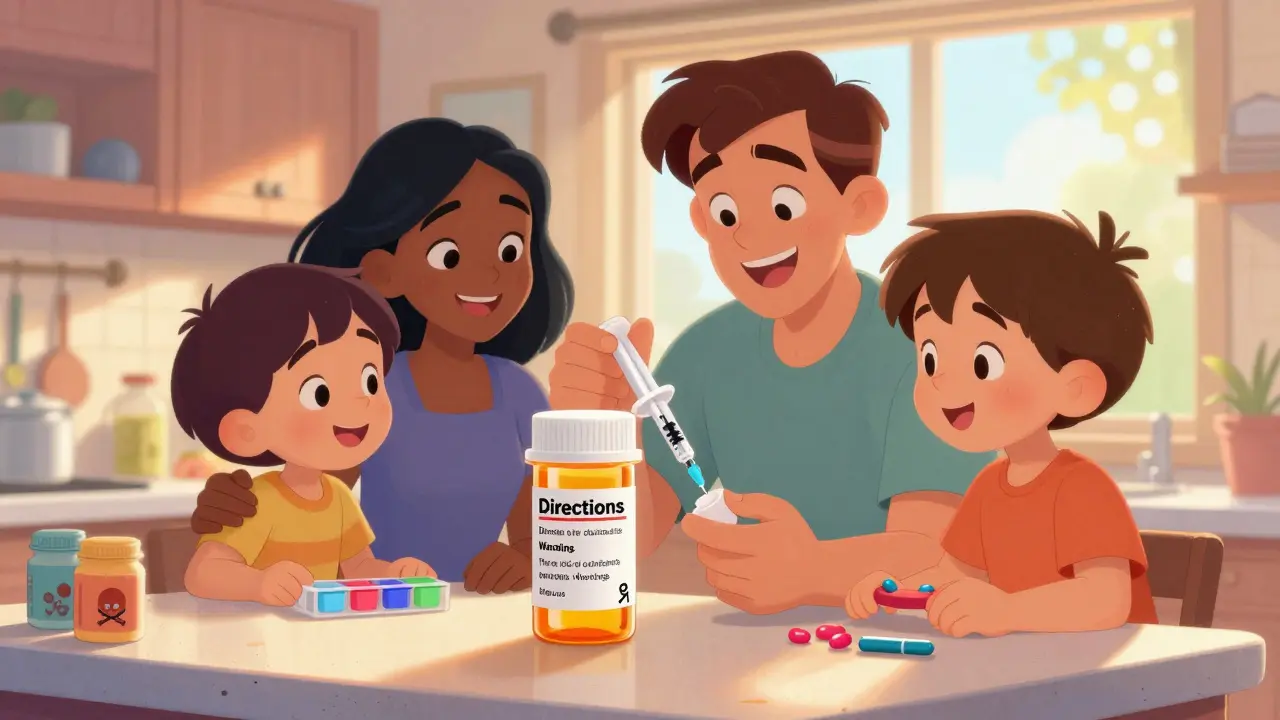
Every time you pick up a bottle of medicine-whether it’s from the pharmacy or the shelf at the grocery store-you’re holding a safety guide. But most people don’t read it like one. They glance at the name, check the expiration date, and take it. That’s risky. In fact, medication labels are the most important tool you have to avoid dangerous mistakes. And if you don’t understand what they’re saying, you could be taking too much, too little, or mixing drugs that shouldn’t be mixed.
What’s on a Medication Label?
There are two main types of medication labels: prescription and over-the-counter (OTC). Both follow strict rules set by the U.S. Food and Drug Administration (FDA), but they look different.
For prescription drugs, the label includes:
- Your full name
- The exact name of the medicine
- The strength (like 500 mg or 10 mL)
- How much to take and how often (dosage and directions)
- How to take it (with food? at bedtime?)
- Expiration date
- The pharmacy’s name and phone number
- Warnings about side effects, alcohol, or other drugs
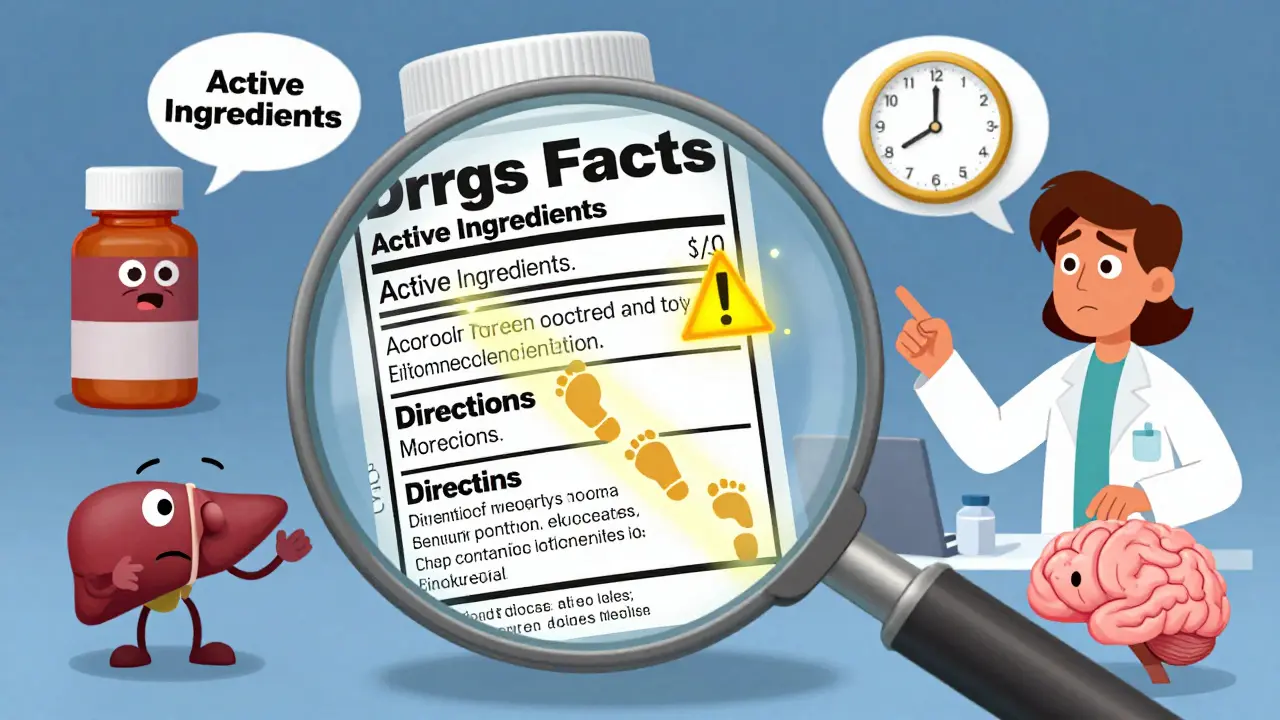
For OTC medicines like pain relievers or cold pills, the label follows the "Drug Facts" format. It’s organized into clear sections:
- Active Ingredients: What’s in the medicine and how much. This is key-if you take two medicines with the same active ingredient, you might overdose.
- Purpose: Why you’re taking it (e.g., "pain reliever", "cough suppressant").
- Uses: What symptoms it treats.
- Warnings: Who shouldn’t take it, when to stop, and what to avoid.
- Directions: Exactly how much to take, how often, and for how long.
- Inactive Ingredients: Things like dyes or preservatives (important if you have allergies).
- Other Information: Storage tips, expiration date, and manufacturer details.
Dosage Isn’t Just "Take One Pill"
Dosage instructions might look simple, but they’re packed with details. "Take one tablet daily" sounds easy-until you realize the tablet could be 10 mg, 50 mg, or 200 mg. Or worse, you’re told to take "one teaspoon" but your measuring spoon isn’t the same as the one used to make the label.
For liquid medicines, the label says something like: "350 mg per 5 mL." That means every 5 milliliters contains 350 mg of the drug. If your doctor says you need 700 mg, you need two doses of 5 mL-not 10 mL all at once. Many parents make this mistake with children’s medicine. A 2022 study found that 68% of parents misread liquid medication concentrations. Using a kitchen spoon? Big risk. Teaspoons vary from 2.5 mL to 7.3 mL. Always use the syringe or cup that came with the medicine.
Some medicines are dosed by weight. That’s common with kids’ medicines and certain antibiotics. If you don’t know your child’s weight in kilograms (or pounds), you can’t pick the right dose. The same goes for older adults-kidney or liver problems can change how your body handles a drug. That’s why some labels say: "Reduce dose if you have kidney disease." Don’t ignore that.
Why Warnings Matter More Than You Think
People skip the "Warnings" section. Big mistake. That’s where the real dangers hide.
One common issue: double-dosing. Many cold and flu medicines contain acetaminophen. If you take Tylenol for a headache and a cold tablet that also has acetaminophen, you can hit the 4,000 mg daily limit without realizing it. That can cause liver failure. The Cleveland Clinic says 27% of ER visits from medication errors happen because people didn’t realize they were taking two drugs with the same active ingredient.
Another warning you might miss: "Do not take with grapefruit juice." That one can make blood pressure or cholesterol drugs too strong-leading to dangerous drops in blood pressure or muscle damage. Or "Avoid alcohol." Some antibiotics and sleep aids can cause dizziness, vomiting, or even breathing problems when mixed with even one drink.
And don’t forget the "Do not use if" section. If you’re pregnant, breastfeeding, or have asthma, certain OTC medicines could be unsafe. The label tells you that. If it doesn’t say it’s safe, assume it’s not.
The Five Rights of Medication Safety
Nurses use a simple rule to avoid mistakes: the Five Rights. You should use it too.
- Right Patient: Is the name on the bottle yours? Double-check spelling.
- Right Drug: Does the name match what your doctor prescribed? Sometimes brand names change.
- Right Dose: Is the amount correct? If it looks way higher or lower than usual, ask.
- Right Route: Is it meant to be swallowed, injected, or applied to the skin? Don’t use a cream as a pill.
- Right Time: Does it say "take every 6 hours" or "take at bedtime"? Timing matters. Taking something too early or too late can reduce its effect-or make side effects worse.
Each of these is checked by reading the label carefully. One slip-like confusing "2x daily" with "2 tablets daily"-can change everything.
What You Should Do Every Time You Get a New Prescription
Here’s a quick checklist you can follow:
- Compare the label to your prescription. Does the name match? Is the strength the same?
- Ask the pharmacist: "Is this the same as before?" If you’ve taken it before, but the pill looks different, it might be a generic. That’s fine-but confirm.
- Read the directions out loud. If you don’t understand them, ask: "Can you explain this in simpler terms?"
- Check the expiration date. Prescription meds are usually good for one year from when they were filled. OTC meds last 2-3 years from manufacture.
- Ask: "Are there any foods, drinks, or other meds I should avoid?"
- Keep the label. Don’t throw it away. You’ll need it if you have side effects or need to refill.
What’s Changing on Labels (And Why)
Medication labels aren’t stuck in the past. The FDA is pushing for clearer, simpler language. By 2025, all high-risk drugs-like insulin, blood thinners, and opioids-must use plain language. No more "q.d." or "bid." Those mean "once daily" and "twice daily," but most people don’t know.
Also, starting in 2024, some prescription bottles will have QR codes. Scan it with your phone, and you’ll get a video showing how to take the medicine, what side effects to watch for, and even a dosage calculator. Early tests showed a 37% drop in errors. That’s huge.
And in the next few years, you’ll start seeing color-coded caps and icons. Red caps for high-alert drugs. A skull-and-crossbones icon for serious warnings. It’s not just a design change-it’s a safety upgrade.
What Happens When You Ignore the Label
Let’s say you take a painkiller because your back hurts. You take two, but it doesn’t help. So you take two more. You’ve doubled the dose. Now you’re at risk for liver damage. Or you take a sleep aid and drink wine because you’re stressed. You fall asleep in the shower. That’s not just a mistake-it’s a medical emergency.
According to the Institute of Medicine, about 1.5 million preventable drug errors happen every year in the U.S. Half of them come from patients misunderstanding the label. And those errors cost the system over $3.5 billion annually.
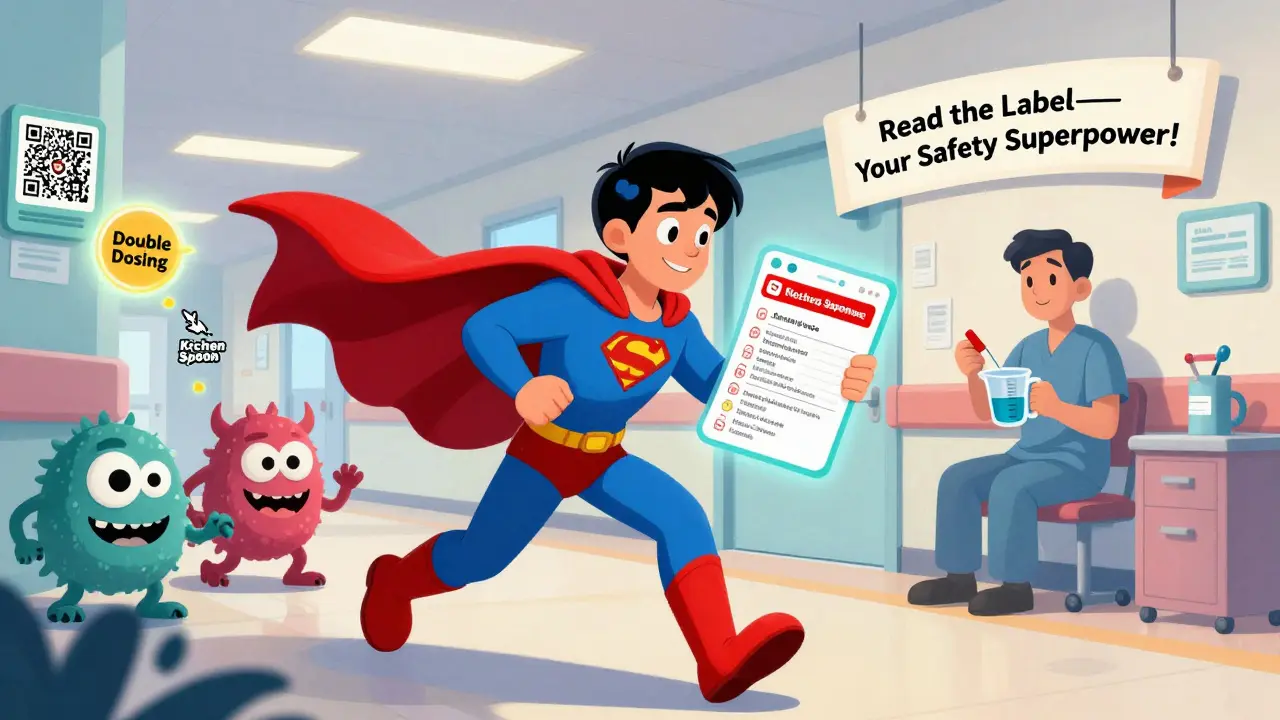
You don’t need to be a doctor to read a label. But you do need to slow down. Take a breath. Read it like your life depends on it-because it does.
Final Tips to Avoid Mistakes
- Always use the measuring tool that comes with the medicine. Never use a kitchen spoon.
- Keep a list of all your meds-prescription, OTC, and supplements. Show it to every doctor.
- If you’re unsure, call the pharmacy. Pharmacists are trained to explain labels.
- Use pill organizers with clear labels. They help you remember when to take each dose.
- Don’t take old medicine. Expired drugs can lose strength or become harmful.
- Teach kids: "This isn’t candy." Store meds out of reach.
Medication labels aren’t paperwork. They’re your safety net. Read them. Understand them. Use them. Your body will thank you.
What should I do if I can’t read the label on my medicine?
If the print is too small or unclear, don’t guess. Call the pharmacy where you got the medicine. Pharmacists can read the label to you over the phone or print a larger version. Many pharmacies also offer large-print labels or audio instructions for people with vision problems.
Can I cut or crush pills if I have trouble swallowing them?
Not always. Some pills are designed to release medicine slowly. Crushing them can make the drug too strong too fast, leading to overdose. Others are coated to protect your stomach or to survive stomach acid. Always check with your pharmacist before cutting or crushing any pill. If swallowing is hard, ask if there’s a liquid form or a different size.
Why do some medicines say "take with food" and others say "take on an empty stomach"?
Some drugs are absorbed better when there’s food in your stomach. Others can cause nausea or upset if taken with food. Antibiotics like tetracycline, for example, bind to calcium in dairy and won’t work if taken with milk. Your label tells you because it affects how well the medicine works. If you’re unsure, ask your pharmacist what "with food" actually means-like "with a light snack" or "with a full meal."
What if I miss a dose? Should I take two to make up for it?
Usually not. Taking double the dose can be dangerous. Most labels will say what to do if you miss a dose. If it doesn’t, call your pharmacist. For some medicines, like birth control or antibiotics, missing a dose can reduce effectiveness. For others, like blood pressure pills, doubling up can cause your pressure to drop too low. Always follow the label’s advice-or ask for it.
Are generic medicines as safe as brand-name ones?
Yes. Generic medicines have the same active ingredient, strength, dosage form, and route of administration as the brand-name version. The FDA requires them to work the same way. The only differences are in inactive ingredients (like dyes or fillers), which rarely cause issues. If you notice a change in how you feel after switching to a generic, talk to your doctor or pharmacist. But don’t assume it’s unsafe just because the name is different.
Daniel Dover
February 16, 2026
Always use the measuring cup. Kitchen spoons are a gamble.
Michael Page
February 16, 2026
The label isn't just information-it's a contract between chemistry and consequence. We treat it like a menu when it's actually a blueprint for survival. Most people don't realize they're not reading instructions-they're reading warnings written in the language of risk.
There's no such thing as a harmless oversight. One misplaced decimal, one misunderstood abbreviation, one skipped line about grapefruit-and you're one step away from the ER. The system assumes you're rational. It's not your fault if you're not.
Doctors don't explain. Pharmacies don't teach. We're left to decode hieroglyphs written by regulators who never had to swallow a pill at 3 a.m. with a half-empty coffee cup and a toddler screaming in the background.
And yet we're blamed when things go wrong. No one says, 'Why didn't the label say it in plain English?' They say, 'Why didn't you read it?' But what does 'read' mean when the font is 7-point and the ink is fading? What does 'understand' mean when the word 'bid' is used instead of 'twice daily'?
It's not ignorance. It's design failure. And until the FDA forces clarity-not just compliance-we're all just guessing.
QR codes? Color-coded caps? Good. But they're bandages on a wound that needs surgery.
Medication labels should be as clear as a stop sign. Not a legal document. Not a puzzle. A command. Simple. Unambiguous. Non-negotiable.
Until then, every pill you take is a leap of faith.
Joe Grushkin
February 18, 2026
Let’s be real-the whole system is a scam. You think the FDA cares if you live or die? They care about liability. The labels are written to cover their asses, not help you. That 'Drug Facts' format? Designed so you can't compare two meds side by side without a PhD in pharmacology.
And don’t get me started on generics. 'Same active ingredient'? Sure. But the fillers? The binders? The dyes? Those are where the real differences live. You think your body can't tell the difference between cornstarch and microcrystalline cellulose? You’re delusional.
Pharmacists? They’re paid to sell, not explain. They’ll nod and say 'yes' while you’re holding a bottle that could kill you if you take it wrong.
And don’t even mention 'take with food.' What does that even mean? A toast? A burrito? A 2000-calorie breakfast? It’s meaningless. The label should say 'take with 200g of protein-rich meal'-not some vague, feel-good nonsense.
This isn’t healthcare. It’s a lottery. And you’re the sucker buying the ticket.
Virginia Kimball
February 18, 2026
I love how this post breaks it all down-it’s like a safety manual for your body, and honestly? We treat meds like candy because we’re busy, tired, and overwhelmed. But here’s the thing: you don’t need to be a scientist to save your life. Just slow down. One breath. One label. One question.
My grandma used to keep a little notebook next to her pill organizer. Every time she got a new med, she wrote down: What it’s for. What it looks like. What to watch for. And she’d call the pharmacy if anything felt off. No shame. No stress. Just smart.
And guess what? She’s 89 and still hiking. Not because she’s lucky. Because she read the damn label.
So next time you grab a bottle? Pause. Read it like it’s a love letter from your future self. Because it is.
You’ve got this. One pill at a time.
Kapil Verma
February 20, 2026
India has been doing this right for decades. We don’t need QR codes or color caps. We teach our children: 'Medicine is not food.' We don’t have 1.5 million errors because we respect the label. In India, if you take medicine without reading, you’re not just careless-you’re dishonoring your ancestors.
Why are Americans so lazy? Why do you need a video to tell you not to mix alcohol with pills? We’ve had warning signs in Hindi and Tamil since the 1970s. No emojis. No apps. Just truth.
Stop outsourcing your responsibility. The label is clear. You’re just not paying attention.
This isn’t a U.S. problem. It’s a moral failure.
Mandeep Singh
February 21, 2026
You think this is bad? Wait till you see what’s coming. The FDA is pushing for 'plain language'-but they’re still using corporate jargon. 'Take one tablet daily'? What does 'daily' mean? Every 24 hours? Sunrise? Bedtime? Who decides? And why are they still using 'q.d.' in some places? It’s a joke.
And don’t get me started on the 'inactive ingredients.' That’s where the real danger lies. Most people don’t know that dyes like FD&C Red 40 can trigger seizures in kids. Or that lactose in pills can wreck a lactose-intolerant person’s gut. But the label? It just says 'other ingredients.' That’s not transparency. That’s obfuscation.
And why are we still using milliliters? Why not just say 'two tablespoons'? Americans can’t measure milliliters. We’re not scientists. We’re humans. Use units people understand.
Also, why is there no mandatory warning on OTC meds about addiction potential? Oxycodone is controlled. But hydrocodone? Not always. That’s insane. People get hooked on cough syrup. And the label says nothing.
This isn’t about reading. It’s about rewriting. The whole system needs to be rebuilt from the ground up-with real people, not lawyers, writing the labels.
And if you’re still using a kitchen spoon? You’re not just stupid. You’re dangerous.
Kaye Alcaraz
February 21, 2026
Reading medication labels is not optional. It is a fundamental act of self-advocacy. Every individual deserves to understand what they are ingesting, regardless of educational background or socioeconomic status.
The Five Rights framework is not merely a nursing protocol-it is a human right. Right Patient. Right Drug. Right Dose. Right Route. Right Time. These are not abstract concepts. They are non-negotiable pillars of bodily autonomy.
I urge every reader to print this information. Tape it to the bathroom mirror. Share it with neighbors. Teach it to children. Medication safety is not a niche concern. It is public health infrastructure.
And yes-pharmacists are trained to explain. Ask. Again. And again. Until you understand. Your life depends on it.
Sarah Barrett
February 21, 2026
I’ve been a nurse for 22 years. I’ve seen people take four different painkillers at once because they 'thought they’d work better together.' I’ve seen diabetics take insulin with grapefruit juice because 'it tasted better.' I’ve seen grandparents swallow pills with coffee because 'it helps them swallow.'
None of them were careless. They were just tired. Overwhelmed. Uninformed.
This post? It’s not alarmist. It’s necessary. And the QR code initiative? Brilliant. But we need more than tech. We need empathy. We need labels written in the voice of a concerned friend-not a regulatory committee.
Also-yes, generics are safe. But if you feel different? Speak up. Your body knows. Trust it.
Erica Banatao Darilag
February 21, 2026
i just wanted to say thank you for this post. i’ve been taking blood pressure meds for 5 years and i never knew what 'q.d.' meant until now. i thought it meant 'every day' but i didn’t know if it was morning or night. i called my pharmacy today and they printed me a new label with 'once daily' in big letters. i feel so much better now. i didn’t even realize i was scared to take it.
also i have bad eyesight and i use the audio option from my pharmacy now. it’s a game changer. thank you for reminding me to ask for help.
Chiruvella Pardha Krishna
February 23, 2026
Reading labels is not about intelligence. It’s about discipline. In a world of infinite distractions, the ability to pause, read, and reflect is a rare virtue. We’ve outsourced responsibility to algorithms, apps, and automation-and now we’re paying the price in liver failure, ER visits, and preventable deaths.
The label is not a suggestion. It is a covenant. A silent promise between the chemist who synthesized the molecule, the regulator who verified its safety, and the patient who will ingest it.
When you ignore it, you don’t just risk your life. You disrespect the entire chain of care that exists to protect you.
And yet, we scroll. We multitask. We assume. We guess.
That’s not modern. That’s primitive.
Slow down. Read. Breathe. Then take the pill.
That’s the only ritual that matters.