
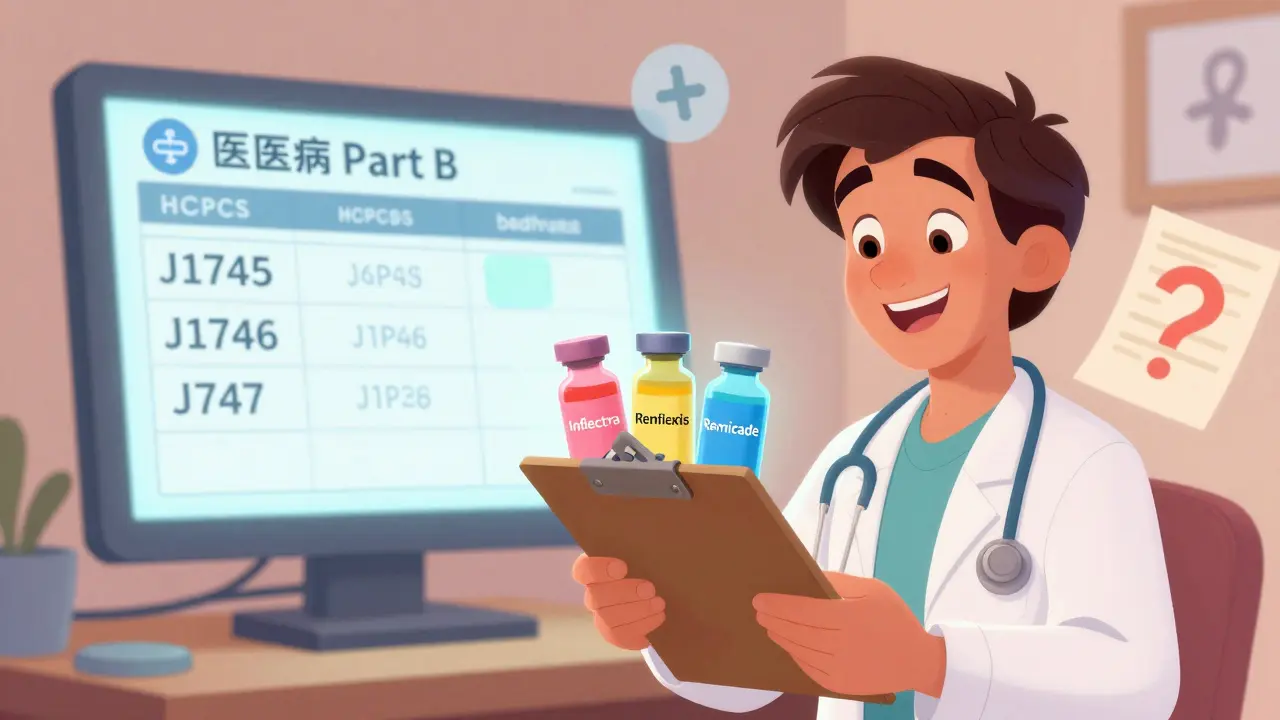
When a doctor prescribes a biosimilar-like Inflectra instead of Remicade-how does the clinic get paid? It’s not as simple as handing in a receipt. Unlike generic pills, biosimilars are complex biologic drugs that require special billing rules under Medicare Part B. The system changed dramatically in 2018, and if you’re a provider, pharmacist, or even a patient trying to understand your bill, knowing how this works can make a big difference.
How Biosimilars Are Coded Differently Than Generics
Biosimilars aren’t like generic pills. A generic version of metformin shares the same active ingredient and gets the same billing code as the brand name. Biosimilars are different. They’re highly similar to their reference biologic-like Humira or Enbrel-but not identical. Because of that, each biosimilar gets its own unique billing code. This wasn’t always the case.Before January 2018, all biosimilars for the same reference drug used one shared HCPCS code. For example, if two biosimilars were approved for infliximab, they both used code Q5101. The payment was a blended rate based on the average price of all products under that code. That created a problem: if one biosimilar came in cheaper, the others still got paid the same average rate. Why would a manufacturer lower their price if they’d still get paid the same? It discouraged competition.
In 2018, CMS flipped the script. Now, every FDA-approved biosimilar has its own HCPCS code. Inflectra has J1745. Renflexis has J1746. Hadlima has J1747. Each gets paid based on its own Average Selling Price (ASP), plus 6% of the reference product’s ASP. This means if Inflectra sells for $2,000 per dose and Remicade sells for $2,500, Inflectra gets paid $2,000 + 6% of $2,500 = $2,150. Remicade gets paid $2,500 + 6% of $2,500 = $2,650.
Why the 6% Add-On Matters More Than You Think
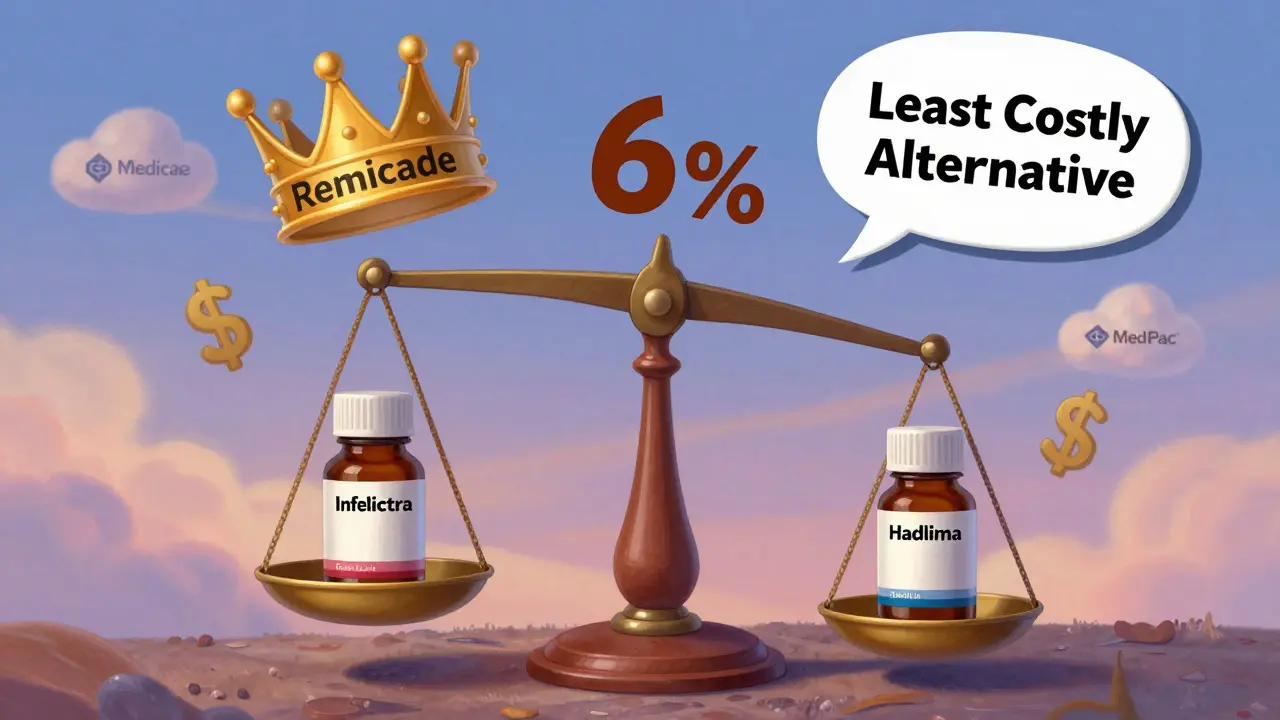
The 6% add-on is built into the payment for every biological drug under Medicare Part B. It’s meant to cover the cost of handling, storing, and administering these complex drugs. But here’s the catch: the add-on is calculated using the reference product’s ASP-not the biosimilar’s.That means even if you give a patient a biosimilar that’s 25% cheaper, the provider still gets paid 6% of the more expensive reference drug. For Inflectra, that’s 6% of Remicade’s price. So while the drug costs less, the provider’s reimbursement doesn’t drop proportionally. In fact, the profit gap stays wide.
Dr. Mark Trusheim from MIT calculated this in 2020: for every dose of Remicade, a provider earns $150 in add-on revenue. For Inflectra, it’s $120. That’s a $30 difference per dose. In a clinic giving out hundreds of doses a month, that adds up to real money. It’s no surprise studies show many providers still default to the reference product-even when biosimilars are cheaper.
Experts like Avalere Health estimate that if CMS paid biosimilars 106% of their own ASP instead of the reference’s, biosimilar use could jump 15 to 20 percentage points. Right now, biosimilars make up only about 35% of the infliximab market in the U.S., even after five years. In Europe, where payment systems are designed to favor the lowest-cost option, that number is closer to 80%.
The JZ Modifier and Other Billing Requirements
Starting July 1, 2023, CMS added another layer: the JZ modifier. This modifier is required on claims for infliximab and its biosimilars when no drug is discarded. If a vial contains 100 mg and you only use 80 mg, you have 20 mg left over. That’s a discarded amount. You don’t use the JZ modifier in that case. But if you use the full vial-no waste-you must add JZ to your claim.Why? It’s about accurate tracking. CMS wants to know if providers are wasting expensive drugs or using them efficiently. But this has created new headaches. One gastroenterology practice reported a 30% increase in billing staff time just to verify discarded amounts. Pharmacies now have to track vial usage down to the milligram. It’s detailed, time-consuming, and not always intuitive.
Providers also have to make sure they’re using the right code. CMS updates payment rates every quarter. If you’re still using a code from last year’s list, your claim will be denied. A 2022 survey found that 22% of initial denials were due to outdated codes. Many clinics now use automated systems or manufacturer guides-like Fresenius Kabi’s 2023 coding handbook-to double-check before submitting.

What Happens When a New Biosimilar Enters the Market?
When the first biosimilar for a reference drug hits the market-say, Inflectra for Remicade-it doesn’t immediately get paid based on ASP. CMS uses a temporary workaround: reimbursement is set at 106% of the Wholesale Acquisition Cost (WAC) for the first six months. That gives the manufacturer time to build up enough sales data for ASP to be calculated accurately.But here’s the twist: any biosimilar that comes in after that-like Renflexis or Avsola-doesn’t get the WAC grace period. It jumps straight into the ASP-based payment system. That puts later entrants at a disadvantage. They’re competing with a product that had six months of higher reimbursement to build market share. This has led to criticism that the system favors early movers, not necessarily the best or cheapest option.
Provider Challenges and Real-World Mistakes
The transition to individual codes in 2018 wasn’t smooth. A 2022 survey of 217 cancer centers found that 68% experienced billing confusion. Nearly half had claims denied because staff picked the wrong code. Even after years, mistakes persist. Some providers still try to use the old shared code. Others forget the JZ modifier. Some don’t realize Medicare Advantage plans may pay differently than traditional Medicare Part B.One oncology practice found that switching to a dual-verification system-where the pharmacist checks the administered product against the billing code before submission-cut claim errors from 15% to under 3%. That’s not just about avoiding denials. It’s about cash flow. A single denied claim can take weeks to resolve. For small clinics, that’s money tied up.
Training also took time. The Healthcare Financial Management Association estimated clinics needed 40 to 60 hours of staff training just to get comfortable with the new system. Many providers still say CMS’s official guidance is too technical and doesn’t cover real-world edge cases.
Where the System Is Headed
There’s growing pressure to fix the reimbursement structure. MedPAC, the Medicare advisory panel, has proposed a “consolidated billing” model: instead of paying each biosimilar separately, pay one rate based on the average price of all products in the class. That’s called a Least Costly Alternative (LCA) approach. If implemented, a clinic giving out Inflectra, Renflexis, and Hadlima would get paid 106% of the average price of all three. That would strongly incentivize using the cheapest option.CMS is already exploring alternatives. In February 2023, they issued a proposal asking for feedback on whether to remove the reference product’s ASP from the biosimilar add-on entirely. If they do, providers would earn less on the reference drug and more on biosimilars-flipping the current incentive.
Right now, biosimilars account for about 18% of the U.S. biologics market. Analysts predict that could rise to 45-50% by 2027 under current rules. But without structural changes, it won’t reach European levels. The system works well for tracking usage and letting new products enter. But it doesn’t do enough to push providers toward lower-cost options.
For patients, that means higher out-of-pocket costs. For providers, it means lost savings. For taxpayers, it means Medicare continues paying more than necessary. The coding system is precise. The payment structure? That’s where the real problem lies.
What Patients Should Know
You might get a bill for a biosimilar and wonder why it’s not cheaper than the brand. The answer isn’t always in the drug’s sticker price-it’s in how it’s billed. Your provider may be paid more to give the reference drug, even if you’re getting the biosimilar. That doesn’t mean you’re being overcharged, but it does mean the financial incentive isn’t aligned with cost savings.Ask your doctor: “Is this a biosimilar? Is it covered the same way under my plan?” Some Medicare Advantage plans have different rules than traditional Medicare. And if you’re paying a copay, make sure you’re not paying more than you should because the provider is being reimbursed differently than expected.
There’s no magic fix yet. But understanding how billing works helps you ask better questions-and maybe push for better choices down the line.
Cecelia Alta
January 11, 2026
Okay so let me get this straight - we’re paying providers 6% more on the brand drug just so they don’t lose money when they give a cheaper biosimilar? That’s not a reimbursement system, that’s a bribery scheme wrapped in bureaucracy. And don’t even get me started on the JZ modifier - now nurses have to become milligram accountants? I swear, if CMS wanted to make healthcare more confusing, they couldn’t have designed a better system.
George Bridges
January 12, 2026
This is actually really well explained. I work in a small clinic and we struggled with the coding switch in 2018 - I remember the first month we had like 12 claims denied. The JZ modifier alone took us three weeks to get right. It’s not that people are lazy, it’s just that the system doesn’t make sense unless you’re deep in the weeds. Kudos for laying it out like this.
gary ysturiz
January 12, 2026
Simple truth: if you want doctors to use cheaper drugs, pay them more for using them. Right now, the system rewards the expensive option. That’s not a bug - it’s the design. Fix the payment, not the paperwork. Less jargon, more incentive. Easy.
Jessica Bnouzalim
January 12, 2026
Wait wait wait - so if I’m getting Inflectra, but my provider is getting paid like they gave Remicade… does that mean I’m being overcharged?? I just got a $1,200 bill for a biosimilar and I thought I was saving money?? 😱 This is insane. Someone please tell me this isn’t real.
laura manning
January 13, 2026
The structural inefficiencies inherent in the current Medicare Part B reimbursement paradigm for biosimilars are not merely administrative inconveniences; they represent a systemic misalignment of financial incentives that fundamentally undermines cost-containment objectives. The 6% add-on based on reference product ASP, coupled with the absence of a consolidated payment model, perpetuates market distortion and incentivizes provider inertia - a phenomenon empirically validated by Avalere Health and MedPAC. The JZ modifier, while ostensibly a tool for waste reduction, imposes disproportionate administrative burdens without commensurate fiscal benefit. A transition to a Least Costly Alternative model is not merely advisable - it is fiscally imperative.
Sumit Sharma
January 15, 2026
India solved this in 2015 - we pay biosimilars 100% of their own ASP + 5% flat admin fee. No reference product nonsense. No JZ modifiers. No confusion. US providers are just lazy. They don’t want to learn new codes. They don’t want to change. Stop blaming CMS. Fix your own staff training. We’ve been doing this for a decade. You’re still stuck in 2017.
beth cordell
January 15, 2026
So… the system rewards the expensive drug? 😔 That’s just… sad. I hope someone fixes this soon. 🙏 Also, anyone else feel like they’re getting scammed when they see their bill? 💸
Lauren Warner
January 16, 2026
Let’s be honest - this entire system is a farce. Providers aren’t choosing biosimilars because they’re cheaper. They’re choosing them because they’re forced to by patients who can’t afford Remicade. The reimbursement structure is designed to keep the big pharma profits flowing. And now we’re supposed to be impressed by a modifier that tracks discarded milligrams? This isn’t innovation - it’s theater. The real problem is that nobody in Washington has the guts to cut the leash on drug companies.
Craig Wright
January 17, 2026
Frankly, this is what happens when you let Americans run healthcare. In the UK, we have a single tariff per drug class. Biosimilars are automatically substituted. No codes. No modifiers. No confusion. The NHS saves billions. Here, you need a PhD in billing to get a shot. It’s absurd. You don’t need complexity - you need leadership. And you don’t have it.
Lelia Battle
January 19, 2026
It’s interesting how the system incentivizes the wrong behavior - not because of malice, but because of unintended consequences. We designed a structure to encourage competition, but ended up preserving the status quo. The 6% add-on was meant to be a bridge, but it became a wall. Maybe the question isn’t how to fix the billing - but how to redesign the incentive altogether. What if we paid for outcomes, not volume? Or for efficiency, not brand loyalty?
Rinky Tandon
January 20, 2026
Let me just say - this is why Indian biosimilars are killing the US market. We don’t have 20 different HCPCS codes for one drug. We don’t have JZ modifiers. We don’t have 6% add-ons based on the most expensive brand. We have one code. One price. One rule. And guess what? Patients get cheaper drugs. Providers get paid fairly. And nobody wastes 40 hours training staff to decode CMS’s hieroglyphics. The US system is broken because it’s designed to protect profits - not patients.
Ben Kono
January 21, 2026
So the provider gets paid more to give the expensive drug even if you get the cheap one? That’s wild. No wonder nobody switches. Just say it. Stop hiding behind codes and modifiers. It’s a scam.
Cassie Widders
January 23, 2026
Wow. I read this whole thing. And honestly? I didn’t understand half of it. But I get this: the system is weird. And it’s not helping people save money. Maybe that’s all I need to know.
Konika Choudhury
January 24, 2026
Why do Americans make everything so complicated? In India we have one code for biosimilars and everyone gets paid the same. Simple. No JZ. No 6%. No wasted time. You guys need to stop overthinking and just fix the price.
Darryl Perry
January 25, 2026
Bottom line: CMS incentivizes brand drugs. The coding system is a distraction. Fix the payment, not the paperwork.