
Medication Safety Cost Calculator
Using multiple pharmacies may seem like a way to save money, but the hidden healthcare costs from drug interactions can far outweigh those savings. Enter your details below to see the potential impact.
Your Medication Safety Profile
Based on data from AHRQ: For every $150 saved by using multiple pharmacies, patients risk $8,750 in avoidable hospital costs. The true cost of fragmented care is often much higher than the perceived savings.
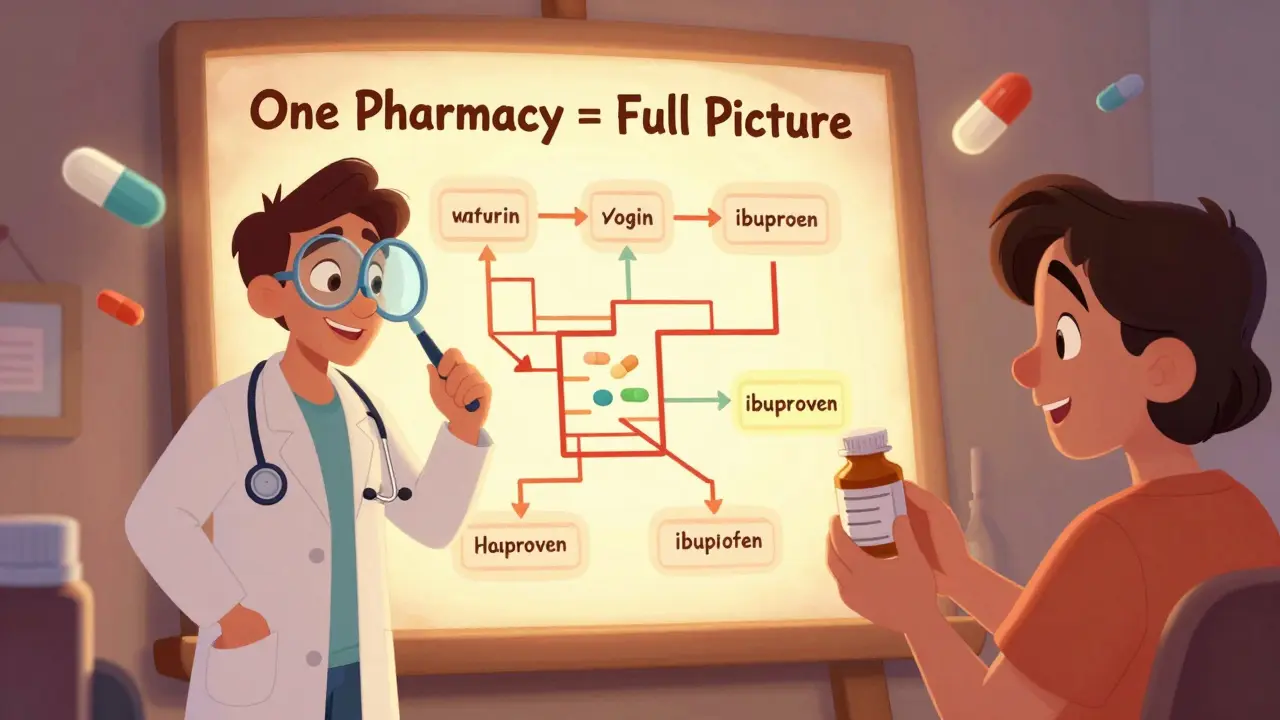
When you take multiple medications, your pharmacist is the one person who can see the full picture. But if you’re filling prescriptions at different pharmacies, that picture is broken. You might get warfarin from one place and ibuprofen from another, not realizing together they raise your risk of dangerous bleeding by five times. Or you might end up taking two different pills with the same active ingredient-duplicating your dose without knowing it. This isn’t rare. In the U.S., one pharmacy use cuts therapy duplication from 7% down to just 0.3%. That’s not a suggestion-it’s a safety net.
Why One Pharmacy Matters More Than You Think
Most people don’t think about their pharmacy the way they think about their doctor. But pharmacists aren’t just people who hand out pills. They’re trained to spot hidden dangers in your medication list. When you use a single pharmacy, that pharmacist sees every prescription you’ve ever filled there. They know what you’re taking, when you’re taking it, and whether something could go wrong. The system works because modern pharmacy software checks every new prescription against your full history-over 10,000 possible drug interactions at once. But here’s the catch: if you use multiple pharmacies, that software only sees part of your list. One pharmacy might flag a risky combo, but if another pharmacy doesn’t have the full picture, they’ll still fill it. That’s why patients using multiple pharmacies have a 34% higher chance of a dangerous drug interaction, according to a 2014 study in the Journal of Managed Care & Specialty Pharmacy.How Medication Synchronization Keeps You Safe
One pharmacy doesn’t just mean fewer places to visit. It means your meds can be synced. Medication synchronization, or "med sync," is a program where all your prescriptions are aligned to refill on the same day each month. It’s not magic-it’s a four-step process:- You sign up for the program during a visit to your pharmacy.
- The pharmacist reviews every medication you take, including over-the-counter drugs and supplements.
- They give you short-term refills to get all your pills on the same schedule.
- From then on, you pick everything up on one day-usually the same day each month.
The Hidden Dangers of Using Multiple Pharmacies
It’s tempting to shop around for the best price. One pharmacy might have your blood pressure pill for $10, another your diabetes med for $5. But that savings can cost you more in the long run. A 2022 study from the Agency for Healthcare Research and Quality found that fragmented pharmacy use leads to an estimated $29 billion in preventable hospital costs every year. Why? Because when prescriptions are split, pharmacists can’t catch:- Drug interactions-like mixing antidepressants and migraine meds that trigger serotonin syndrome.
- Therapy duplication-two different pills with the same ingredient, like taking both Tylenol and a cold medicine that also contains acetaminophen.
- Missing critical alerts-pharmacists override 80% of interaction warnings when they don’t have your full history.

What You Should Do Right Now
You don’t need to wait for a crisis to act. Here’s how to consolidate safely:- Make a complete list of everything you take: prescriptions, OTC meds, vitamins, herbal supplements-even the ones you only use occasionally.
- Call your current pharmacy and ask if they offer medication synchronization. Most do.
- Ask them to transfer all your prescriptions from other pharmacies. It usually takes 2-5 business days.
- Set up a monthly pickup day. Mark it on your calendar. Set a phone reminder.
- Bring your list to every appointment-even if you think it’s up to date. Changes happen fast.
What Experts Say
Dr. Amit Kakar, a pharmacist in the HI-Desert region, says: “All prescriptions are monitored. That’s how we prevent duplicate medication.” That’s the core of it. A single pharmacy doesn’t just track your pills-it protects you. The University of Southern California’s Polypharmacy Research Group found that 15% of U.S. adults take five or more medications. For those people, using multiple pharmacies isn’t a cost-saving trick-it’s a gamble. Their research shows that consistent use of one pharmacy improves adherence and reduces hospitalizations by up to 27%. Diabetes Care Community’s 2022 analysis lists five clear reasons why people with chronic conditions should stick to one pharmacy:- Protection from dangerous drug interactions
- Elimination of therapy duplication
- Access to combination pills that reduce pill burden
- Coordinated refill schedules
- Personalized advice from a pharmacist who knows your history
What’s Changing in 2026
The system is catching up. In 2023, pharmacy quality standards began requiring comprehensive medication reviews as a performance metric. In 2024, CMS started offering financial incentives to pharmacies that hit 90%+ med sync rates. And in 2025, USC is launching a new AI tool that will analyze medication combinations for both risks and benefits-not just flagging interactions, but suggesting safer alternatives. But technology alone won’t fix this. The biggest barrier isn’t software-it’s habit. Sixty-one percent of patients still use multiple pharmacies, mostly because they think they’re saving money. But the data shows otherwise. For every $150 saved by switching pharmacies, patients risk $8,750 in avoidable hospital costs, according to AHRQ.Final Thought: Your Pharmacy Is Your Safety Partner
Your pharmacist isn’t just there to fill prescriptions. They’re your last line of defense against dangerous mistakes. When you use one pharmacy, you’re not just simplifying your life-you’re giving them the full story. And with that story, they can protect you.Don’t wait for a warning sign. Start today. Gather your list. Call your pharmacy. Ask about med sync. It’s the simplest, most effective safety step most people never take.
Can I still save money if I use only one pharmacy?
Yes. Many pharmacies now match competitor prices, especially for common medications. Ask your pharmacist to check if they can beat the price you’re paying elsewhere. Some even offer discount programs for patients on multiple prescriptions. The savings might be smaller than hopping between pharmacies, but the safety benefit is huge.
What if my doctor prescribes something new? Will my pharmacy still catch the interaction?
If you use one pharmacy, they’ll see the new prescription and run it against your full history automatically. The software flags potential interactions in real time. But you still need to tell your pharmacist about any over-the-counter meds, supplements, or herbal products you’re taking-those aren’t always in the system.
How long does it take to switch to one pharmacy?
Transferring prescriptions usually takes 2-5 business days. The full sync process-getting all your meds on the same refill day-can take 2-4 weeks. That’s because your pharmacist may need to give you short-term refills to align your schedules. It’s worth the wait.
Do I need to tell my doctor I’m switching to one pharmacy?
Not directly, but it helps. Let your doctor know you’re consolidating your prescriptions. They can coordinate with your pharmacist to make sure your treatment plan stays aligned. Some doctors now ask patients during visits: "Do you use one pharmacy?"-because they know it improves safety.
Is this only for people on many medications?
No. Even if you take just two or three prescriptions, you can still be at risk for dangerous interactions. Warfarin and ibuprofen, for example, are common prescriptions that can cause serious bleeding when combined. You don’t need to be on five drugs to benefit from one pharmacy. If you take any meds regularly, it’s a smart move.
Nat Young
January 15, 2026
Yeah right, like pharmacists are some kind of magic safety wizards. I’ve been to three different pharmacies in the last year and I’ve never had a problem. They all just scan the barcode and hand you the bottle. If your meds are dangerous, maybe you shouldn’t be taking them at all.
Niki Van den Bossche
January 16, 2026
Oh, how quaint-the modern pharmakon as a sacred altar of compliance. We’ve fetishized the pill, the algorithm, the pharmacist’s gaze as the sole arbiter of bodily integrity. But tell me, does the one-pharmacy dogma also require you to worship at the altar of CVS’s loyalty points? Are we not, in truth, trading autonomy for the illusion of safety? The body is not a database. The soul does not sync.
Diane Hendriks
January 17, 2026
Let’s be clear: this isn’t about convenience. It’s about national responsibility. Americans have been conditioned to treat healthcare like a shopping mall-price shop, switch vendors, treat prescriptions like coupons. That’s not freedom. That’s negligence. The data is irrefutable. Fragmented pharmacy use is a public health failure. And if you’re too lazy to consolidate your meds, you’re not just risking your life-you’re costing every taxpayer $29 billion a year. Stop being a burden.
ellen adamina
January 19, 2026
I switched to one pharmacy last year after my mom had a bad reaction from mixing two OTC cold meds. I didn’t even know she was taking both. Now I get everything on the same day. It’s so much easier. I just wish more people knew this was an option.
Gloria Montero Puertas
January 19, 2026
Oh, please. You’re telling me that a pharmacist, who barely spends 90 seconds with you, magically knows your entire medical history? And you believe this because…? The software? The software is trained on biased datasets, outdated interaction databases, and corporate formularies. You’re not safer-you’re just more compliant. And compliance is what Big Pharma wants. Don’t confuse convenience with care.
Tom Doan
January 20, 2026
Let’s not pretend this is a revelation. The entire premise rests on the assumption that pharmacists are actively engaged in comprehensive medication reviews-which, in most retail settings, they are not. The software flags interactions, yes-but 80% of those warnings are overridden because the pharmacist is rushed, understaffed, and incentivized to move the next customer. This isn’t safety. It’s theater. And the ‘med sync’ program? It’s just a loyalty program with a medical veneer.
Nicholas Urmaza
January 22, 2026
If you’re taking more than two meds you’re already playing Russian roulette with your body. One pharmacy isn’t a suggestion-it’s your only shot at staying alive. Stop overthinking it. Call your pharmacy. Ask for med sync. Do it today. Your future self will thank you. No excuses. No delays. Just action.
Sarah Mailloux
January 22, 2026
I used to think this was overkill until my dad got hospitalized for mixing his blood thinner with a new OTC painkiller. He didn’t even know it was in there. Now we use one pharmacy, everything’s synced, and he actually remembers to take his meds. It’s not perfect, but it’s way better than before. Seriously, if you’re on any meds, just try it. It’s free. And your pharmacist will probably love you for it.