

How Air Pollution Makes Asthma Worse
Every year, millions of people with asthma face flare-ups not because of colds or stress, but because of the air they breathe. Outdoor pollution-especially tiny particles called PM2.5, nitrogen dioxide from traffic, and ground-level ozone-directly irritates the lungs. These pollutants don’t just cause coughing or wheezing; they trigger inflammation that can last for days. For someone with asthma, this means more rescue inhaler use, more missed work or school, and sometimes trips to the emergency room.
A 2024 study published in PubMed found that when air pollution dropped during pandemic lockdowns, asthma patients saw a clear improvement: their Asthma Control Test (ACT) scores jumped from an average of 17.3 to 19.7. That’s not a small change-it means fewer nighttime symptoms, less reliance on medication, and better daily function. In cities with high traffic, children living within 200 feet of a major road are up to 30% more likely to develop asthma than those living farther away.
It’s not just outdoor air. Indoor air can be just as bad. Cooking with gas stoves releases nitrogen dioxide. Dust mites and mold thrive in humid homes. Even cleaning products can release volatile organic compounds that trigger attacks. For people with asthma, the air inside their homes isn’t always safe.
Check the Air Quality Index (AQI) Before You Go Outside
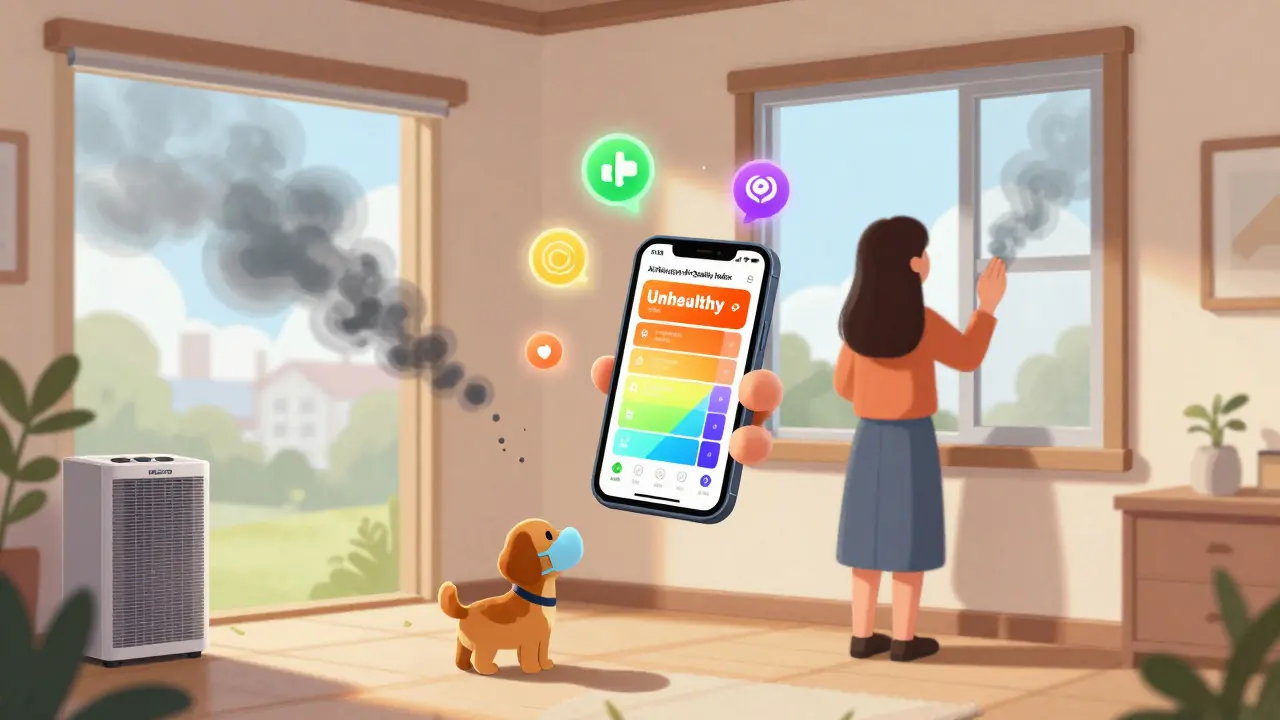
You don’t need a fancy app to know when it’s unsafe to be outside. The U.S. Environmental Protection Agency’s AirNow.gov website gives real-time air quality data for every county in the country. The Air Quality Index (AQI) uses colors and numbers to show how clean or dirty the air is.
- AQI 0-50 (Green): Good air. Safe for everyone.
- AQI 51-100 (Yellow): Moderate. People with asthma should limit long or heavy outdoor activity, especially during peak pollution hours (afternoon to early evening).
- AQI 101-150 (Orange): Unhealthy for sensitive groups. All asthma patients should reduce outdoor time. Avoid exercise outdoors.
- AQI 151-200 (Red): Unhealthy. Everyone should avoid prolonged outdoor exposure. Asthma patients should stay indoors.
- AQI 201+ (Purple): Very unhealthy to hazardous. No outdoor activity. Close windows and run air purifiers.
Many free apps-like AirVisual, Plume Labs, or the EPA’s own AirNow app-send alerts when pollution spikes. One user in Edmonton told me she started getting push notifications every morning. Within six months, her daughter’s inhaler use dropped by 45%. It’s simple, but it works.
Use HEPA Filters to Clean Indoor Air
If you’re spending 90% of your time indoors, your home should be a refuge-not a trigger zone. High-Efficiency Particulate Air (HEPA) filters are the gold standard for removing airborne particles. A true HEPA filter captures 99.97% of particles as small as 0.3 microns, which includes smoke, dust, pollen, and PM2.5.
For whole-home protection, install a HVAC filter with a MERV rating of 13-16. These are stronger than standard filters and can be retrofitted into most central systems. For a single room, choose a portable air purifier with a Clean Air Delivery Rate (CADR) that matches your room size. For a 300-square-foot bedroom, look for a CADR of at least 200. That means it can clean the air in that room about twice an hour.
Studies show HEPA filters can reduce indoor PM2.5 levels by 55-67%. One Johns Hopkins study tracked homes with and without purifiers during wildfire season. The homes with HEPA filters had nearly half the particle count inside. But here’s the catch: filters only work if you replace them. Consumer Reports found that only 43% of people change their HEPA filters on time. Set a reminder every three to six months. And don’t place it against the wall-keep it at least a foot away from furniture or corners so air can flow freely.
Reduce Exposure at School and Work
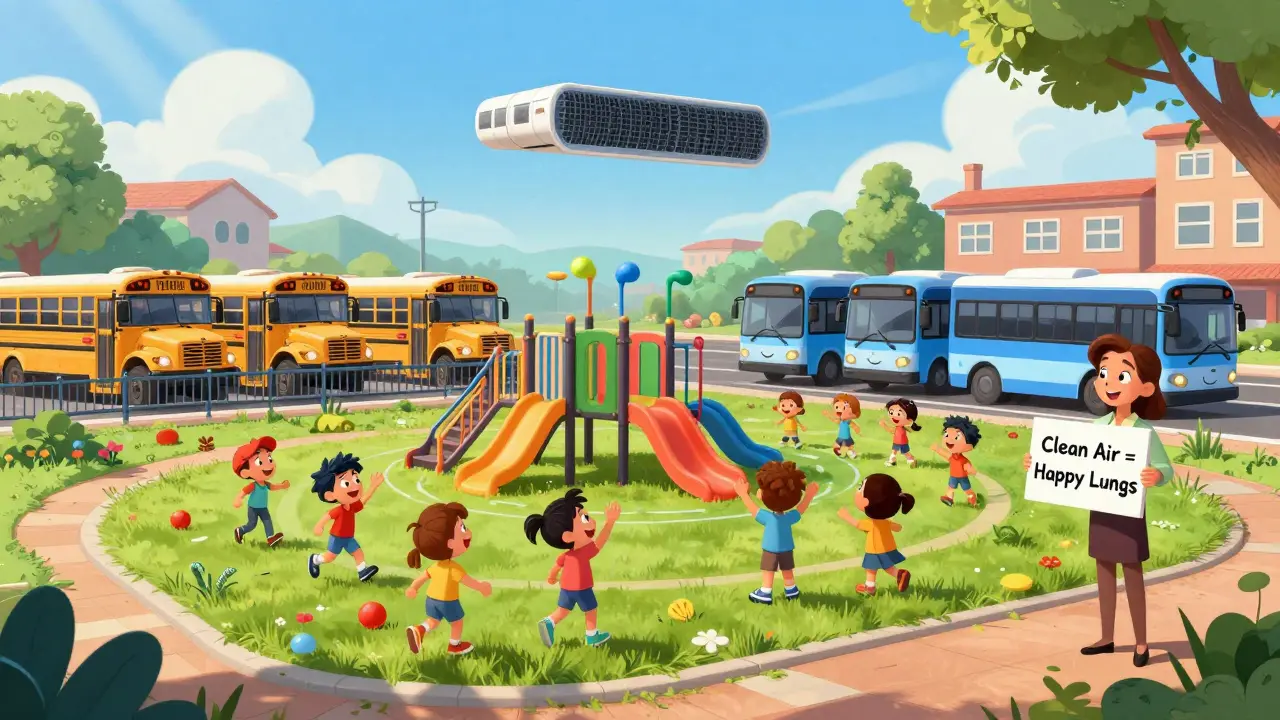
Children with asthma spend hours at school. Many schools sit right next to busy roads, where diesel fumes from buses and cars build up. In Massachusetts, schools that moved playgrounds away from roadways and banned bus idling saw a 22-35% drop in indoor PM2.5 levels. Fewer kids missed school because of asthma.
Workplaces matter too. If you’re in construction, delivery, or outdoor labor, you can’t just stay inside. But you can ask your employer for solutions: relocate break areas away from traffic, install portable HEPA units in break rooms, or provide N95 masks during high-pollution days. The CDC says N95s block 95% of particles-but only if they fit right. A loose mask gives false confidence. For kids, masks are often ineffective because they don’t seal properly.
Employers are starting to pay attention. The Occupational Safety and Health Administration (OSHA) encourages indoor humidity control between 30-50% to reduce mold and dust mites. A simple dehumidifier can cost $100-$300 a year to run but can cut down on triggers significantly.
What Doesn’t Work (And Why)
Not every solution is as effective as it sounds. Many people buy air purifiers, wear masks, or close windows thinking they’re protected-but they’re not doing it right.
Ionizers and ozone generators sound high-tech, but they release ozone, which is itself a lung irritant. The American Lung Association warns against them.
Houseplants won’t clean the air enough to help asthma. A NASA study showed they remove tiny amounts of VOCs, but you’d need hundreds of plants in a small room to make a difference. Not practical.
Open windows during rain might feel refreshing, but rain doesn’t wash away PM2.5-it can even stir it up. And pollen counts often spike after rain, which can trigger asthma too.
Relying on N95 masks daily isn’t sustainable. They’re uncomfortable, expensive ($1-$3 each), and hard to wear for long periods, especially for kids. They’re best for short, high-exposure moments-like walking through smoke or during a wildfire event.
Policy Changes Are Making a Real Difference
Individual actions help, but they can’t fix bad air alone. That’s where policy comes in.
The EPA’s current standard for annual PM2.5 is 12 μg/m³. But the American Thoracic Society says it should be 8 μg/m³ to truly protect asthmatics. In January 2024, the EPA proposed tightening it to 9-10 μg/m³. That’s progress, but not enough.
Meanwhile, cities are acting. Over 47 U.S. cities now require new schools to be built at least 500 feet from major highways. California is replacing all its diesel school buses with electric ones by 2035. Early results show a 60% drop in children’s exposure to traffic pollution.
London’s Ultra Low Emission Zone cut childhood asthma hospitalizations by nearly 12% in two years. In Los Angeles, switching school buses to electric reduced indoor PM2.5 levels in nearby schools by 35%. These aren’t just environmental wins-they’re public health wins.
And it’s getting smarter. The NIH is funding projects that link air quality data directly to electronic health records. Imagine your doctor seeing your asthma flare-ups spike every time pollution rises-and automatically adjusting your treatment plan.
What You Can Do Right Now
You don’t need to wait for government action to feel better. Start with three simple steps:
- Check your local AQI every morning. Make it part of your routine, like checking the weather.
- Get a HEPA air purifier for your bedroom or main living area. Look for a CADR rating that matches your room size.
- Advocate at your child’s school. Ask if they have anti-idling policies or if playgrounds are near roads. If not, push for change.
One survey found that 68% of asthma patients check air quality-but only 32% change their behavior. The gap isn’t ignorance. It’s logistics. You can’t always stay inside if you work outside. You can’t always afford a $700 purifier. But you can start small. Close windows on bad days. Use your car’s recirculation mode. Avoid running the gas stove with the hood off.
Every small change adds up. The goal isn’t perfection-it’s reduction. Less exposure means fewer attacks. Fewer attacks mean better sleep, better school, better work, and better life.
How Much Does It Cost?
Not all solutions are expensive.
- A basic HEPA air purifier: $100-$300
- A high-end model (like Coway Airmega 400): $500-$800
- Replacement filters (every 3-6 months): $20-$100
- N95 masks (for emergencies): $1-$3 each
- Dehumidifier (for humidity control): $100-$300 upfront, $50-$150/year to run
- HEPA HVAC filter upgrade: $50-$150 per filter (replace 2-4 times a year)
Compare that to the cost of an ER visit for an asthma attack-often $2,000-$5,000. Or the lost wages from missing work. Prevention pays for itself.
When to Talk to Your Doctor
If you’re using your rescue inhaler more than twice a week (not counting exercise), your asthma isn’t well controlled. That’s a red flag. Tell your doctor about your exposure to pollution. Ask about:
- Adjusting your controller medication during high-pollution seasons
- Getting an asthma action plan that includes pollution triggers
- Referrals to asthma educators who can help you build a personalized exposure-reduction plan
Studies show that patients who work with asthma educators for 90 minutes or more see better outcomes than those who don’t. It’s not just about medication-it’s about environment.
Can air pollution cause asthma in people who never had it before?
Yes. Research from The Lancet Planetary Health in 2019 found that air pollution contributes to about 4 million new pediatric asthma cases each year worldwide. Children exposed to high levels of NO2 and PM2.5-especially near busy roads-are more likely to develop asthma, even if they have no family history of the disease.
Do air purifiers really help with asthma?
Yes, when used correctly. HEPA filters reduce indoor PM2.5 levels by 55-67%, according to Johns Hopkins research. This leads to fewer nighttime symptoms, less inhaler use, and fewer asthma attacks. But they only work if you choose the right size for your room, place them correctly, and replace filters on schedule.
Is it safe to exercise outside if I have asthma?
It depends on the Air Quality Index. At AQI 51-100, limit prolonged or intense activity. At AQI 101+, avoid outdoor exercise entirely. Morning hours often have lower ozone levels than afternoons. Indoor gyms with good ventilation are a safer option on bad air days.
What’s the best way to protect my child with asthma from pollution?
Start with a HEPA air purifier in their bedroom. Check the AQI daily and keep them indoors on high-pollution days. Ask their school if they have anti-idling policies and if playgrounds are located away from roads. Avoid gas stoves in the kitchen. And never rely on N95 masks for daily use-children often wear them incorrectly, making them ineffective.
Will moving to a less polluted city help my asthma?
For many people, yes. Studies show asthma symptoms improve when people move from high-pollution urban areas to cleaner regions. But moving isn’t always possible. The good news is that even small changes-like using a HEPA filter, avoiding idling cars near your home, or closing windows during wildfire season-can significantly reduce your exposure and improve control, no matter where you live.
pragya mishra
January 20, 2026
This is such common sense it's embarrassing we need a guide. HEPA filters? Check AQI? Stop using gas stoves? My grandma did this in 1978. We didn't need studies to know dirty air makes you sick. But now everyone acts like it's revolutionary.
Manoj Kumar Billigunta
January 21, 2026
I live in Delhi and this is my daily life. I use a $120 Xiaomi purifier in my bedroom. Changed my filter last month. My daughter hasn't had an attack in 4 months. Not magic. Just science. Also, avoid walking near traffic at 7am and 7pm. Those are the worst hours. Simple. Cheap. Works.
sagar sanadi
January 23, 2026
Oh wow. So the government is lying about air quality again? And these 'HEPA filters' are just a scam to sell overpriced boxes? Next they'll tell us oxygen is good for lungs. I've seen the data. The EPA and WHO are in bed with filter companies. Real clean air? That's a myth. Just stop breathing.
Andy Thompson
January 23, 2026
I don't trust any of this. Why do I need a purifier? I'm an American. We breathe clean air. This is just woke climate propaganda. My kid uses an inhaler once a year and he's fine. They're just trying to scare you so you buy more stuff. Also, EV buses? More taxes. No thanks.
Edith Brederode
January 23, 2026
I just got my first HEPA purifier after reading this 🙌 My asthma has been wild lately and I didn't realize how much my kitchen stove was messing with me. I'm switching to induction next month. Also, I set a reminder for filter changes - finally! 🤗
Crystal August
January 24, 2026
I've been using an ionizer for years because it's 'high tech' and looks cool. So you're saying I've been poisoning my family? That's disgusting. I'm throwing it out today. And I'm calling my kid's school to ask why their playground is next to the highway. This is negligence.
Art Gar
January 25, 2026
The empirical data presented herein is methodologically sound and aligns with contemporary epidemiological findings. However, the prescriptive recommendations lack sufficient nuance regarding socioeconomic disparities in access to HEPA filtration systems. One cannot reasonably expect a single-parent household earning minimum wage to allocate $700 toward an air purifier when food and rent are prioritized. Policy intervention, not individual mitigation, is the only ethically defensible solution.
Nadia Watson
January 26, 2026
i just rea dthis and wow. i had no idea rain could make pm2.5 worse. i always open my windo ws after it rains becuz it smells so good. guess i need to stop. also, my filter is 8 months old… oops. gonna order a new one tonite. thanks for the nudge.
Renee Stringer
January 26, 2026
I’ve been using a $25 filter from Amazon for two years. I never changed it. I didn’t think it mattered. I guess I was wrong.