
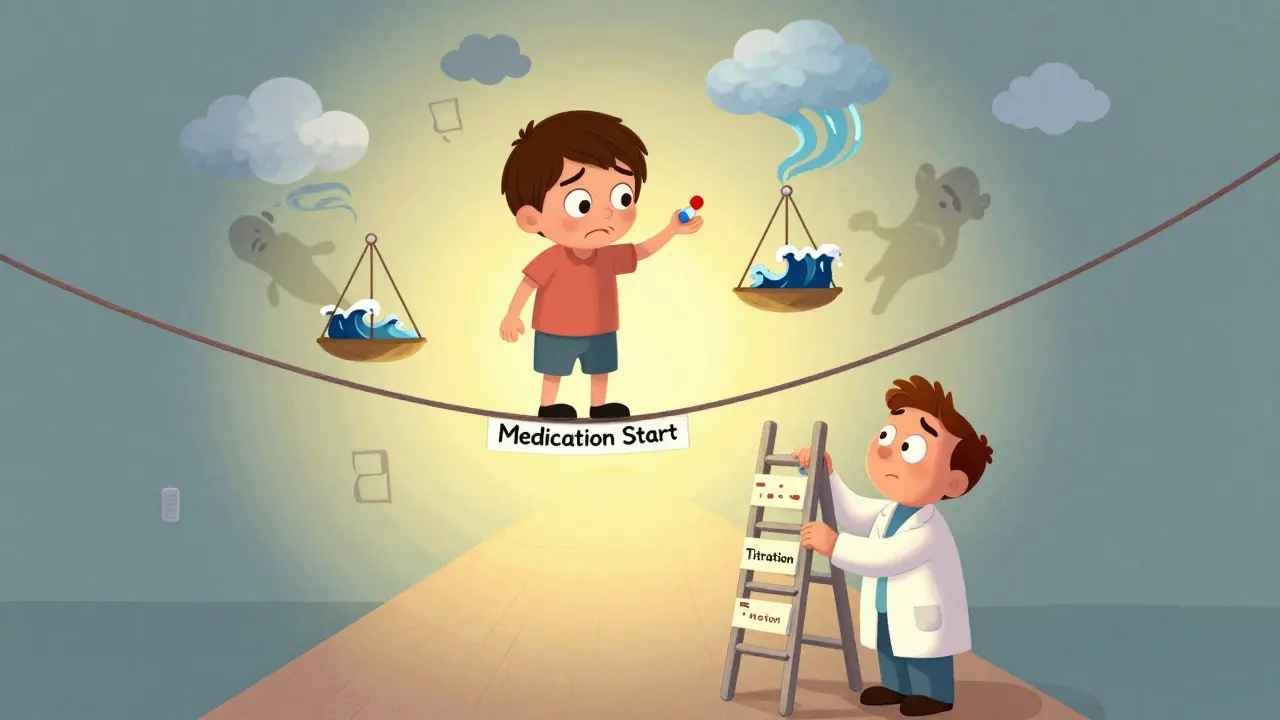
Starting a new medication can feel like walking a tightrope. You want relief from your symptoms, but you’re terrified of the side effects. What if the first dose makes you dizzy? What if it gives you nausea so bad you quit? What if you never find the right balance? This isn’t just anxiety-it’s a real problem millions face every year. The good news? There’s a proven way to avoid most of these pitfalls: dose titration.
What Is Dose Titration, Really?
Dose titration is the slow, careful process of adjusting your medication dose to find the sweet spot: enough to work, but not so much that it hurts you. It’s not guessing. It’s not rushing. It’s science with a human touch. For medications with a narrow therapeutic index-where the difference between a helpful dose and a harmful one is small-titration isn’t optional. It’s standard care.Think of it like tuning a guitar. You don’t crank the string to its max and hope it sounds right. You turn it a little, listen, adjust again. That’s exactly what doctors do with your meds. Start low. Go slow. Watch what happens. Adjust. Repeat.
According to the American Medical Association, 87% of prescription drugs that require precise dosing now come with official titration guidelines from the FDA. That includes everything from antidepressants and ADHD meds to heart drugs and cancer treatments. If your doctor didn’t start you on a low dose and slowly build up, they might be skipping a critical safety step.
How Titration Works: Up-Titration and Down-Titration
There are two main paths in titration: up-titration and down-titration.Up-titration means slowly increasing your dose. This is the most common approach. For example, stimulant ADHD medications like Adderall or Vyvanse usually start at 5-10 mg per day. After a week or two, if you’re tolerating it well, your doctor might bump it up by 5 mg. This continues every 3-7 days until you hit the dose that controls your symptoms without causing jitteriness, insomnia, or appetite loss.
Non-stimulants like atomoxetine take longer-often 8 to 12 weeks-because they build up in your system slowly. Skipping ahead to the full dose? That’s how people end up in the ER with high blood pressure or severe nausea.
Down-titration is the reverse. It’s used when you’re on too high a dose and the side effects are worse than the symptoms. Maybe you’ve been on 30 mg of fluoxetine for a year and now you’re exhausted, emotionally flat, or gaining weight. Your doctor might drop you by 5 mg every 2-4 weeks until you find a lower dose that still works. This isn’t quitting-it’s optimizing.
Some drugs have very specific schedules. Venetoclax, used for leukemia, follows a 5-week ramp-up: 20 mg, then 50 mg, then 100 mg, then 200 mg, then 400 mg. Why? To prevent tumor lysis syndrome-a dangerous drop in electrolytes that can cause heart rhythm problems. Lamotrigine, an epilepsy and mood stabilizer, takes 5 weeks to reach full dose because a sudden jump can trigger Stevens-Johnson syndrome, a life-threatening skin reaction. These aren’t suggestions. They’re safety rules built into the drug’s approval.
Why Titration Reduces Side Effects by 40-60%
A 2021 meta-analysis in the Journal of Clinical Psychopharmacology found that proper titration cuts initial side effects by 40-60%. That’s not a small number. That’s the difference between staying on your medication and quitting because you felt awful.Take ADHD meds. In a survey of 1,200 patients by ADDitude Magazine, 74% who followed a slow titration plan reported manageable side effects. Only 41% of those who started at the full dose did. One Reddit user wrote: “Starting at 5 mg Adderall instead of 10 mg saved me from horrible anxiety. I’m still on it two years later.” Another said: “My doctor started me at 20 mg. I couldn’t sleep, lost 15 pounds, and quit for two years.”
The same pattern shows up with antidepressants. SSRIs like sertraline or escitalopram often cause nausea, headaches, or sexual side effects at first. Starting at 10 mg instead of 50 mg gives your body time to adjust. Beta-blockers for heart failure follow the same rule. The American Heart Association found that gradual up-titration cut dropout rates due to side effects from 45% down to 18%.
It’s not magic. It’s biology. Your brain and body need time to adapt. Rushing the dose? You’re forcing them to react all at once.

What Medications Need Titration the Most?
Not all drugs need it. But the ones that do are often the most important-and the most dangerous if mismanaged.- ADHD medications (methylphenidate, amphetamines): 78% of patients need dose changes during initial titration.
- Antidepressants (SSRIs, SNRIs): Side effects peak in the first 2 weeks; titration reduces dropout rates.
- Anticonvulsants (lamotrigine, perampanel): Risk of severe skin or neurological reactions without slow ramp-up.
- Anticoagulants (warfarin): Requires weekly INR blood tests and daily dose tweaks. Newer drugs like apixaban don’t need this-because they’re designed to be more forgiving.
- Thyroid meds (levothyroxine): Starting at 25-50 mcg and increasing every 4-6 weeks prevents heart palpitations or bone loss.
- Cancer drugs (venetoclax, rituximab): Titration schedules are legally required to prevent life-threatening reactions.
Warfarin is a classic example. In the first month, 67% of patients need a dose change. For apixaban? Only 28%. Why? Warfarin’s therapeutic window is razor-thin. Too little? You clot. Too much? You bleed. Titration isn’t just helpful-it’s the only way to stay alive on it.
What You Can Do: The Patient’s Role in Titration
You’re not just a passive recipient of doses. You’re a key part of the process.Keep a side effect journal. Write down how you feel each day. Rate symptoms like fatigue, nausea, or anxiety on a scale of 1-10. Note the time you took your med and what you ate. A 2023 Healthgrades review found that 78% of patients who used a journal had better outcomes. Your doctor can’t read your mind-but they can read your notes.
Stick to timing. Take your med at the same time every day. Even a 2-hour shift can throw off how your body processes it, especially with slow-release formulations like Vyvanse or extended-release metformin.
Wait before blaming the drug. Side effects often fade after 7-14 days. Feeling dizzy on day 3? Maybe it’s just your body adjusting. But if it’s still there on day 14? That’s a signal to call your doctor. A 2021 BMC Psychiatry study found that 58% of patients couldn’t tell if their symptoms were from the drug or just stress or lack of sleep.
Ask for the titration plan in writing. Many manufacturers, like the makers of Vyvanse, provide 12-page titration guides. Generic drugs? Sometimes nothing. Don’t assume your doctor remembers the protocol. Print it out. Bring it to your appointment.
The Hidden Challenge: Time and Adherence
Titration takes time. Four to twelve weeks. That’s longer than most people expect. And that’s where it falls apart.A 2021 study in the Journal of Clinical Pharmacy and Therapeutics found that 32% of patients don’t follow their titration schedule. Why? They get impatient. They feel fine after a week and think, “Why not just double the dose?” Or they miss a doctor’s appointment and don’t know what to do next.
That’s why structured support matters. In hospitals, 94% have standardized titration protocols. In private clinics? Only 68% of doctors follow them consistently. If your doctor doesn’t schedule follow-ups every 1-2 weeks during titration, ask why.
There’s also a cost. Warfarin needs weekly blood tests. Some titration protocols require lab work every few weeks. In low-income countries, the WHO reports only 22% have access to these monitoring tools. In Canada and the U.S., access is better-but still not universal. If cost is a barrier, talk to your pharmacist. Some labs offer discounted panels for titration monitoring.

What’s New in Titration: AI and Genetics
The field is evolving fast. In January 2023, the FDA cleared the first AI-powered titration app: TitrationTracker. It asks you daily questions-“How’s your sleep?” “Any dizziness?”-and uses your answers to suggest dose changes. A 2023 study in Nature Digital Medicine showed it reduced side effects by 32% compared to standard care.Even more promising? Pharmacogenetic testing. Your genes affect how you metabolize drugs. For 28 medications-including antidepressants, blood thinners, and painkillers-you can now get a DNA test that tells your doctor your ideal starting dose. By 2025, 12 more drugs will get official genetic dosing guidelines. By 2030, experts predict 75% of high-risk meds will be dosed this way.
This isn’t sci-fi. It’s the future of safe prescribing.
When Titration Isn’t the Answer
Titration isn’t a cure-all. It doesn’t work in emergencies. If you’re having a heart attack, a seizure, or an allergic reaction, you need the full dose now-not a slow ramp-up. In those cases, speed saves lives.It also doesn’t work well if you’re in severe depression or psychosis and need rapid relief. Dr. Alan F. Schatzberg, former president of the American Psychiatric Association, warns that overly slow titration can delay recovery in severe cases. Sometimes, a higher starting dose with close monitoring is safer than waiting weeks to feel better.
The key? Context. Your doctor should explain why they’re choosing titration-and when they might not.
Final Thought: It’s Not About Speed. It’s About Safety.
The goal isn’t to get to the right dose as fast as possible. It’s to get there without wrecking your body in the process. Side effects aren’t just annoying-they’re dangerous. They lead to hospitalizations. They make people quit life-changing meds. They cause long-term harm.Titration is the bridge between getting better and staying well. It’s not glamorous. It’s not quick. But it’s the most reliable way we have to make powerful drugs safer. If your doctor skips it, ask why. If you’re on a new med and feel terrible after the first dose? Don’t quit. Call your provider. You might just be one small dose adjustment away from feeling like yourself again.
Aurora Daisy
December 25, 2025
Oh wow, finally someone wrote an article that doesn’t sound like a pharmaceutical ad. Who knew slow dosing was a thing? Guess my doctor skipped that chapter when they shoved 20mg of Adderall at me like it was a candy.
Turns out, I didn’t need to be a human taser to feel ‘focused.’
Paula Villete
December 27, 2025
It’s wild how we’ve turned medical science into a game of ‘guess how fast your liver can die.’
Start low, go slow - sounds like common sense, right? But apparently, common sense is a controlled substance in 73% of primary care offices.
Also, typo: ‘dose titration’ is not ‘dose titration’ - but I’ll let that slide because this is the most useful thing I’ve read all week.
Thank you for not saying ‘just trust your doctor.’ I don’t.
And yes, I kept a journal. It had 14 entries before I realized my ‘anxiety’ was just the 50mg sertraline screaming inside my skull.
Georgia Brach
December 28, 2025
The claim that titration reduces side effects by 40–60% is methodologically unsound. The meta-analysis cited conflates patient-reported outcomes with clinically significant adverse events. No control group accounted for placebo effects or regression to the mean. Additionally, the ADDitude Magazine survey is non-randomized and self-selected. This article reads like a marketing whitepaper disguised as clinical guidance.
Furthermore, the assertion that ‘titration isn’t optional’ contradicts current off-label prescribing norms and real-world pharmacovigilance data from the FDA’s FAERS database.
Correlation is not causation - and this article confuses both.
suhani mathur
December 28, 2025
As a pharmacist in Mumbai, I’ve seen people skip titration because they think ‘more is better.’ One guy took 3x the starting dose of lamotrigine because his cousin said it ‘works faster.’ Ended up in the ER with a rash that looked like a burnt map.
Titration isn’t just science - it’s survival. And yes, your doctor should give you the schedule in writing. If they don’t? Ask for it. Again. And again.
Also - yes, journaling works. I’ve seen patients who couldn’t tell if they were depressed or just tired… until they wrote it down. Then they realized: ‘Oh. I’ve been sleeping 12 hours a day for two weeks.’
Don’t be that person who blames the drug. Be the person who tracks it.
Chris Buchanan
December 29, 2025
Y’all are making this sound like rocket science. It’s not. It’s called ‘listening to your body.’
My therapist told me to start at 10mg of Lexapro. I did. Day 3: nausea. Day 7: still nauseous. Day 10: still nauseous. Called my doc. Cut to 5mg. Day 14: felt like me again.
That’s it. No magic. No conspiracy. Just patience.
Also - if your doctor doesn’t schedule a follow-up in two weeks? Fire them. Or at least ask why they think you’re a lab rat.
Raja P
December 30, 2025
Man, I wish I read this before I quit my antidepressant because I felt ‘weird’ on day 2. Now I’m back on it, starting at 5mg. Took me 3 months to get to 20mg. But now? I sleep. I laugh. I don’t cry over coffee.
Also, my doctor gave me a paper schedule. I laminated it. No joke.
Thanks for writing this. I’m sharing it with my cousin who’s about to start on something similar.
Austin LeBlanc
January 1, 2026
So you’re telling me the reason people quit meds isn’t because they’re useless - it’s because their doctors are lazy? Wow. Groundbreaking.
Also, ‘journaling’? You mean writing down how you feel? Like, in a notebook? Are we in 2005?
And don’t get me started on ‘pharmacogenetic testing.’ That’s just a fancy way for Big Pharma to charge you $800 for a test that says ‘you’re probably not a mutant.’
Most people just need to stop being dramatic and take the pill.
niharika hardikar
January 2, 2026
The conceptual framework underpinning dose titration is predicated upon a pharmacokinetic paradigm that assumes linear absorption and homogeneous tissue distribution - both of which are empirically untenable in heterogeneous patient populations. The cited 40–60% reduction in side effects lacks multivariate adjustment for comorbidities, polypharmacy, and CYP450 polymorphisms. Furthermore, the reliance on self-reported symptomatology introduces significant recall bias.
Moreover, the normalization of patient-led titration protocols constitutes a dangerous erosion of clinical authority. The physician, not the journal, is the arbiter of therapeutic intent.
While anecdotal testimonials are emotionally compelling, they are not evidence-based practice.
Christine Détraz
January 4, 2026
I started my anxiety med at full dose. Felt like I was being electrocuted from the inside. Quit. Got depressed. Tried again - this time, 10mg. Took three weeks to adjust. Now I’m on 20mg and I can actually go to the grocery store without crying.
It’s not about being strong. It’s about being smart.
Also - if your doctor says ‘just push through,’ they’re not helping. They’re just saving time.
Bhargav Patel
January 5, 2026
The principle of titration, as articulated herein, is an elegant embodiment of the Aristotelian golden mean - a mediating path between the extremes of therapeutic nihilism and pharmacological hubris. The human organism, as a complex adaptive system, does not respond to abrupt perturbations with equilibrium, but rather with dysregulation.
Therefore, the incremental modulation of pharmacological input constitutes not merely a clinical protocol, but a metaphysical act of respect for biological temporality.
One cannot hasten the maturation of neural receptors any more than one can hasten the blooming of a lotus - and to attempt such is to invite entropy.
Steven Mayer
January 7, 2026
Titration is a myth. I’ve been on 10 different meds. Every single time, the side effects were worse than the condition. The ‘slow ramp-up’ just prolongs the suffering. I’d rather get it over with.
Also, I don’t journal. I don’t care if my sleep is ‘poor’ on day 4. I’m tired. The drug is the problem.
And no, I won’t go back. I’ve lost years to this. I’m done.
Charles Barry
January 8, 2026
Let’s be real - titration is just Big Pharma’s way of keeping you dependent. Why? Because if you get better too fast, they lose money.
Ever wonder why lamotrigine takes 5 weeks? Because they need you to keep buying it. Same with venetoclax. The ‘life-threatening reactions’? Probably exaggerated to scare you into compliance.
And that ‘AI app’? It’s tracking your data to sell to insurers. You think they care about your sleep? They care about your premiums.
This isn’t medicine. It’s surveillance with a prescription pad.
Rosemary O'Shea
January 8, 2026
I mean, I suppose if you’re not a genius who understands pharmacodynamics, you might need a step-by-step guide. But really - if you can’t handle a 50mg dose on day one, perhaps you shouldn’t be on SSRIs at all?
And who writes a 12-page titration guide for Vyvanse? Did they think we were all children? I’ve been on this drug for 12 years. I know my body better than your algorithm.
Also, I find it offensive that you imply I need a journal to know how I feel. I am not a lab rat. I am a woman of refined sensibilities.
Ademola Madehin
January 8, 2026
Bro. I took my first dose of Zoloft at night. Woke up at 3am like I was possessed. Thought I was dying. Called my mom. She said ‘take it slow next time.’
So I did. Started at 12.5mg. Now I’m at 50mg and I don’t cry every time I hear ‘Bohemian Rhapsody.’
Also, my doctor didn’t give me a plan. I printed one from the manufacturer’s site. He was like ‘huh, smart.’
Y’all need to chill. It’s not that complicated. Just don’t be dumb.
Joseph Manuel
January 9, 2026
The meta-analysis referenced fails to control for concomitant psychotherapy, which is a significant confounding variable in outcomes related to antidepressant tolerability. Furthermore, the FDA guidelines cited are non-binding recommendations, not regulatory mandates. The assertion that titration is ‘standard care’ is overstated and misrepresents clinical heterogeneity across practice settings.
Additionally, the inclusion of anecdotal Reddit testimonials as empirical evidence constitutes a logical fallacy.
This article, while well-intentioned, lacks methodological rigor and risks promoting therapeutic misinformation.