
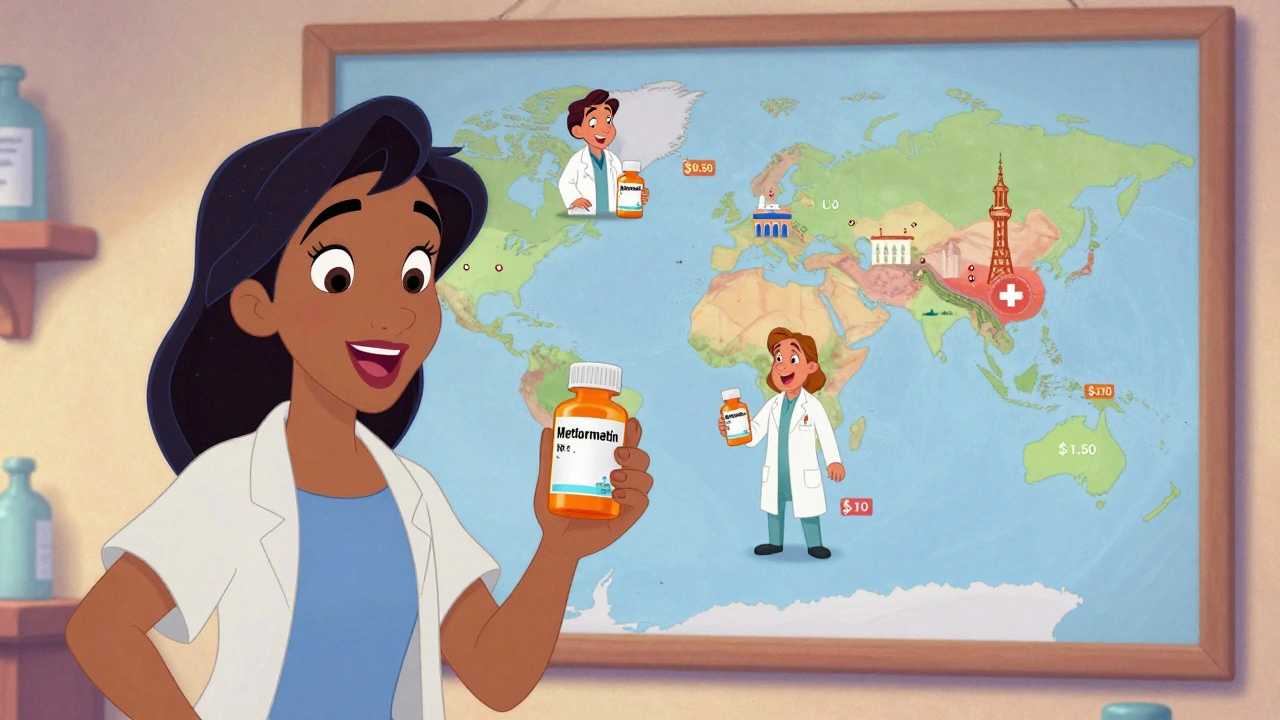
Ever bought a generic drug in the U.S. and then seen the same pill, same dose, same manufacturer, for half the price in Canada or India? It’s not a scam. It’s the reality of how generic medicines work across the globe. The same active ingredient - say, metformin for diabetes or lisinopril for high blood pressure - can be sold at wildly different prices depending on where you are. And it’s not just about cost. Sometimes, the version you get in Germany isn’t even the same as the one you get in the U.S., even if the label says it’s identical.
Why Do Generic Drugs Vary So Much Between Countries?
Generic drugs aren’t copies. They’re legally approved alternatives to brand-name drugs that contain the same active ingredient, work the same way, and meet the same safety standards. But here’s the catch: approval standards, pricing rules, and market competition differ drastically from country to country. In the U.S., nearly 90% of prescriptions are filled with generics. That sounds impressive - until you realize Americans pay more for these generics than almost any other country. In 2022, U.S. drug prices - including generics - were 2.78 times higher than in other OECD nations. Why? Because even with dozens of manufacturers making the same drug, prices don’t always drop. Some generics spike in cost overnight, even when competition is high. That’s not how markets are supposed to work. In contrast, the U.K. has mandatory generic substitution. When a brand-name drug loses its patent, pharmacists automatically switch to the cheapest generic unless the doctor says no. As a result, 83% of prescriptions in the U.K. are for generics. Germany and the Netherlands follow similar models. In Switzerland? Only 17% of prescriptions are generics. Why? Because doctors and patients still prefer the original brand, and insurers pay just as much for both.Who Makes Your Generic Drugs - And Where?
Most of the generic pills you take weren’t made in your home country. About 40% of the generic drugs consumed in the U.S. come from India. India has over 750 FDA-approved manufacturing facilities and produces roughly 20% of the world’s generic supply. It’s the pharmacy of the world - not because it’s the cheapest, but because it can make huge volumes at low cost. China is catching up fast. Its FDA-approved facilities jumped from just 12 in 2010 to 187 in 2023. But quality control remains a concern. A 2023 study from Ohio State University found that generic drugs made in India had a 54% higher rate of severe adverse events - including hospitalizations and deaths - compared to the same drugs made in the U.S. This wasn’t about the active ingredient. It was about fillers, coatings, or manufacturing conditions that affected how the drug was absorbed. The FDA inspects foreign factories, but here’s the problem: inspections are often announced in advance. That means manufacturers have time to clean up, fix issues, or hide problems. In the U.S., inspections are unannounced. So when you get a generic made in India and it causes unexpected side effects, it might not be the drug’s fault - it might be how it was made.Price Gaps Are Wild - Sometimes Over 600%
For the exact same generic drug - same dose, same manufacturer, same batch - prices can vary by more than six times across countries. Take the blood pressure drug amlodipine. In the U.S., a 30-day supply might cost $12. In the U.K., it’s $1.50. In India, it’s less than $0.50. Meanwhile, in Switzerland, the same pill can cost over $10. Why? Because Switzerland doesn’t negotiate drug prices the way other countries do. They let manufacturers set prices, and insurers pay whatever they ask. In the U.S., even though there are many generic makers, prices don’t always drop because of how insurance and pharmacy benefit managers (PBMs) work. PBMs get rebates from drugmakers, so sometimes they push more expensive generics because they make more money from them. That’s why you might see a $15 generic instead of a $3 one - even if they’re identical.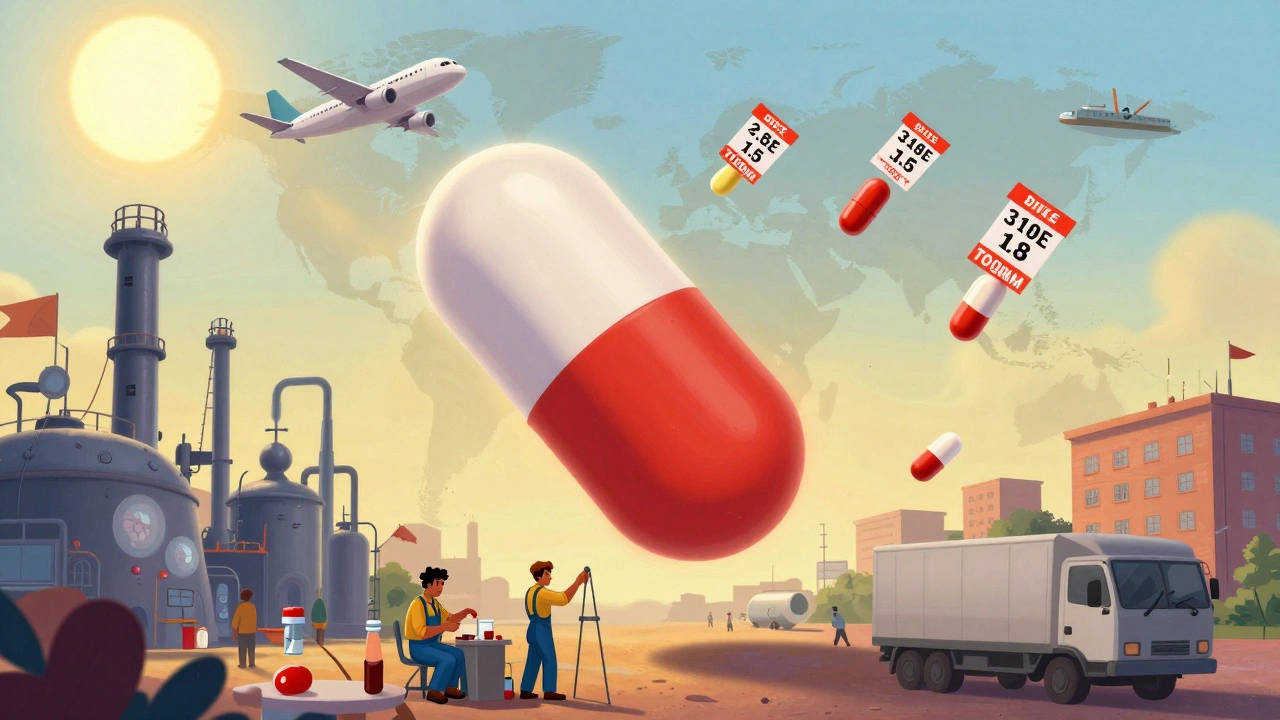
Why Some Countries Can’t Access Generic Drugs at All
It’s not just about price. In some countries, generics simply aren’t available - even if the patent has expired. In Italy and Greece, less than 20% of prescriptions are for generics. Why? Because doctors don’t prescribe them. Patients don’t ask for them. The system doesn’t reward substitution. It’s cultural, regulatory, and economic all at once. In South Korea, 92% of generic ingredients are used less than in other developed countries - even though prices are lower. Why? Because doctors and patients still trust brand names more. That’s not about quality. It’s about perception. Even when generics are available, supply chains can break. During the pandemic, India temporarily banned exports of 26 key active ingredients - including antibiotics and antifungals. That caused shortages in 22 countries. The U.S. alone had 147 generic drug shortages in 2023. Two-thirds of those were because a single factory had quality issues. One bad facility can shut down supply for millions.What’s Being Done to Fix This?
Governments are starting to act. The European Union wants 80% generic use across all member states by 2030. The U.S. Inflation Reduction Act now gives the FDA more money and faster timelines to review generic applications. The World Health Organization just updated its global benchmarking tool to push countries to standardize how they test generic quality. But the biggest hurdle? Regulatory fragmentation. The European Medicines Agency approves a generic for the whole EU - but then each country has to approve it again. That adds 18 to 24 months before the drug reaches patients. In the U.S., the FDA approves a drug, but then each state has its own rules on whether pharmacists can substitute it. That’s why a drug approved in January might not be available in your pharmacy until June.
What This Means for You
If you take a generic drug regularly, here’s what you need to know:- Don’t assume two generics with the same name are identical. They might have different fillers or coatings - and that can affect how your body absorbs them.
- If you travel, bring your medication with you. A generic you take in the U.S. might not be available in Canada or Europe - or it might be made by a different company with different side effects.
- Price doesn’t always mean quality. A cheaper generic isn’t necessarily worse - but it might be made under looser standards.
- If you notice new side effects after switching generics, talk to your doctor. It might not be your condition changing - it might be the pill.
The Future of Global Generics
Biosimilars - generic versions of complex biologic drugs like insulin or cancer treatments - are the next big wave. They’re already 50% cheaper than the originals, but they’re harder to make and harder to approve. Adoption is slow. Meanwhile, AI is starting to help. Companies are using machine learning to design generic formulations faster - cutting development time from 3-5 years to 18-24 months. That could mean more generics, sooner, in more countries. But unless countries agree on basic quality rules, pricing transparency, and inspection standards, the global generic market will stay broken. Some people will get safe, cheap medicine. Others will pay more, wait longer, or take pills that don’t work the same way. The truth? Generic drugs were meant to make medicine affordable for everyone. But right now, they’re making medicine affordable for some - and a gamble for others.Why are generic drugs cheaper than brand-name drugs?
Generic drugs are cheaper because they don’t need to repeat expensive clinical trials. The original brand-name drug already proved it’s safe and effective. Generic manufacturers only need to show their version works the same way in the body - a process called bioequivalence. That cuts development costs by 80-90%, so they can sell it for far less.
Are generic drugs as safe and effective as brand-name drugs?
Yes - by law. Regulatory agencies like the FDA and EMA require generics to have the same active ingredient, strength, dosage form, and route of administration. They must also be bioequivalent, meaning they deliver the same amount of medicine into your bloodstream within the same time frame. But manufacturing quality varies. A generic made in a well-inspected U.S. plant is more likely to be consistent than one from a factory with poor oversight.
Why do I feel different when I switch to a new generic?
Even if two generics have the same active ingredient, they can contain different inactive ingredients - like fillers, dyes, or coatings. These don’t treat your condition, but they can affect how fast the drug dissolves or how your body absorbs it. For some people - especially those on narrow-therapeutic-index drugs like warfarin or levothyroxine - even small changes can cause side effects or make the drug less effective.
Can I buy cheaper generics from other countries?
Some people do - especially from Canada, India, or the U.K. - and save 60-80%. But buying drugs online from overseas carries risks. You might get counterfeit medicine, expired products, or versions that don’t meet your country’s standards. If you do this, use verified pharmacy sites like PharmacyChecker or LegitScript. Never buy from random websites.
Why doesn’t my country have more generic options?
It’s not always about patents. Even after a drug’s patent expires, manufacturers may delay entry due to complex regulations, lack of reimbursement, or low profit margins. In some countries, doctors aren’t encouraged to prescribe generics. In others, the market is too small to attract manufacturers. It’s a mix of policy, economics, and culture.
Is there a global standard for generic drug quality?
No - not yet. The WHO and other groups are pushing for one, but each country sets its own rules. The U.S. FDA, Europe’s EMA, and India’s CDSCO all have different inspection protocols, testing methods, and approval timelines. That’s why a generic approved in one country might be rejected in another - even if it’s made by the same factory.
sean whitfield
December 6, 2025
So let me get this straight - we pay $12 for a pill that costs 50 cents in India because some guy in a suit in DC gets a kickback? And we call this capitalism? This isn’t a market. It’s a rigged casino where the house always wins and you’re the sucker holding the losing ticket.
They say generics are the same. Sure. Like a knockoff Rolex is the same as the real one. It tells time. But it also falls apart in the shower.
And don’t get me started on the FDA inspections. Announced? Are you kidding? That’s like having a cop show up to your house 2 hours before the party so you can hide the weed.
They’re not regulating drugs. They’re regulating PR.
Carole Nkosi
December 6, 2025
Let’s be clear - this isn’t about healthcare. It’s about power. The U.S. is the world’s pharmacy tax collector. We pay inflated prices so other countries can get cheap medicine. India makes the pills. China makes the ingredients. We make the profits. And we call it freedom.
Meanwhile, my cousin in Cape Town can’t get metformin because her clinic ran out. Not because it’s too expensive. Because it never got shipped. The same pill that costs $0.30 in Mumbai is a myth in Soweto.
This system isn’t broken. It’s working exactly as designed. For someone else.
Manish Shankar
December 8, 2025
As a citizen of India, I must express my deep concern regarding the portrayal of our pharmaceutical industry. While it is true that India produces approximately 20% of the world’s generic drugs, the majority of these are manufactured under stringent regulatory frameworks, including WHO-GMP and FDA compliance. The claim of 54% higher adverse events is misleading without context - most reported incidents involve polypharmacy, non-adherence, or misdiagnosis, not manufacturing defects.
Our factories employ over 2 million people and serve more than 150 nations. To reduce our contribution to global health equity to a narrative of quality failure is both inaccurate and unjust. The real issue lies in fragmented international standards, not Indian production.
Let us not confuse economic disparity with moral failure.
luke newton
December 9, 2025
People who buy drugs from India are literally gambling with their lives. You think you’re saving money? You’re just delaying the hospital bill. I’ve seen it - people on cheap generics end up in the ER because their blood pressure spiked or their thyroid went haywire.
And now you want to import them? Are you insane? The FDA doesn’t inspect these places because they’re too busy chasing down fake Adderall on Instagram.
This isn’t about price. It’s about responsibility. If you can’t afford your meds, go on Medicaid. Don’t risk your life because you’re too lazy to fill out a form.
Ali Bradshaw
December 11, 2025
I’ve been on lisinopril for 12 years. Switched generics three times. Felt nothing different each time. My pharmacist says they’re all bioequivalent. And I believe him.
Maybe the problem isn’t the pills. Maybe it’s the noise. We’ve turned medicine into a horror story. Every pill’s a potential trap. Every brand change, a betrayal.
But here’s the thing - most people don’t notice a difference. And those who do? They’re usually the ones who’ve read too many Reddit threads.
Try trusting the science. And your pharmacist. They’re not in on the conspiracy.
an mo
December 12, 2025
Pharmacy Benefit Managers (PBMs) are the real villains. They’re not pharmacies. They’re not insurers. They’re private equity vultures with Excel sheets and zero accountability. They get rebates from manufacturers based on list price - so they incentivize higher-cost generics.
That’s why your $3 pill disappeared. It got replaced with the $15 version because the PBM gets $12 back from the drugmaker.
This isn’t market failure. It’s corporate fraud. And the FDA? They’re just the PR arm for the industry.
Time to break up the PBMs. Like we did with Standard Oil.
Lynette Myles
December 13, 2025
The FDA doesn’t inspect foreign plants randomly. That’s the point.
Annie Grajewski
December 15, 2025
Okay but like… why do we even have this system? 🤔 Like I get that generics are cheaper but why do they taste different?? And why does my one brand make me not feel like a zombie and the other one make me want to cry in the shower??
Also I bought some metformin off a site that said ‘Canada’ and it looked like a crayon. Like. Literally. The pill had a rainbow swirl. I was like ‘is this medicine or a lollipop??’
Also why is the US the only country where your doctor can’t just give you the cheapest version? Like I don’t care if it’s called ‘Apo-Metformin’ or ‘SunPharma-Met’ - it’s still diabetes juice. Why are we this complicated??
Also I think the FDA is scared of India. Like… they just nod and say ‘yep that’s fine’ but then secretly they’re all like ‘please don’t let this kill someone’
Also I’m pretty sure my pill is made by aliens. No other explanation for why it works sometimes and other times I feel like I’m being slowly turned into a potato.
Jimmy Jude
December 16, 2025
They told us generics were the answer. The great equalizer. The people’s medicine.
Instead, we got a global pyramid scheme where the poor in the Global South are the laborers, the corporations are the architects, and the patients are the collateral.
It’s not about price. It’s about dignity. You don’t get to choose your medication. You get what the system assigns you - like a prisoner getting the cheap toothpaste.
And now we’re supposed to be grateful because it’s ‘bioequivalent’? As if that word makes it okay that your life is being rationed by a spreadsheet in New Jersey.
This isn’t capitalism. This is medical feudalism.
And the worst part? We all knew this was coming. And we did nothing.
Rupa DasGupta
December 17, 2025
Umm hello?? India makes the drugs but we’re the ones getting sick?? 😒
Also I think the FDA is just lazy and the U.S. government is too scared to fight Big Pharma 💀
And why does everyone act like Canada is some magical land of free medicine?? I went there last year and the pharmacy lady asked me if I had insurance… 😭
Also I switched generics and my anxiety got worse - so now I’m mad at the pill AND the system AND my doctor AND my cat for not caring 😤
Also I’m pretty sure my metformin is haunted. Last week it made me dream about spreadsheets. I’m not okay.