
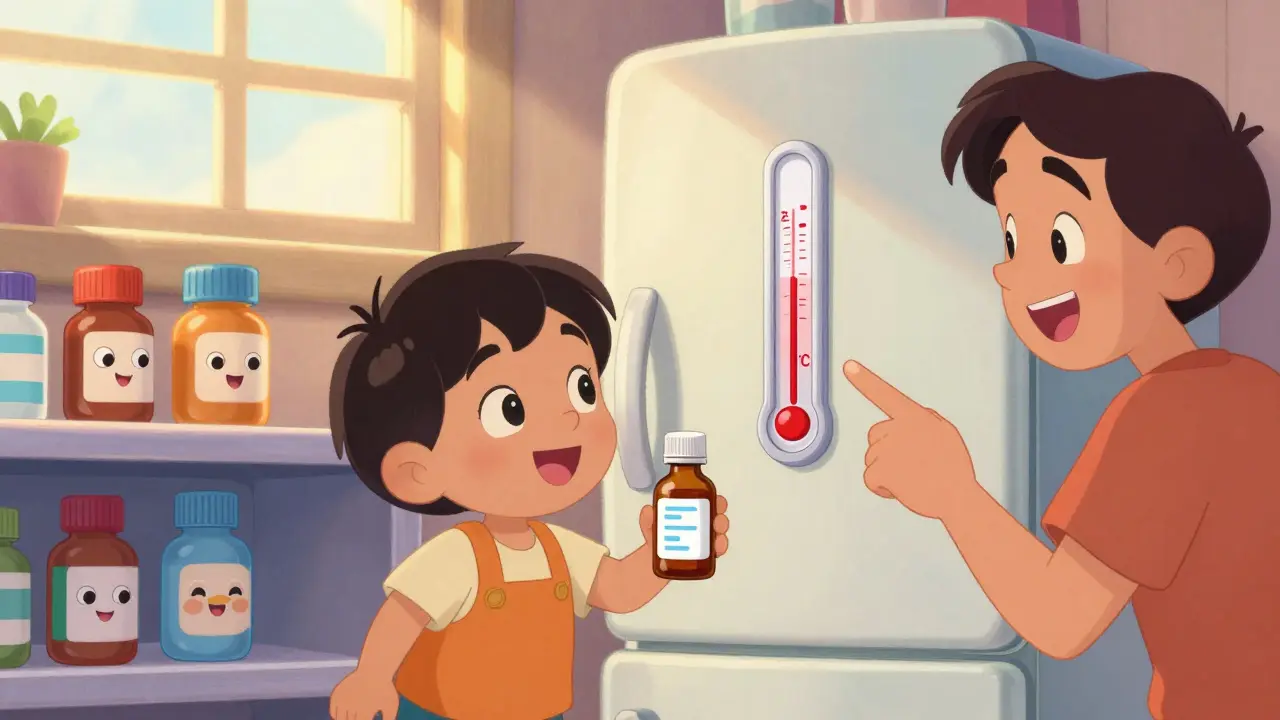
Storing liquid antibiotics correctly isn’t just a suggestion-it’s what keeps your treatment working. If you’ve ever been told to refrigerate your child’s antibiotic suspension, only to find the bottle sitting on the counter because the fridge was full, you’re not alone. But here’s the truth: not all liquid antibiotics need the fridge. Some actually lose their strength if chilled. Others fall apart after just a few days, no matter where you put them. Getting this wrong can mean your infection doesn’t clear up-and that’s when things get dangerous.
Why Storage Matters More Than You Think
Antibiotics aren’t like vitamins or pain relievers. They’re delicate. When you mix a powder with water to make a suspension, you’re creating a new chemical environment. The active ingredients start breaking down the moment they touch liquid. Heat, light, and even time can weaken them. A study from JAPSONLINE (2013) showed that amoxicillin clavulanate, a common combo antibiotic, loses its effectiveness faster when stored above room temperature. And if it’s left out too long? The bacteria you’re trying to kill might not only survive-they could become stronger.
The FDA says expiration dates only mean something if the drug was stored the way it was tested. That means if your medicine sat in a hot car or on a sunny windowsill before you even used it, it might be useless by the time you open it. Baystate Health estimates that nearly 30% of households store medications improperly. For antibiotics, that’s not just inconvenient-it’s risky.
Refrigeration: Yes or No?
This is where people get confused. Many assume cold = better. But refrigeration isn’t a universal fix. Some antibiotics need to be kept cold. Others break down in it.
- Need refrigeration: Many penicillin-based suspensions, like amoxicillin (in some formulations), are more stable at 2-8°C (36-46°F). This slows down chemical breakdown and keeps the taste more tolerable.
- Don’t refrigerate: Some suspensions, especially those with added flavorings or stabilizers, can become too thick, clumpy, or even lose potency when chilled. Walgreens pharmacists warn that freezing or over-chilling certain antibiotics can make them less effective.
The Cleveland Clinic gives clear guidance for amoxicillin suspension: "Store in the refrigerator if possible. If not, keep it at room temperature between 20-25°C (68-77°F)." That’s the sweet spot for most. No need to freeze it. No need to stress if your fridge is packed. Just keep it out of direct heat and sunlight.
How Long Do They Last After Mixing?
Once you mix the powder, the clock starts ticking. And it ticks fast.
- Amoxicillin (without clavulanate): Lasts up to 14 days, whether refrigerated or kept at room temperature. That’s the longest window most parents get.
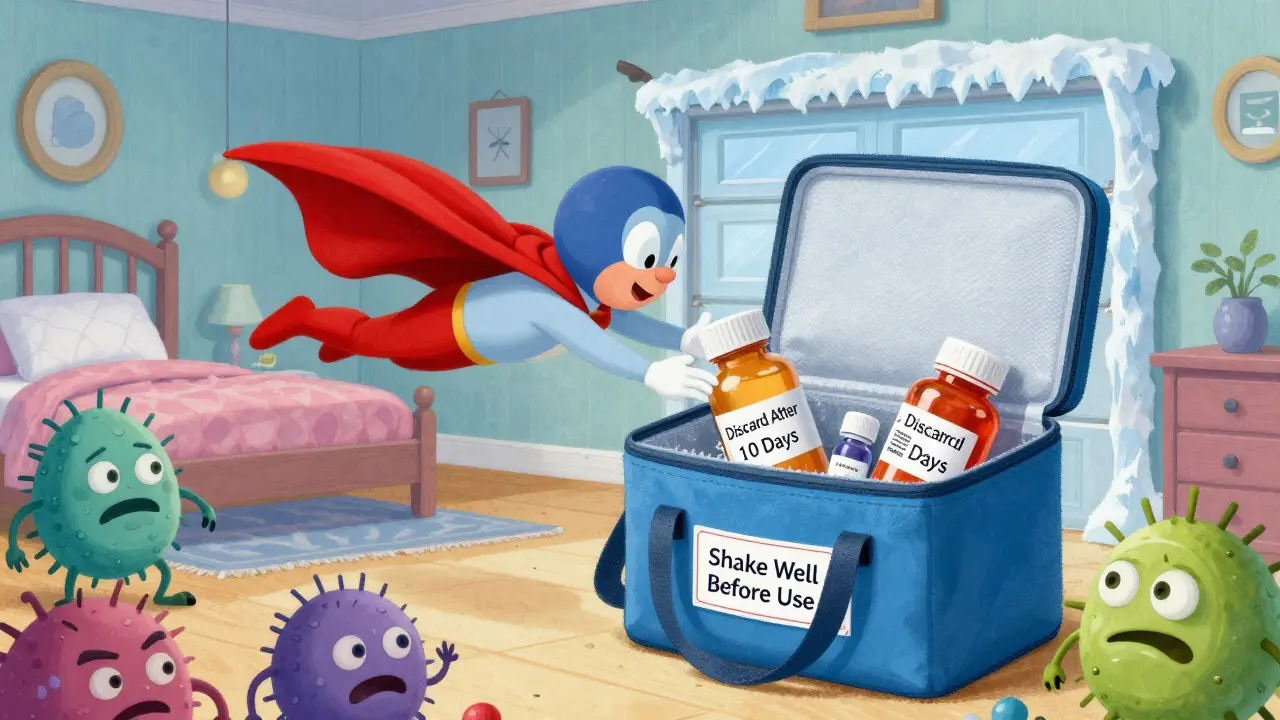
- Amoxicillin/clavulanate (co-amoxiclav): Only 10 days in the fridge. Some sources say 5 days at room temperature. If you’re unsure, stick to 10 days max.
- Other suspensions: Always check the label. Cephalexin? Usually 14 days. Azithromycin? Often 10 days. Clindamycin? Around 14 days if refrigerated.
Here’s the hard truth: if your pharmacist didn’t write a "discard by" date on the bottle, call them. Don’t guess. A 2013 study found that amoxicillin stayed stable for 7 days even when submerged in water at room temperature-but that’s not a rule you should follow at home. Manufacturer guidelines vary, and mixing conditions matter. Stick to what’s printed.
What About Temperature Extremes?
Both heat and cold can ruin antibiotics.
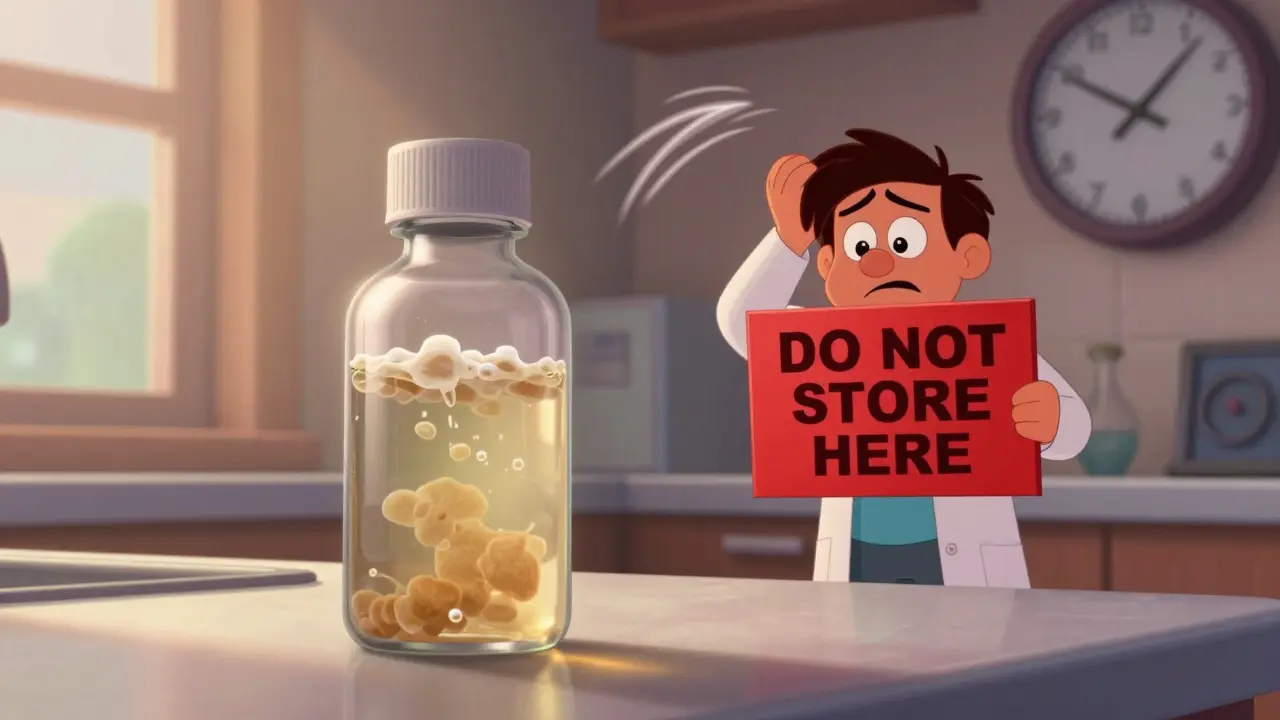
Heat: Keep them away from stoves, radiators, and sunny windows. A car dashboard in March in Edmonton can hit 30°C-even if it’s freezing outside. That’s enough to degrade many suspensions. Baystate Health warns that medications stored on windowsills often lose potency. Sunlight isn’t just a bother-it’s a threat.
Cold: Freezing is a no-go. Liquid antibiotics aren’t like ice cream. If your medicine freezes, the structure of the drug can change. You might not see it, but it’s damaged. That’s why you shouldn’t leave it in the garage, on a porch, or in a car overnight. Insulated bags with cool packs are fine for short trips, but never freeze the bottle.
How to Measure and Use Correctly
Storage isn’t the only thing that matters. How you give the dose does too.
- Always shake the bottle well before each use. The medicine settles. If you don’t shake, you might give half the dose-or none at all.
- Use the measuring tool that came with it. A plastic syringe, dropper, or dosing cup. Never use a kitchen spoon. A tablespoon isn’t 15 mL. A teaspoon isn’t 5 mL. Inaccurate dosing leads to treatment failure.
- Take it on schedule. Even if your child feels better, finish the whole course. Skipping doses invites resistant bacteria.
The Cleveland Clinic also says: "Take it with food if it upsets the stomach." That’s helpful advice. But don’t mix it into juice or milk unless the label says it’s okay. Some antibiotics bind to calcium and lose their power.
What to Do With Leftovers
Never flush antibiotics down the toilet or toss them in the trash. That’s bad for the environment and unsafe for kids or pets who might find them.
Instead:
- Check if your pharmacy has a take-back program. Many do.
- Call your local waste management. Some cities have drug disposal days.
- If all else fails, mix the liquid with cat litter, coffee grounds, or dirt in a sealed container before throwing it away. This makes it unappealing and harder to accidentally ingest.
And if you’re unsure whether a suspension is still good? When in doubt, throw it out. It’s cheaper than a second round of illness.
Traveling with Liquid Antibiotics
If you’re flying or driving to visit family, keep your antibiotic safe.
- Use a small insulated cooler with a cold pack if it needs refrigeration.
- Keep it in your carry-on. Checked luggage can get too hot or too cold.
- Bring the original label and prescription. Airport security might ask.
- If you’re going somewhere without reliable power, ask your pharmacist: "Is there a version that doesn’t need refrigeration?" Some newer formulations are designed for stability at room temperature.
Varcode’s guidelines say: "Always follow the storage instructions on the packaging." That’s your golden rule. The manufacturer tested it. They know best.
Final Reminder: Labels Are Your Best Friend
Every bottle, every packet, every label is different. What works for amoxicillin won’t work for cephalexin. What’s safe for 14 days for one drug might be dangerous after 7 for another.
Don’t rely on memory. Don’t ask a friend. Don’t Google it during a 2 a.m. fever panic. Look at the label. Read the instructions. If it says "refrigerate," do it. If it says "store at room temperature," leave it out. If it says "discard after 10 days," toss it on day 11.
Antibiotics are powerful tools. But they’re not magic. They need care. And if you’re caring for someone who can’t tell you if their medicine smells funny or looks cloudy? You’re the one who has to notice.
One more thing: if the suspension changes color, smells sour, or has chunks in it? Don’t use it. Even if it’s "only" day 8. That’s not normal. That’s degradation. Throw it away and call your pharmacy.
Do all liquid antibiotics need to be refrigerated?
No. Some, like amoxicillin, can be stored at room temperature (20-25°C or 68-77°F) for up to 14 days. Others, especially certain penicillin-based suspensions, require refrigeration (2-8°C or 36-46°F). Always check the label. Refrigerating some antibiotics can actually make them less effective or change their texture.
How long can I keep an opened liquid antibiotic?
It depends on the drug. Amoxicillin suspension lasts up to 14 days. Amoxicillin/clavulanate (co-amoxiclav) lasts 10 days if refrigerated, or as little as 5 days at room temperature. Azithromycin is usually good for 10 days. Always follow the discard date on the label. If no date is given, ask your pharmacist.
Can I freeze liquid antibiotics to make them last longer?
Never freeze liquid antibiotics. Freezing can damage the chemical structure, making the drug ineffective or even unsafe. This applies to all suspensions, including those meant for refrigeration. The cold can cause ingredients to separate or degrade. Keep them cool, but never frozen.
What happens if I give my child an antibiotic that’s been stored wrong?
The antibiotic may not work as well-or at all. That means the infection won’t clear up, and the bacteria could become stronger or resistant. It can also lead to longer illness, more doctor visits, or even hospitalization. In rare cases, degraded antibiotics can cause unexpected side effects. If you suspect improper storage, stop using it and call your healthcare provider.
Can I mix liquid antibiotics with food or juice?
Only if the label or your pharmacist says it’s okay. Some antibiotics, like tetracyclines, bind to calcium in milk and lose effectiveness. Others, like amoxicillin, can be mixed with juice or applesauce to make them easier to swallow. Always check first. Never mix without approval.
Ray Foret Jr.
March 7, 2026
Honestly this saved my butt last year when my kid was on amoxicillin and i thought fridge = always better. Turned out it was supposed to stay at room temp and i was making it clumpy. lol 🙃
Samantha Fierro
March 8, 2026
Thank you for sharing such a clear, evidence-based guide. Many parents are left guessing, and this level of detail can truly prevent harm. Proper storage isn't optional-it's part of the treatment.
Robert Bliss
March 10, 2026
i had no idea some antibiotics break down in the fridge 😅 my bad. always just stuck em in there. good to know!
Peter Kovac
March 11, 2026
The assertion that refrigeration universally improves stability is a dangerous oversimplification. The pharmacokinetic degradation profiles of beta-lactams under thermal stress are non-linear and formulation-dependent. Ignoring manufacturer-specific data is not merely negligent-it is a violation of pharmaceutical compliance standards.
APRIL HARRINGTON
March 11, 2026
OMG I JUST REALIZED I LEFT MY BABYS ANTIBIOTIC IN THE CAR FOR 3 HOURS ON A 90 DEGREE DAY 😭😭😭 IS IT RUINED I THINK I KILLED HER
Leon Hallal
March 13, 2026
you think this is bad wait till you find out the government is secretly adding preservatives to make us dependent. they dont want you to heal. they want you to keep buying. 🤡
rafeq khlo
March 13, 2026
In the context of global pharmaceutical governance and the commodification of pediatric healthcare, the individual responsibility placed upon caregivers is both ethically indefensible and structurally coercive. The onus of storage compliance should rest with institutional providers, not overburdened parents.
Morgan Dodgen
March 14, 2026
I’ve been saying this for years. Big Pharma doesn’t want you to know that refrigeration destabilizes certain suspensions because it increases returns. The FDA? Bought and paid for. Check the patent filings on shelf-stable formulations-there’s a reason they’re not marketed. 🤫💉
Philip Mattawashish
March 15, 2026
You’re all missing the point. Antibiotics are not medicine-they’re a tool of control. The real danger isn’t improper storage, it’s the normalization of chemical dependency. You think your kid needs this? Maybe they just need a better diet, some sunlight, and less screen time. Stop trusting pills. Start trusting nature.
Tom Sanders
March 16, 2026
this whole thing is so much work. why cant they just make one pill that works forever and you dont have to think about it? i dont got time for this.
Jazminn Jones
March 18, 2026
The structural integrity of pharmaceutical suspensions under variable thermal regimes requires rigorous adherence to ICH Q1A(R2) guidelines. To suggest that a layperson can accurately interpret storage requirements without formal training is not merely misguided-it is a failure of regulatory oversight.
Stephen Rudd
March 19, 2026
You all are being manipulated. The reason some antibiotics can’t be refrigerated is because the manufacturers want you to buy more. They know you’ll toss it after 10 days if it looks weird. They profit from waste. Wake up.
Erica Santos
March 19, 2026
Wow. So we’ve turned parenting into a pharmaceutical compliance exam. Congrats. You’ve made giving a child medicine feel like a NASA launch. Next they’ll require a signed waiver before you can use a thermometer.
George Vou
March 21, 2026
i heard the flu shot is what causes autism so i dont trust any meds anymore. also i think the fridge magnet is spying on me. my cousin said the government puts nanos in the liquid so they can track your kid. idk man
Ray Foret Jr.
March 21, 2026
lol @april harrington i did the same thing and my kid got better anyway 🤷♂️ maybe the placebo effect worked? or maybe the medicine was still fine? idk i just kept going