

When you have an autoimmune disease like rheumatoid arthritis, lupus, or Sjögren’s syndrome, the pain and fatigue aren’t just inconvenient-they can make everyday tasks impossible. Getting dressed, cooking a meal, or even holding a coffee cup can become exhausting challenges. This isn’t laziness or weakness. It’s functional impairment-a direct result of inflammation damaging joints, muscles, and nerves over time. And while medications help control flare-ups, they don’t fix the loss of movement, strength, or independence. That’s where rehabilitation and occupational therapy come in.
What Functional Impairment Really Looks Like
Functional impairment in autoimmune diseases doesn’t show up on blood tests. It shows up when you can’t button your shirt, stand up from a chair without help, or walk to the mailbox without needing to rest for 20 minutes. The American Autoimmune Related Diseases Association reports that 5-8% of people globally live with these conditions, and women are three times more likely to be affected. For many, the biggest fear isn’t the diagnosis-it’s losing the ability to do the things that make life feel normal. Studies using the Health Assessment Questionnaire Disability Index (HAQ-DI) show that people with active autoimmune disease often score above 2.0, meaning they struggle with basic self-care tasks. That’s not just discomfort-it’s disability. And the longer you wait to address it, the harder it becomes to reverse. Research from the Journal of Autoimmunity (2022) found that starting rehab within the first 12 months of symptoms can improve function by 35-42%. Delaying treatment? That’s like letting a leaky pipe rust shut-you end up needing a full replacement instead of a simple fix.How Physical Therapy Helps You Move Again
Physical therapy (PT) focuses on restoring movement and strength. But it’s not about lifting heavy weights or running marathons. In autoimmune conditions, exercise must be precise-like medicine. Too much, and you trigger a flare. Too little, and you lose more function. During a flare, therapists start with gentle isometric exercises-muscle contractions without joint movement-at just 20-30% of your max effort. These help maintain muscle tone without adding stress to inflamed joints. As inflammation settles, the focus shifts to aerobic training. The goal? Keep your heart rate at 40-60% of your reserve. That’s not intense-it’s sustainable. A 2022 study in the Back to Motion database showed PT improved lower-body function by 28% more than occupational therapy alone, measured by how fast someone could stand up, walk 3 meters, and sit back down (Timed Up and Go test). Hydrotherapy is one of the most effective tools. Water at 92-96°F reduces joint pressure and eases pain. One study found patients using underwater treadmills saw pain scores drop from 7.2 to 4.1 on a 10-point scale-22% better than land-based exercise. But here’s the catch: 68% of rural clinics don’t have access to hydrotherapy pools. That means many people miss out on one of the most gentle, effective ways to rebuild mobility.Occupational Therapy: Relearning How to Live
While PT helps you move, occupational therapy (OT) helps you do the things you need to do while moving. Think brushing your teeth, opening jars, typing on a keyboard, or carrying groceries. OT doesn’t just adapt your body-it adapts your environment. The cornerstone of OT for autoimmune disease is the 4 Ps: Prioritize, Plan, Pace, Position. You don’t have to do everything. You just have to do what matters-without crashing afterward. Therapists teach patients to break tasks into 15-20 minute chunks, followed by 5-10 minutes of rest. This isn’t lazy-it’s science. Pushing past that limit leads to the infamous “boom-bust cycle,” where a good day turns into three days of recovery. OT also uses tools you might not expect. Voice-activated smart home systems let people control lights, thermostats, and door locks without lifting a finger. One study showed these systems increased independence by 31% in people with hand impairments. Custom splints, jar openers, and reachers aren’t gimmicks-they’re lifelines. The Arthritis Hand Function Test shows OT improves upper limb function 33% better than PT alone.
Measuring Progress: It’s Not Just Pain
Pain scales don’t tell the full story. The real measure of success is whether you can get dressed, cook dinner, or play with your grandkids without needing to lie down for hours afterward. That’s why therapists use the Canadian Occupational Performance Measure (COPM). It’s a 10-point scale where a 2-point increase means real, meaningful change. A patient who goes from scoring 1/10 on “washing my hair” to 3/10 might seem small-but that’s the difference between needing help and doing it yourself. The goal isn’t to be pain-free. It’s to be functional. And studies show that’s possible. Patients who stick with rehab for 6 months average a 1.8-point improvement on the HAQ-DI. That’s enough to return to part-time work, as one Reddit user shared: “After 6 months of graded exercise, my HAQ-DI dropped from 2.1 to 0.8. I went from being housebound to working 20 hours a week.”When Rehab Doesn’t Work-And Why
Rehab isn’t magic. It doesn’t work if you’re in the middle of a severe flare. When the Disease Activity Score-28 (DAS28) hits 5.1 or higher, therapy can actually make things worse. That’s why therapists must check for signs of active inflammation: swollen joints, fever over 100.4°F, or recent steroid injections. Pushing through pain? That’s a recipe for injury. A 2023 study found 37% of patients try high-impact workouts on their own-and end up with 23% more injuries. Another big problem? Misguided therapy. Too many therapists treat autoimmune patients like they have ordinary arthritis or general deconditioning. But conditions like lupus and Sjögren’s involve central fatigue-a brain-based exhaustion that doesn’t improve with more effort. Dr. Alan Peterson’s 2021 JAMA commentary warned that 19% of rehab programs ignore this, pushing patients harder and making fatigue worse. Insurance is another wall. Most plans cover only 12-15 sessions a year. But research shows you need 24-30 to see lasting results. Many patients quit after 10 sessions because they’re told, “You’re done.” That’s not care-that’s cost-cutting.What Makes a Good Therapist?
Not every physical or occupational therapist knows how to work with autoimmune disease. You need someone trained in the specifics: how to adjust for flares, recognize central fatigue, and use tools like heart rate variability monitoring to personalize intensity. Dr. Lisa Rodriguez from Mayo Clinic recommends tracking your heart rate variability (HRV) daily. When HRV drops, it’s a sign your body is stressed-even if you don’t feel it yet. Look for therapists with the Academy of Pelvic Health Physical Therapy’s Autoimmune Specialty Certification. It’s a 120-hour program with a 78% pass rate. They’re trained in 87 different autoimmune conditions and must complete 40+ hours of continuing education each year. Ask: “Do you use the COPM? Do you adjust exercise based on my flare status?” If they look confused, keep looking.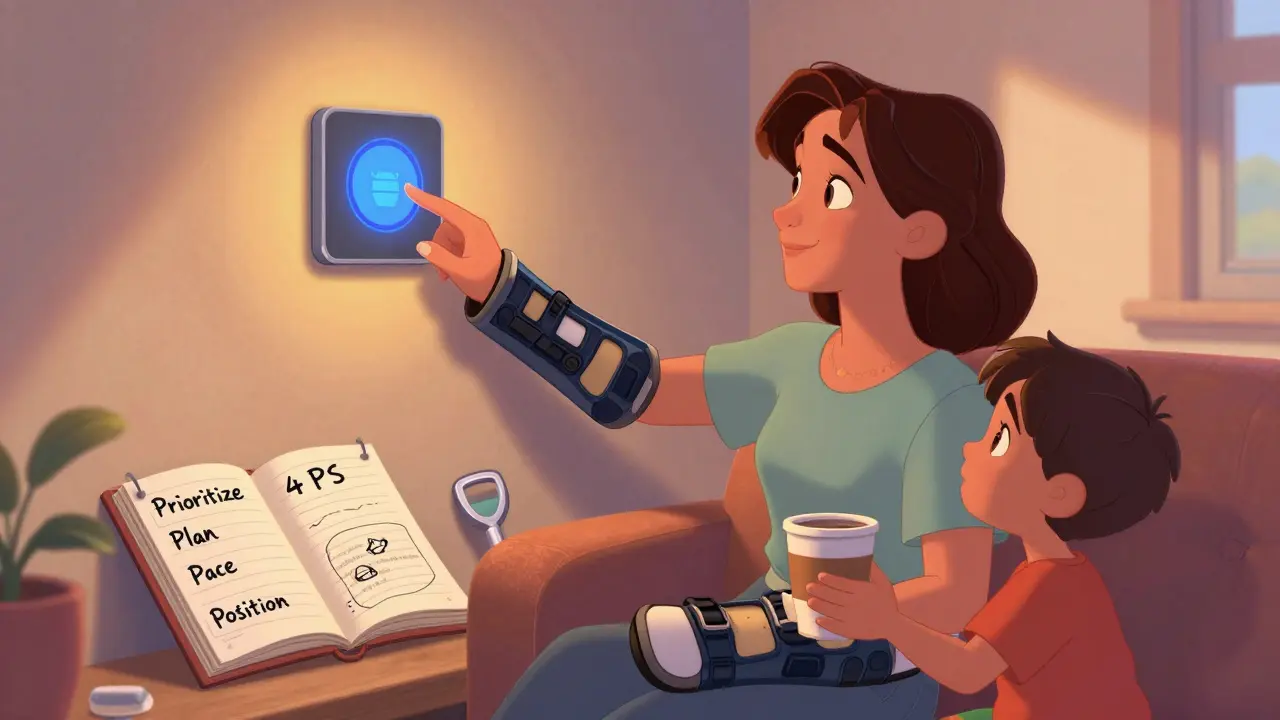
Home-Based Rehab: The New Normal
Before the pandemic, only 22% of patients used telehealth for rehab. Now, it’s 68%. Video sessions let you do exercises in your own space, with your own equipment. Therapists can watch your form, adjust your pacing, and even review your activity diary in real time. Apps like the Lupus Foundation’s “PacePartner,” currently in Phase 3 trials, use wearable sensors to predict flares with 82% accuracy. That means you get warned before you crash-instead of recovering after. You don’t need fancy gear. A resistance band, a chair, a timer, and a journal are enough. The key is consistency. The 70% effort rule works: never push past 70% of what you think you can do. That leaves room for bad days. It’s not about maxing out-it’s about staying in the game.The Future: Smarter, Personalized Care
The NIH launched the Autoimmune Rehabilitation Registry in January 2023, tracking over 5,000 patients across 47 clinics. Early data shows adjusting exercise based on weekly IL-6 levels (a key inflammation marker) improves outcomes by 39%. This isn’t science fiction-it’s the next step. Soon, your rehab plan might be updated automatically based on your blood test results and wearable data. But technology can’t replace human judgment. The best rehab combines smart tools with therapists who listen. Who understand that a good day isn’t a license to overdo it. Who know that rest isn’t failure-it’s part of the plan.What You Can Do Today
If you’re struggling with function:- Ask your doctor for a referral to a therapist with autoimmune training.
- Start an activity diary. Note what you do, how long, and how you feel afterward.
- Use the 4 Ps: Prioritize your tasks, plan breaks, pace yourself, position your body to reduce strain.
- Never push through joint swelling or fever. Rest is treatment.
- Try water-based exercise if you can access it. It’s gentler and more effective during flares.
- Use adaptive tools-grabbers, voice assistants, ergonomic keyboards. They’re not cheating. They’re empowering.
Can exercise make autoimmune symptoms worse?
Yes-if it’s too intense, too frequent, or done during a flare. High-impact workouts, heavy lifting, or pushing through pain can trigger flares and increase injury risk. But the right kind of exercise-gentle, paced, and adjusted to your current condition-can reduce pain, improve strength, and prevent further decline. The key is matching intensity to disease activity, not your motivation.
How long does it take to see results from rehab?
Most patients notice small improvements in 4-6 weeks, like less stiffness or being able to stand longer. Meaningful changes-like returning to work or doing household tasks independently-usually take 3-6 months of consistent therapy. The biggest gains happen when rehab starts early, within the first year of symptoms. Waiting longer makes progress slower and harder.
Why won’t my insurance cover more therapy sessions?
Many insurance plans limit rehab to 12-15 sessions per year, even though research shows 24-30 are needed for lasting results. This is because there are no specific billing codes for autoimmune rehab in 31 U.S. states. Therapists have to use generic codes, which insurers often deny. You may need to appeal, provide clinical notes, or ask your therapist to help you submit a letter of medical necessity.
Is occupational therapy really necessary if I’m already doing physical therapy?
Yes. PT improves how your body moves; OT improves how you live. You might regain leg strength with PT, but if you can’t open a medicine bottle or use a computer, you’re still limited. OT teaches you how to adapt tasks, use tools, and conserve energy so you can do what matters-without burning out. Studies show OT is 33% more effective than PT alone for upper-body function and daily tasks.
What’s the 70% effort rule, and why does it matter?
The 70% effort rule means you never push yourself beyond 70% of what you think you can do. This creates a safety buffer for bad days and prevents the boom-bust cycle-where a good day leads to days of crash recovery. Most people with autoimmune disease overestimate their capacity on good days. Staying at 70% helps you stay active without triggering flares. It’s not about being lazy-it’s about being sustainable.
Can I do rehab at home without a therapist?
You can start, but you shouldn’t stay there. A trained therapist helps you avoid dangerous mistakes-like doing the wrong exercises during a flare or progressing too fast. Once you’ve learned the principles, home-based programs with video check-ins or apps like PacePartner can be very effective. But skipping professional guidance entirely increases your risk of injury and setbacks.
What should I look for in a rehab clinic?
Ask if they use the Canadian Occupational Performance Measure (COPM), adjust programs based on flare status, and have therapists with autoimmune specialty training. Look for clinics that offer hydrotherapy, heart rate monitoring, and activity diaries. Avoid places that push you to “push through pain” or treat you like a general fitness client. You need specialists, not generalists.
lisa Bajram
January 10, 2026
Okay, but let’s be real-most PTs treat us like we’re just ‘out of shape’ and push us until we cry. I had one therapist who made me do squats during a flare. I was in bed for a week. Don’t let that happen to you. Find someone who gets that autoimmune isn’t just ‘arthritis with extra steps.’
Ted Conerly
January 11, 2026
This is the most accurate breakdown I’ve seen in years. The 70% rule is everything. I used to think ‘no pain, no gain’ applied here. It doesn’t. It kills. I went from housebound to working remotely because I finally stopped trying to outrun my body. Thank you for saying this clearly.
Faith Edwards
January 12, 2026
It is, of course, utterly regrettably deplorable that our healthcare system continues to commodify rehabilitation as if it were a subscription service rather than a medically necessary intervention. One cannot, after all, simply ‘purchase’ functional capacity through arbitrary session caps. The fact that insurers still refuse to acknowledge the biological reality of central fatigue is not merely bureaucratic-it is ethically indefensible.
Jay Amparo
January 12, 2026
From India, I want to say-this is exactly what we need more of. Here, most doctors think if you’re not in a wheelchair, you’re fine. I spent two years being told to ‘just walk more.’ I cried the day I found a therapist who knew what HAQ-DI meant. Please, if you’re reading this and you’re in a country where this care is scarce-reach out. We’re out here. You’re not alone.
Lisa Cozad
January 13, 2026
I’ve been doing the 4 Ps for six months now. Prioritize? I only do laundry once a week. Plan? I schedule naps like meetings. Pace? I set a timer for every task. Position? I have a whole ‘chair setup’ for typing. It’s not glamorous, but I made it to my niece’s birthday party without needing a wheelchair. That’s a win.
Saumya Roy Chaudhuri
January 14, 2026
You’re all missing the point. The real problem is that people with autoimmune diseases are too lazy to just ‘push through.’ If you exercised like normal people, you wouldn’t need all these fancy apps and splints. My cousin had lupus and still ran marathons. You just need discipline.
anthony martinez
January 15, 2026
So let me get this straight-we’re supposed to trust a therapist who has a 120-hour certification… but insurance won’t cover more than 12 sessions? Sounds like a marketing brochure written by a robot who’s never met a patient.
Mario Bros
January 16, 2026
Just started using a voice assistant to turn off lights. I used to cry trying to reach the switch. Now I say ‘Hey Google, lights off’ and I don’t have to fight my own body. Small wins, folks. They add up.
Jake Nunez
January 18, 2026
Hydrotherapy is a game-changer, but good luck finding it outside of big cities. I drive 90 minutes each way for my pool sessions. My therapist says it’s worth it. I say I’m lucky I still have a car.
Michael Marchio
January 18, 2026
It’s interesting how the article casually mentions that 68% of rural clinics lack hydrotherapy pools, as if this were an inevitable consequence of geography rather than a direct result of systemic underfunding and the prioritization of profit over patient outcomes. The fact that we have to rely on wearable sensors and IL-6 tracking to justify basic therapeutic access speaks volumes about the state of modern medicine. One wonders whether the term ‘rehabilitation’ still holds any meaning in a system that measures value in billing codes and ROI.
Kunal Majumder
January 19, 2026
My wife has RA. She started with just a resistance band and a timer. Now she cooks dinner most nights. No magic. Just consistency. And the 70% rule saved her from two hospital visits. You don’t need fancy gear. You need to listen.
Dwayne Dickson
January 20, 2026
While the article presents a compelling case for personalized rehabilitation protocols, it is worth noting that the underlying epistemological framework assumes a biomedical model of illness that fails to account for the sociocultural dimensions of disability. The emphasis on ‘function’ as a metric-while clinically useful-reinforces ableist norms that privilege productivity over lived experience. One might ask: is the goal to be ‘functional,’ or to be seen as worthy of care?
Ian Cheung
January 20, 2026
I used to think rest was giving up. Then I realized it’s the only thing keeping me alive. Now I nap like it’s my job. And guess what? I’m more productive. Not because I pushed harder-but because I stopped trying to be someone I’m not.
Christine Milne
January 22, 2026
What nonsense. In America, we don’t need special certifications or hydrotherapy pools. Back in my day, people just dealt with it. You think your pain is unique? Everyone’s got something. Maybe if you stopped treating yourself like a fragile porcelain doll, you’d get stronger.
Bradford Beardall
January 22, 2026
Wait-so if I track my HRV and IL-6, and use a smart app, and do 70% effort, and use COPM… am I basically building my own personal autoimmune OS? Because honestly? That sounds kind of cool.