
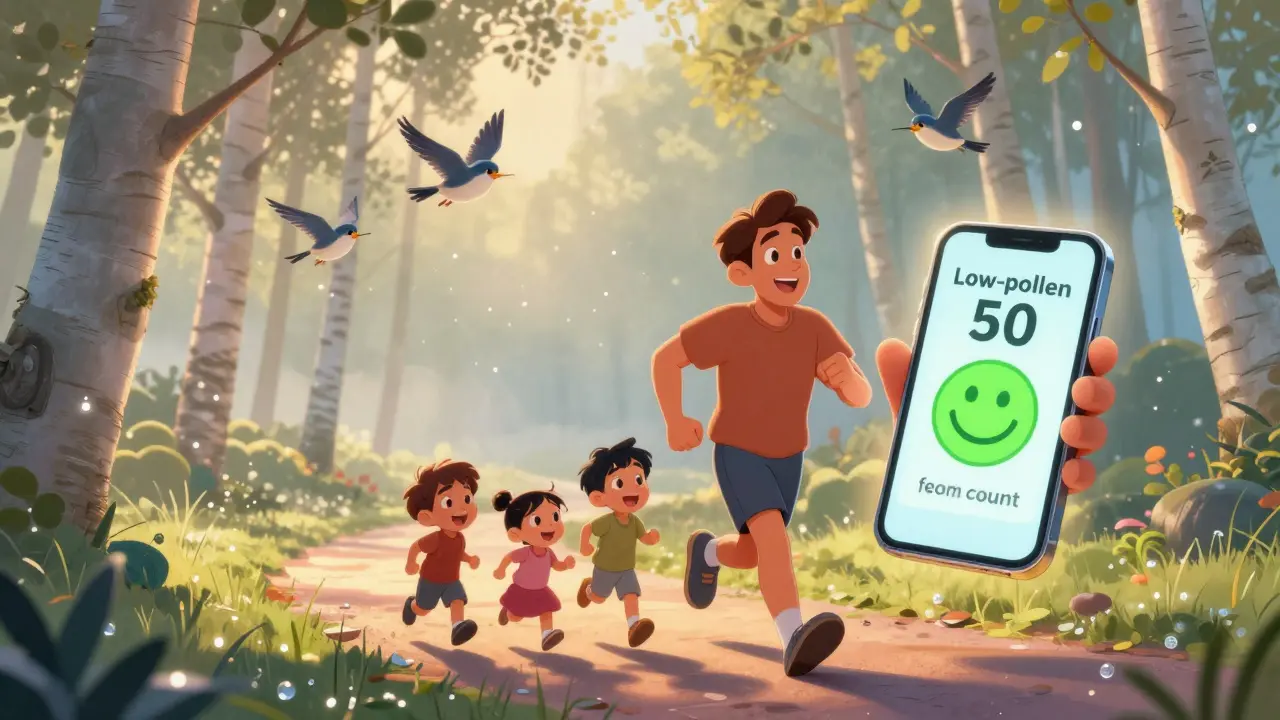
If you’ve ever sneezed through a spring hike or coughed your way through a weekend soccer game, you know how much pollen can ruin plans. For millions of people, allergies aren’t just a nuisance-they’re a daily obstacle to enjoying the outdoors. But here’s the good news: pollen forecasting is now accurate enough to help you avoid the worst days. You don’t have to give up outdoor time. You just need to know when to go out-and when to stay inside.
What Pollen Forecasting Actually Tells You
Pollen forecasting isn’t magic. It’s science. Scientists measure how many pollen grains are floating in a cubic meter of air. That’s the pollen count. A count of 50 or less is considered low. Between 150 and 499? That’s high. Over 500? Very high. For ragweed, even 20 grains can trigger symptoms.
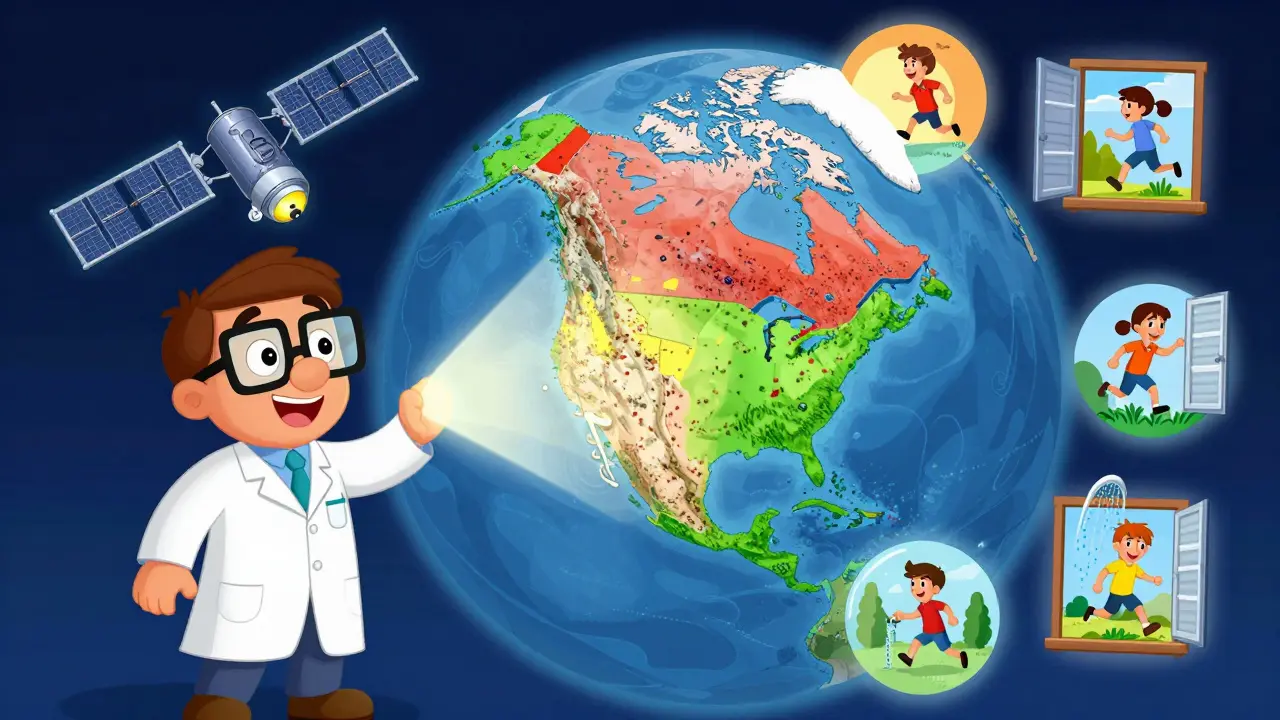
Modern systems like BreezoMeter and the Copernicus Atmosphere Monitoring Service use weather data, satellite images, and machine learning to predict these numbers days in advance. These models look at temperature, wind, humidity, and even how much vegetation is blooming nearby. In places like Edmonton, where tree pollen kicks off in late February, this info is gold.
Back in the 1950s, pollen counts were tracked with greased rods left outside overnight. Today, forecasts use 200+ data points per location, including traffic patterns and land use. Some systems now predict pollen levels with 82-89% accuracy-close enough to make real decisions.
When Pollen Hits Its Peak (And How to Avoid It)
Pollen doesn’t just rise randomly. It follows a daily rhythm.
- Trees (like birch, oak, and maple): Peak between 5 AM and 10 AM. Dew dries, pollen floats.
- Grasses (the big trigger in late spring): Peak from 10 AM to 4 PM. Warmth and sun make them release.
- Weeds (ragweed, sagebrush): Peak from 4 PM to 8 PM. Heat and wind carry them far.
That means your best window for outdoor time? Early morning (5-7 AM) or evening (7-9 PM). Pollen counts drop 30-50% during those hours. Runners and cyclists who shift their workouts to 7-9 AM during grass season report 45% fewer symptoms, according to allergy researcher Dr. Amit Momaya.
And don’t forget rain. A light shower-just 0.1 inch-can knock pollen levels down by 30-50% for a few hours. Plan your gardening, dog walks, or kid’s soccer practice for after a rain. But avoid going out right after a storm. Windy conditions after rain can stir up pollen like a tornado.
What’s Happening in Edmonton Right Now
Here in Edmonton, tree pollen starts as early as February. Birch and aspen are the worst offenders. By mid-March, counts climb into the high range. Grass pollen spikes in late May and stays strong through June. Ragweed doesn’t show up until late July, but once it does, it lasts until frost.
Local forecasts from Environment Canada and BreezoMeter show that Edmonton’s pollen season has gotten longer by nearly three weeks since 2010. That’s thanks to warmer winters and longer growing seasons. The same trend is happening across Canada and the northern U.S. If you’re allergic, you’re dealing with more pollen for more days than your parents did.

Which Forecast Tools Actually Work?
Not all apps are created equal. Here’s what’s out there:
| Service | Accuracy | Forecast Range | Resolution | Cost |
|---|---|---|---|---|
| BreezoMeter | 82% | 5 days | 1.5 km | Paid API (free app) |
| Pollen.com | 75% | 3 days | 10 km | Free |
| WeatherBug | 78% | 5 days | 5 km | Free (with ads) |
| Environment Canada | 70% | 2 days | Regional | Free |
BreezoMeter leads in precision. It can tell you if your neighborhood park has higher pollen than your front yard. Pollen.com is free and reliable for general planning. Environment Canada gives you the official local data but doesn’t go beyond 48 hours.
Use at least two sources. If BreezoMeter says “high” and WeatherBug says “moderate,” err on the side of caution. Cross-checking cuts your risk of a bad reaction.
Real-Life Strategies That Work
People who manage their allergies well don’t just check a forecast-they build habits around it.
- Plan workouts for early morning. If you run or bike, do it before 7 AM. You’ll avoid the midday grass pollen surge.
- Check the forecast before you leave home. Don’t wait until you’re already outside. A 10-minute look can save you hours of sneezing.
- Wear sunglasses. They block pollen from your eyes, which reduces itching and swelling.
- Shower after being outside. Pollen sticks to hair and clothes. Washing it off helps prevent nighttime symptoms.
- Keep windows closed during peak hours. Especially between 5 AM and 10 AM. Use AC instead.
- Track your symptoms. Use a journal or app. If you notice your sneezing spikes every time the forecast says “high,” you’ve got a pattern. That’s your personal data-and it’s more useful than any generic alert.
One Reddit user, u/AllergyWarrior89, cut their antihistamine use in half by switching their runs to 7 PM. Another parent in Calgary said her son’s outdoor playtime went from 3 days a week to 6 after they started using BreezoMeter to avoid high-pollen afternoons.
The Limits of Forecasting (And What to Watch Out For)
Pollen forecasts are powerful-but not perfect.
They struggle with thunderstorm asthma. In 2016, Melbourne, Australia had a massive event where pollen grains burst open in humid air, triggering severe asthma attacks in hundreds. No forecast predicted it. The same thing happened in Toronto in 2022. These events are rare but dangerous.
Also, forecasts don’t always account for localized stirring. If you’re mowing your lawn or raking leaves, you’re kicking up pollen that the model didn’t predict. Apps can’t know you’re about to do yard work.
And if you’re in a region with less monitoring-like parts of Alberta or the Yukon-forecasts may be less precise. Only 37% of the world’s major allergenic pollen types are tracked with high accuracy. Ragweed, for example, is poorly modeled in many areas.
Still, even with these limits, using forecasts reduces symptoms by up to 65% according to clinical studies. That’s not just a nice-to-have. It’s a game-changer.
What’s Coming Next
By 2025, the European Space Agency plans to launch PollenSat-a satellite designed to map pollen types from space. That means global coverage, something we’ve never had before.
Apple Health and BreezoMeter are already teaming up to link pollen levels with your heart rate, sleep, and symptom logs. Imagine your phone saying: “You had a bad night. Your pollen exposure yesterday was 30% higher than your personal threshold.” That’s coming soon.
Meanwhile, the U.S. National Institutes of Health just funded $2.4 million in research to predict thunderstorm asthma using AI. We’re not just forecasting pollen anymore-we’re predicting danger.
Bottom Line: You Can Still Enjoy the Outdoors
Allergies don’t have to keep you inside. With today’s pollen forecasts, you can plan your life around the peaks, not against them. You don’t need to suffer through every spring day. You just need to know when the pollen is flying-and when it’s safe to step outside.
Check your forecast every morning. Adjust your schedule. Use the quiet hours. Combine tools. Track your body. You’ll be surprised how much better you feel when you stop guessing-and start planning.
How accurate are pollen forecasts today?
Modern pollen forecasts, especially from services like BreezoMeter and ECMWF’s Copernicus system, are 82-89% accurate for daily predictions. Seasonal forecasts (predicting when tree pollen starts) are even more accurate-up to 92% in temperate regions like Canada and the northern U.S. Accuracy drops in tropical climates or during sudden weather events like thunderstorms.
What time of day has the lowest pollen count?
Pollen counts are typically lowest between 5 AM and 7 AM, and again from 7 PM to 9 PM. Tree pollen peaks early morning, grass pollen peaks midday, and weed pollen peaks late afternoon. Avoiding outdoor activity between 10 AM and 6 PM significantly reduces exposure.
Can rain really reduce pollen?
Yes. A light rain (0.1 inch or more) can wash pollen out of the air and reduce counts by 30-50% within two hours. However, avoid going out right after a storm if it’s windy-wind can stir up pollen that was knocked down and spread it farther.
Which pollen type affects Edmonton the most?
In early spring (February-April), birch and aspen tree pollen are the biggest triggers. Grass pollen dominates from late May to June, and ragweed becomes the main issue from mid-August through September. Local forecasts can tell you which one is peaking each week.
Should I use multiple pollen forecast apps?
Yes. The American College of Allergy recommends checking at least two sources. BreezoMeter gives hyperlocal precision, while Environment Canada offers official regional data. If one says “high” and the other says “moderate,” assume it’s high. Cross-checking reduces the chance of being caught off guard.
Do pollen forecasts work for kids and athletes?
Absolutely. Parents of allergic children report a 72% usage rate of forecasts to plan school activities and playtime. Athletes-especially runners and soccer players-see 45% fewer symptoms when they schedule training for early morning or evening hours based on forecasts. Many school districts and even pro sports teams now use pollen data to adjust outdoor schedules.
Christina VanOsdol
February 22, 2026
This is literally the most useful thing I’ve read all year. 🌸☔️ I started using BreezoMeter last spring and my sneezing fits? Gone. I even convinced my husband to switch his runs to 7 AM. He went from ‘I hate spring’ to ‘I love spring’ in two weeks. Thank you for this. 💯
Brooke Exley
February 23, 2026
YESSSSS this is the kind of practical, science-backed advice we need! 🙌 I used to think allergies meant giving up hiking, but now I plan my weekends like a military operation: check forecast → pack sunglasses → shower after → celebrate with tea. My kid’s outdoor playtime went from 2 days a week to 7. You’re not broken-you just need better intel. Go out there and live!
Alfred Noble
February 23, 2026
i’ve been using pollen.com for years and it’s fine but breezomter is next level. i live in austin and it told me my backyard had 3x more ragweed than the park 2 blocks away. i didn’t believe it till i checked with my nasal spray count. wild. also i typo’d ‘pollen’ as ‘polen’ 3 times in this comment. sorry.
Matthew Brooker
February 25, 2026
If you're allergic and still thinking you have to suffer, you're not alone-but you don't have to stay there. This isn't just about weather data. It's about reclaiming your life. I used to cancel plans every weekend. Now I plan them around the forecast. My dog even knows when it's a good day to go outside. She barks at the window if the app says 'low'. That's how far we've come.
Emily Wolff
February 26, 2026
82% accuracy? That’s barely better than a coin flip. And you’re seriously recommending apps over medical advice? How about just taking Zyrtec? Or moving to Antarctica?
Lou Suito
February 28, 2026
You say pollen forecasting is science? Funny. Last week, your app said ‘low’-I went jogging. I sneezed for 45 minutes. Turns out your ‘science’ didn’t account for my neighbor’s 37-acre ragweed farm. Also, thunderstorm asthma? Nah. That’s just Big Pharma selling inhalers. I’ve got a 12-year-old son who hasn’t used an inhaler since 2019. I don’t need your forecasts. I need better science.
Joseph Cantu
March 1, 2026
Let me guess-you’re one of those people who thinks ‘pollen’ is the enemy. But what if the real culprit is the government’s secret drone program spraying allergens to keep us docile? I’ve seen the patterns. The spikes always happen right after EPA press releases. And why is BreezoMeter owned by a company that also makes air purifiers? Coincidence? I think not. I’ve stopped using apps. I now track pollen by reading the wind. It’s been 14 months. No sneezes. No meds. Just pure truth.
Jacob Carthy
March 2, 2026
Canada’s got it all wrong. We don’t need fancy apps. We need tough love. If you can’t handle a little pollen, maybe you shouldn’t be outside. I’ve been running in Edmonton since ‘08. No meds. No forecast. Just grit. This whole thing feels like snowflake culture. You want to enjoy the outdoors? Get used to it. Stop asking for help. Start breathing.
Lisandra Lautert
March 3, 2026
I read this entire post. It was well-structured. But I still think you missed the point. The real issue isn’t pollen-it’s the decline in personal responsibility. People used to endure. Now they demand predictive algorithms for their sneezes. Pathetic.
Cory L
March 5, 2026
I used to think pollen forecasts were just for nerds. Then I tried them. Now I’m obsessed. I’ve got a spreadsheet. I track my symptoms. I compare apps. I even have a ‘low pollen’ playlist for my morning runs. I went from ‘I hate spring’ to ‘I’m the king of spring.’ It’s not magic. It’s just data. And data? Data sets you free.
Khaya Street
March 7, 2026
I appreciate the effort, but this feels like over-engineering a simple biological response. In South Africa, we don’t have apps for this. We have vinegar rinses, herbal tea, and common sense. If you’re sneezing because of birch pollen, maybe you’re in the wrong hemisphere. Or maybe you just need to stop treating nature like a spreadsheet.
Bhaskar Anand
March 7, 2026
All this talk about forecasts and apps-what about the real problem? The West is obsessed with data because they’ve lost touch with nature. In India, we’ve lived with pollen for centuries. We use neem leaves, turmeric, and early morning walks. You don’t need a satellite to know when to stay inside. You need wisdom. Not an algorithm.