
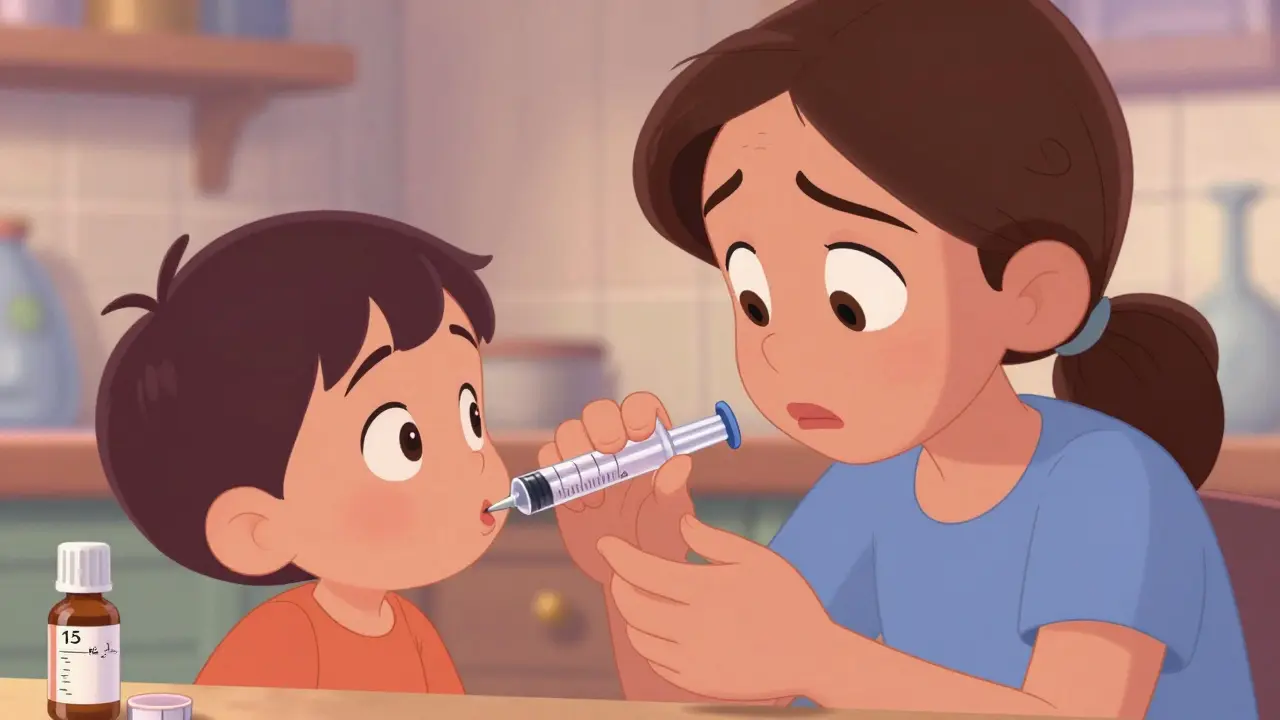
Every year, thousands of children end up in emergency rooms because someone gave them the wrong amount of medicine. Not because the doctor made a mistake - but because the person giving the medicine didn’t measure it right. It’s not about being careless. It’s about using the wrong tool, misunderstanding the label, or guessing with a kitchen spoon. For kids, even a tiny mistake can mean the difference between healing and harm.
Why Getting the Dose Right Matters More for Kids
Children aren’t small adults. Their bodies process medicine differently. A dose that’s safe for a 150-pound teen could be deadly for a 20-pound toddler. The American Academy of Pediatrics says that 7 in 10 parents make at least one mistake when measuring liquid medicine at home. Most of these errors happen because people use household spoons, dosing cups with unclear markings, or mix up milligrams (mg) with milliliters (mL).
One of the most dangerous mix-ups? Confusing 0.5 mL with 5 mL. That’s a tenfold error - ten times too much medicine. For some drugs, like seizure medications or heart medicines, that kind of mistake can cause breathing problems, seizures, or even death. The CDC calls this a preventable tragedy. And it’s not rare. In 2023, over 65,000 U.S. emergency visits were linked to incorrect pediatric dosing.
Forget Teaspoons and Tablespoons - Use mL Only
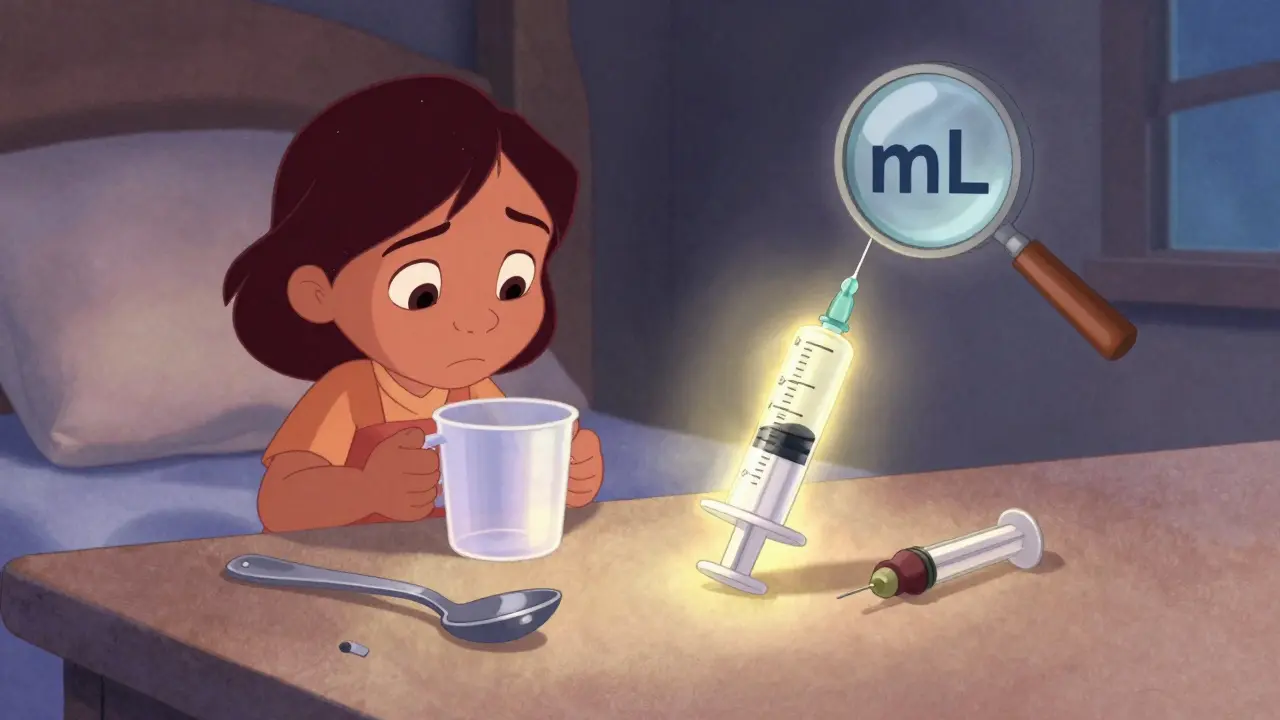
Stop using kitchen spoons. Seriously. A regular teaspoon from your drawer doesn’t hold 5 mL. It might hold 3.9 mL. Or 7.3 mL. That’s a 50% error right there. The CDC, the FDA, and the American Academy of Pediatrics all agree: never use household spoons for children’s medicine.
Instead, every dose must be measured in milliliters (mL). No teaspoons. No tablespoons. No “a splash.” The label on your child’s medicine bottle should say “give 5 mL,” not “give 1 teaspoon.” If it says both, that’s a red flag. The goal is to remove all ambiguity. In 2023, 78% of pediatric liquid medications in the U.S. now use mL-only labeling - up from just 42% in 2015. But you still need to check.
The Right Tools for the Job
Not all measuring tools are created equal. Here’s what works - and what doesn’t:
- Oral syringes - Best choice, especially for doses under 5 mL. They’re accurate, easy to control, and let you slowly give the medicine to the side of the mouth. Accuracy rate: 94%. For babies and toddlers, this is the gold standard.
- Dosing cups - Okay for older kids who can drink from a cup, but risky for small doses. Error rate jumps to 68.5% for 2.5 mL doses. Only use if the medicine comes with one and the child won’t take it from a syringe.
- Droppers - Fine for very small doses (like newborns), but hard to read accurately. Don’t use for doses over 2 mL.
- Medication spoons - Only if they’re labeled with mL and have a clear 5 mL mark. Avoid any spoon that says “teaspoon.”
Studies show that using an oral syringe cuts dosing errors by over 40% compared to cups. And if your child’s medicine comes with a syringe? Use it. Don’t toss it. That syringe is calibrated for that specific bottle.
How to Use an Oral Syringe Correctly
It sounds simple, but most people get it wrong. Here’s how to do it right:
- Shake the bottle first. Liquid medicines like antibiotics or antihistamines settle. If you don’t shake, you might give a dose with no medicine at all. Shake for 10 seconds - until it looks even.
- Draw the medicine slowly. Insert the syringe tip into the bottle. Pull the plunger back until the top of the black ring lines up with the right mL mark. Don’t guess. Don’t eyeball it.
- Hold it up to eye level. Look straight at the syringe. The medicine forms a curve - called a meniscus. Read the measurement at the bottom of that curve. If you look from above or below, you’ll be off.
- Give it slowly. Put the tip inside the cheek, not the front of the mouth. Gently push the plunger. Let your child swallow between small pushes. This prevents spitting or choking.
- Wash the syringe after each use. Rinse with warm water. Don’t use soap unless the instructions say so - it can leave residue. Let it air dry.
Pro tip: Use a permanent marker to mark the syringe for doses you give often. For example, if your child always gets 2.5 mL of amoxicillin, draw a line at that point. It helps when you’re tired or in a rush.
Weight Matters - Know Your Child’s Weight in Kilograms
Many pediatric doses are based on weight: mg per kg per dose. That means you need to know your child’s weight in kilograms, not pounds.
Here’s the math: 1 kg = 2.2 lb
If your child weighs 33 pounds, divide by 2.2: 33 ÷ 2.2 = 15 kg.
Now check the prescription: “Give 15 mg/kg every 6 hours.” Multiply: 15 mg × 15 kg = 225 mg per dose.
If the medicine is 100 mg per 5 mL, then 225 mg = 11.25 mL. That’s 11.25 mL - not 11, not 12. Use the syringe. Don’t round up unless your doctor says so.
Keep a small card in your wallet or phone with your child’s weight in kg and common doses. You’ll thank yourself when it’s 2 a.m. and your child has a fever.
Common Mistakes (and How to Avoid Them)
- Mixing medicine with juice or food. Only do this if the pharmacist says it’s okay. Some medicines lose effectiveness when mixed. And if your child doesn’t finish the whole cup? You don’t know how much they got.
- Using someone else’s syringe. Never reuse a syringe from another child’s medicine. Even if it looks clean, it could be contaminated or mislabeled.
- Assuming “more is better.” If your child still has a fever after one dose, don’t give another one early. Check the timing. Most acetaminophen doses are every 4-6 hours, max 5 times in 24 hours.
- Not reading the label every time. Different brands have different concentrations. One ibuprofen might be 50 mg/mL. Another might be 100 mg/mL. Always check the concentration on the bottle before measuring.
What to Do If You’re Not Sure
Never guess. If the label says “give 0.5 mL” and you’re not sure how to measure that - call your pharmacy. Or your pediatrician. Or a nurse line. Most pharmacies have pharmacists on call after hours. They’ve seen this a thousand times.
Some hospitals, like Cincinnati Children’s and Children’s Healthcare of Atlanta, give parents free oral syringes and printed dosing charts when they discharge. Ask for one. If you’re getting a new prescription, ask the pharmacist: “Can you give me an oral syringe and show me how to use it?”
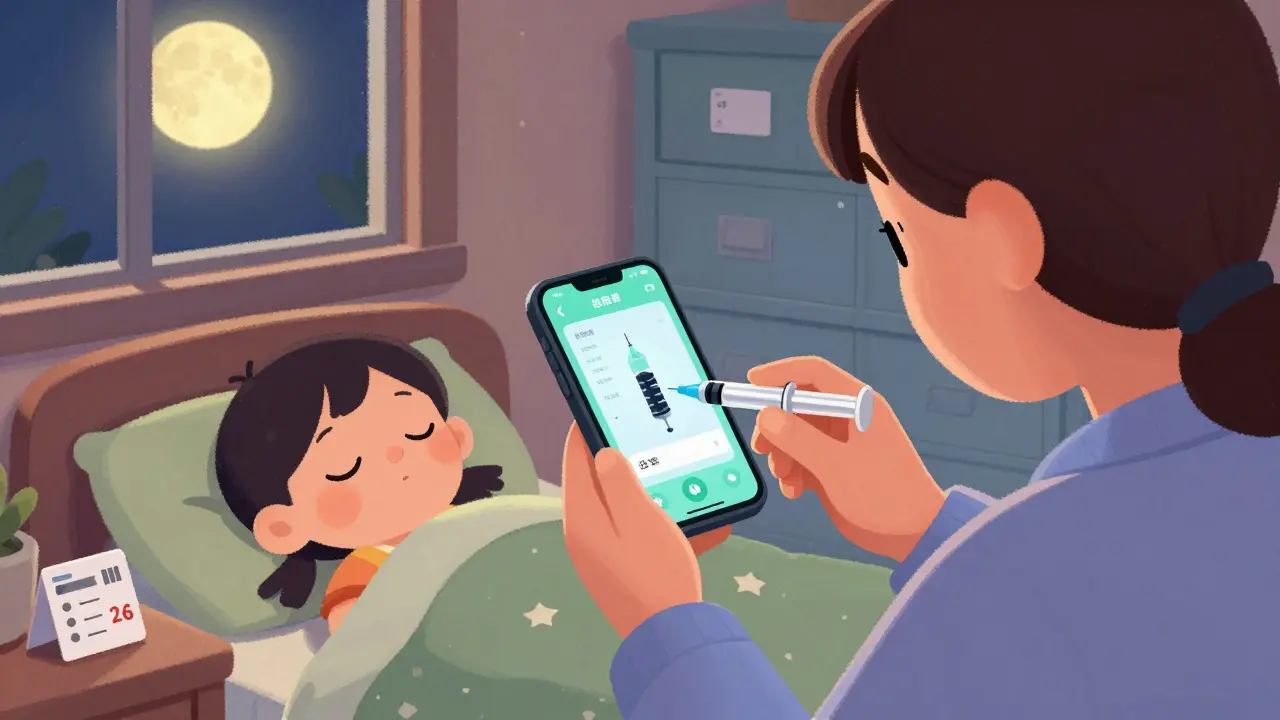
There are also free apps like MedSafety (developed by Cincinnati Children’s) that use your phone’s camera to guide you through measuring. Just point it at the syringe - the app highlights the right level. In trials, it cut errors by 54%.
Special Cases: Narrow Therapeutic Index Medications
Some medicines have a very small window between a helpful dose and a dangerous one. These include:
- Digoxin (for heart conditions)
- Warfarin (blood thinner)
- Levothyroxine (for thyroid)
- Phenytoin (for seizures)
For these, only use an oral syringe. Never use a cup. Never estimate. Even a 0.2 mL error can cause serious problems. Keep these medicines locked up. Write down the dose and time on a calendar. Double-check with another adult if possible.
What to Do After the Dose
After giving the medicine:
- Write down the time and amount given. Use a notebook or your phone. This prevents double-dosing.
- Watch for side effects. If your child vomits within 15 minutes, call your doctor. Don’t give another dose unless they say so.
- Store medicine out of reach. Even a few mL of adult medicine can be deadly to a child.
Final Reminder: You’re Not Alone
It’s normal to feel unsure. Even experienced parents mess up. But the tools are better now than ever. Oral syringes are cheap - often free at the pharmacy. Apps help. Pharmacies will show you how. And every time you use the right tool, you’re making your child safer.
Next time you open a bottle of liquid medicine, ask yourself: Do I know exactly how much I’m giving - and why? If the answer isn’t clear, stop. Call someone. Get help. Your child’s safety depends on it.
Can I use a kitchen teaspoon if I don’t have a syringe?
No. Kitchen teaspoons vary in size from 3.9 mL to 7.3 mL - far from the standard 5 mL. Using one can lead to under-dosing or overdosing. Always use an oral syringe or dosing cup labeled in mL. If you don’t have one, call your pharmacy - they’ll give you one for free.
What if the prescription says ‘teaspoon’ instead of ‘mL’?
Ask the prescriber or pharmacist to rewrite it in mL. The CDC and AAP recommend eliminating teaspoon and tablespoon from all pediatric prescriptions. If the label says ‘1 tsp,’ ask them to change it to ‘5 mL.’ Never assume a teaspoon equals 5 mL - it might not.
Why do some medicines say ‘shake well’?
Many liquid medicines are suspensions - the active ingredient settles at the bottom. If you don’t shake it, the first dose might have no medicine, and the last dose might be too strong. Shake for 10 seconds until the liquid looks even. Always shake before every dose.
Can I mix medicine with milk or juice?
Only if the pharmacist says it’s safe. Some medicines break down in milk or become less effective in acidic juice like orange. Even if it’s okay, never mix the full dose into a full bottle. Give only a small amount (like a tablespoon) and make sure your child drinks it all.
How do I know if my child got the right dose?
You can’t always tell by symptoms. If you’re unsure - if you think you gave too much, too little, or the wrong medicine - call your pediatrician or poison control immediately. In Canada, call 1-800-268-9017. Don’t wait for symptoms. Early action saves lives.
Nicole Rutherford
December 19, 2025
I used to just grab a spoon-until my kid threw up after the third dose of amoxicillin. Turns out my ‘teaspoon’ was holding 7.3 mL. That’s not a dose, that’s a gamble. Now I keep three oral syringes in the medicine cabinet. One for each kid. No excuses.
Also, shake the bottle like you’re trying to start a car in winter. Seriously. I’ve seen parents skip this and wonder why the medicine ‘didn’t work.’ It’s not magic. It’s chemistry.
Mark Able
December 21, 2025
Bro, I just used a measuring cup from my coffee maker. I thought it was accurate. Turns out, nope. My daughter got 8 mL instead of 5. She was drowsy for 6 hours. We went to the ER. They laughed. Not in a mean way-just ‘oh honey, we see this every week.’
Now I use the syringe. And I label it with tape. I’m not ashamed. I’m just trying not to kill my kid.
Chris Clark
December 22, 2025
Y’all need to stop calling it a ‘teaspoon’ on labels. I’m not even joking. I’m a pharmacist’s son. We had a whole debate in med school about this. The FDA pushed for mL-only for a reason. But pharmacies still print ‘1 tsp’ because ‘it’s easier for grandma.’
Grandma’s not the one holding the syringe at 2 a.m. with a feverish toddler. I’ve seen moms cry because they thought ‘a splash’ meant 2 mL. It was 8. The kid went into a seizure. Don’t be grandma.
Also-get the free syringe. They give them out at CVS like gum. Just ask. Say ‘I’m scared I’ll mess up.’ They’ll hand you three.
And if you’re using a dropper for more than 2 mL? You’re doing it wrong. Stop.
Dorine Anthony
December 22, 2025
I used to mix medicine with apple juice. My kid would drink it fast and then run off. I never knew if she got it all. Now I use a syringe and give it slowly in the cheek. She still hates it-but she doesn’t spit it out anymore.
Also, I write the time on my phone’s calendar. I set a reminder. I’m not a genius. I’m just tired. And I don’t want to be the mom who gave too much.
William Storrs
December 23, 2025
You got this. Seriously. Every parent who reads this and says ‘I didn’t know’-you’re not dumb. You’re just human. The system made it easy to mess up. Now you know better. That’s progress.
Grab a syringe. Shake the bottle. Read the meniscus. You’re not just giving medicine. You’re giving safety. And that’s huge.
And if you forget? That’s okay. Just stop. Call the pharmacy. They won’t judge. They’ve seen worse.
Alisa Silvia Bila
December 23, 2025
My daughter’s seizure med is 0.3 mL. I use a syringe. I double-check with my husband. I write it down. I don’t care how silly it looks. I’d rather look like a robot than bury my kid.
Marsha Jentzsch
December 24, 2025
Why do pharmacies even still give out cups?!?!?! They’re useless!! They’re slippery!! They have tiny lines that look like smudges!! I’ve been using syringes for 7 years and I still get yelled at by the pharmacist when I ask for one!! They act like I’m asking for a gun!!
And don’t even get me started on the ‘shake well’ thing. I shake like I’m trying to win a race. I shake until my arm falls off. My kid thinks I’m possessed. Worth it.
Henry Marcus
December 25, 2025
They’re lying about the syringes. The real reason they want you to use them? It’s not safety. It’s control. The pharmaceutical industry knows if you use a syringe, you’ll notice how much they charge for 5 mL of liquid. It’s $120. For a drug that costs 3 cents to make.
And the ‘free syringe’? It’s a trap. They’re tracking your usage. Your kid’s name, your pharmacy, your dose-all logged. They’re building a database of children’s medication habits. For what? Insurance? AI? Who knows?
Just use a spoon. It’s been fine for 100 years. The ‘experts’ just want you scared.
Carolyn Benson
December 25, 2025
It’s not about the tool. It’s about the hierarchy of care. We’ve outsourced trust-from doctor to parent to pharmacist to app. And now we’re paralyzed by measurement. We’ve turned medicine into a math problem instead of a relationship.
What if the real problem isn’t the mL? It’s that we don’t feel safe asking for help? That we’re too ashamed to say, ‘I don’t know how to do this’?
Maybe we need to stop teaching people how to measure-and start teaching them how to ask.
And maybe-just maybe-the real tragedy isn’t the overdose. It’s the silence.
William Liu
December 26, 2025
I used to think I was fine until my niece almost got hospitalized. Now I carry a syringe in my purse. I’ve given medicine to three kids in my family. All of them are fine. I’m not a hero. I just don’t want to be the reason someone’s child ends up in the ER.
If you’re reading this and you’re scared? You’re not alone. Just get the syringe. It’s free. It’s simple. And it’s the best thing you can do today.
Danielle Stewart
December 28, 2025
As a pediatric nurse, I’ve seen over 300 cases of dosing errors in the last five years. 87% involved household spoons. 12% involved misreading mL vs mg. 1% involved syringe misuse. The majority were parents who thought they were doing everything right.
So if you’re reading this and thinking, ‘I’m careful’-good. But careful isn’t enough. You need to be precise.
Use the syringe. Shake the bottle. Read the label. Write it down. Call if unsure.
It’s not complicated. It’s just critical.
Glen Arreglo
December 29, 2025
My mom used to give my brother medicine with a spoon. He turned out fine. But my daughter? She’s got a heart condition. I don’t take chances.
I got a syringe from the pharmacy. I marked it with a Sharpie. I even laminated the dosing chart. I keep it in my wallet next to my insurance card.
It’s not overkill. It’s love.
benchidelle rivera
December 31, 2025
While the technical guidance presented herein is both empirically valid and clinically endorsed by authoritative pediatric bodies, it remains imperative to contextualize this protocol within the broader sociocultural framework of caregiver stress, health literacy disparities, and systemic access inequities.
Merely providing an oral syringe does not address the underlying cognitive load imposed upon caregivers who operate under conditions of sleep deprivation, economic precarity, and linguistic barriers.
Thus, while adherence to mL-based dosing is non-negotiable from a pharmacological standpoint, the ethical imperative lies not in individual compliance, but in institutional accountability: universal access to pharmacist-led dosing education, subsidized measurement tools, and culturally competent discharge protocols.
Without structural intervention, even the most precise syringe remains a Band-Aid on a hemorrhage.