
Every day, millions of people in the U.S. take generic drugs without even realizing it. They’re the pills in your medicine cabinet that cost a fraction of the brand-name version-sometimes just a few dollars instead of hundreds. But how exactly are these drugs made? And how can we be sure they work just as well as the expensive originals? The truth is, making a generic drug isn’t just copying a pill. It’s a precise, heavily regulated science that takes years, millions of dollars, and strict compliance with federal rules.
The Legal Foundation: What the Hatch-Waxman Act Did
Before 1984, if you wanted to make a copy of a brand-name drug, you had to run the same expensive clinical trials as the original company. That made generics nearly impossible to produce. Everything changed with the Hatch-Waxman Act, passed in September 1984. This law created the Abbreviated New Drug Application, or ANDA. It let generic manufacturers skip the long, costly human trials-because they could rely on the brand-name drug’s existing safety and effectiveness data. All they had to prove was that their version worked the same way in the body. That single change turned generics from a niche idea into the backbone of modern healthcare.Step 1: Reverse Engineering the Original
The first real job in making a generic drug is figuring out exactly what’s in the brand-name version. This isn’t as simple as buying a bottle and popping it open. Manufacturers need to analyze the active ingredient, the fillers, the coating, even how the tablet breaks down in the stomach. This reference drug is called the Reference Listed Drug (RLD). They use advanced lab tools-like mass spectrometry and chromatography-to map out every component. The goal? To match the RLD’s performance exactly, not just its appearance.Step 2: Designing the Formula with Quality by Design
Once they know what’s in the original, they start building their own version. This isn’t guesswork. It follows a system called Quality by Design (QbD), developed by the International Council for Harmonisation (ICH). QbD means you don’t just mix ingredients and hope it works. You identify what matters most: the Critical Quality Attributes (CQAs)-like how fast the drug dissolves or how stable it is over time. Then you figure out which raw materials (Critical Material Attributes) and manufacturing steps (Critical Process Parameters) affect those qualities. A tiny change in particle size of lactose, for example, can make a tablet too hard or too soft. That’s why every ingredient and step is measured, tested, and documented.Step 3: The Seven Stages of Manufacturing
The actual production of a generic drug follows a strict, seven-step sequence:- Formulation: The active pharmaceutical ingredient (API) is mixed with excipients-fillers, binders, lubricants-that help the tablet hold together and be absorbed properly.
- Mixing and Granulation: The powders are blended until uniform, then turned into small granules for better flow and compression.
- Drying: Moisture is removed to prevent degradation and ensure shelf life. Too much water? The tablet can crumble. Too little? It won’t bind right.
- Compression and Encapsulation: Granules are pressed into tablets or filled into capsules. Machines here must hit exact weights-FDA rules say tablet weight can’t vary more than ±5% for small pills or ±7.5% for medium ones.
- Coating: Tablets get a thin outer layer to mask taste, protect from moisture, or control how fast the drug releases. Some coatings are designed to dissolve only in the intestine, not the stomach.
- Quality Control: At every stage, samples are pulled for testing. Is the API present in the right amount? Does it dissolve within 15 minutes? Are there impurities? Dissolution testing is especially critical: the generic must release the drug at the same rate as the brand-name version.
- Packaging and Labeling: Final products are sealed in blister packs or bottles with exact labeling. The FDA requires the label to match the brand’s in strength, usage, and warnings-even if the pill looks different.
Why It Has to Be Exactly the Same: Bioequivalence
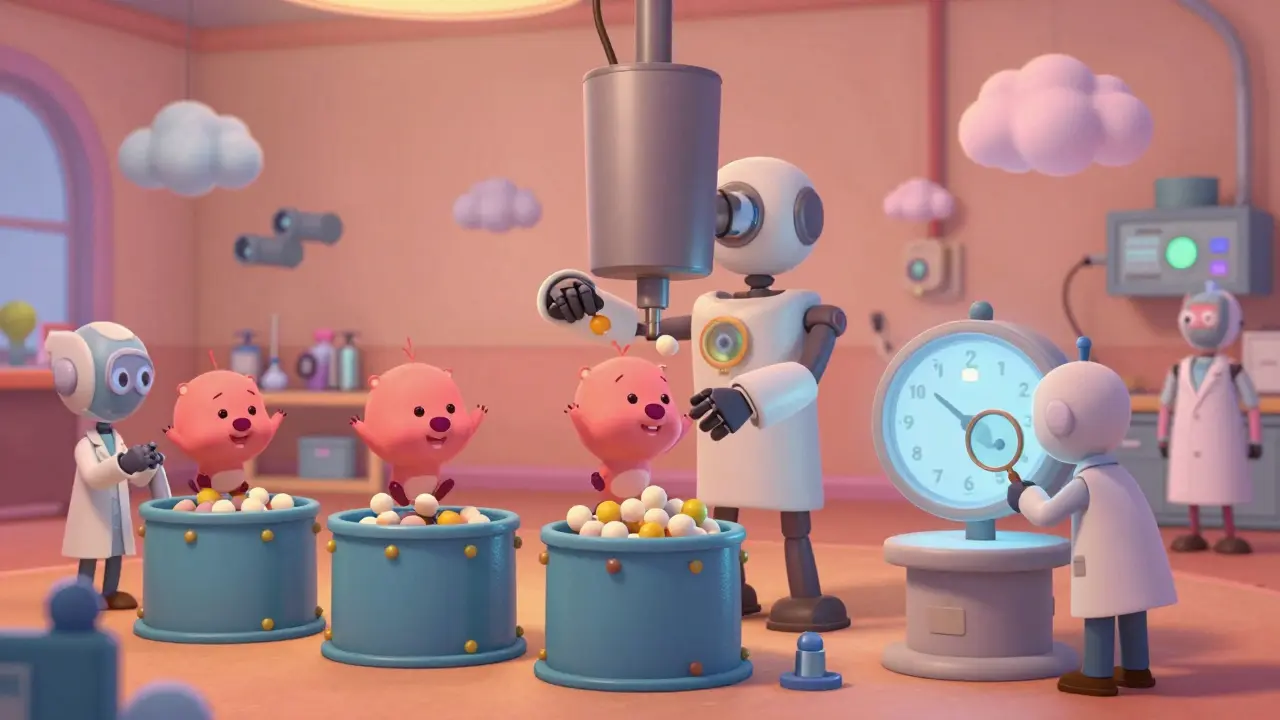
The biggest hurdle isn’t making the pill-it’s proving it works the same way in your body. That’s where bioequivalence comes in. Manufacturers run small studies with 24 to 36 healthy volunteers. They give half the group the brand-name drug, half the generic, then measure how much of the drug enters the bloodstream over time. Two numbers matter: Cmax (peak concentration) and AUC (total exposure). The generic’s values must fall between 80% and 125% of the brand’s. That’s not a guess-it’s a legally binding standard set by the FDA. If it’s outside that range, the drug doesn’t get approved.Manufacturing Under Strict Rules: CGMP
You can’t just make these drugs in a garage. Every facility must follow Current Good Manufacturing Practices (CGMP). That means:- Controlled environments: Temperature kept at 20-25°C, humidity at 45-65% RH.
- Cleanrooms: Air filtered to ISO Class 5-8 standards, depending on the step.
- Trained staff: Workers get 160+ hours of initial training and 40 hours yearly.
- Documentation: Every batch has a paper trail-what was used, who did it, what tests passed.
Complex Generics: The Harder Stuff
Not all generics are equal. Simple pills-like metformin or lisinopril-are easy to copy. But things like inhalers, eye drops, or topical creams? Much harder. Why? Because how the drug moves through your skin or lungs can’t be measured just by blood tests. A generic version of Clobetasol Propionate, a topical steroid, took 7 years and $47 million to develop because scientists struggled to match how the cream penetrated the skin. These are called complex generics, and they’re the future. As of 2023, 35% of pending ANDA applications are for complex products, up from just 12% in 2015. The FDA has launched a dedicated initiative to create new testing methods for these.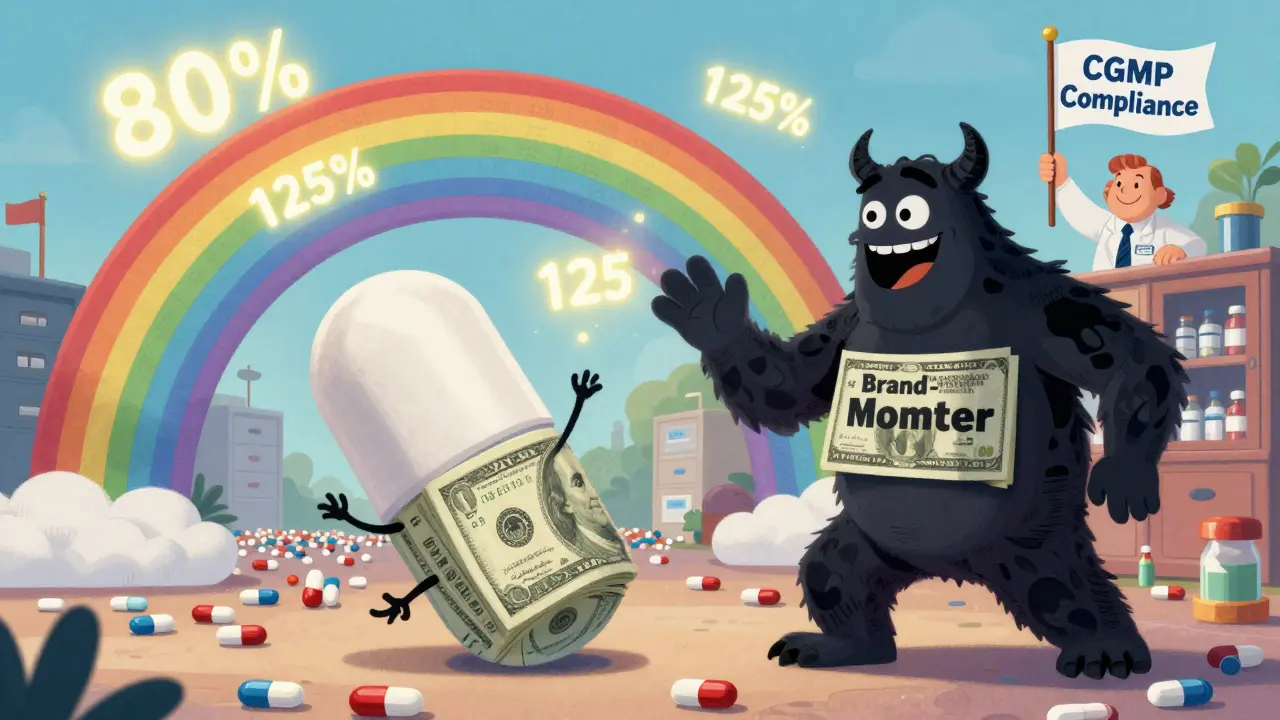
Patents, Delays, and Market Competition
Even after you build the drug, you’re not done. Generic companies must file one of four patent certifications with their ANDA. If they claim the patent is invalid or not infringed (Paragraph IV), the brand-name company can sue-and trigger a 30-month legal delay. That’s why some big pharma companies make their own generics, called authorized generics, to block competitors. In 2023, they grabbed 23% of first-generic market share. Meanwhile, price wars are brutal: simple generics often lose 70-80% of their value within two years. But complex generics? They hold their price better, with only 2-5 competitors and slower erosion.Real Results: Savings, Safety, and Trust
The numbers speak for themselves. In 2023, 90% of all prescriptions filled in the U.S. were for generics. That saved consumers and insurers over $1.7 trillion in the last decade. Pharmacists trust them: 89% report no meaningful difference in clinical outcomes. Patients on long-term meds like statins or blood pressure pills rarely notice a switch. Even so, concerns linger. Some doctors worry about narrow therapeutic index drugs-like warfarin or levothyroxine-where tiny differences in absorption could matter. But the FDA’s own data shows that across hundreds of millions of prescriptions, adverse events linked to generics are extremely rare.What’s Next: AI, Digital Twins, and Continuous Manufacturing
The industry is changing fast. The FDA now approves continuous manufacturing lines-where raw materials flow in one end and finished pills come out the other, in hours instead of weeks. Vertex’s cystic fibrosis drug hit 99.98% batch acceptance with this method, compared to 95% with old batch systems. AI is being used to spot defects in pills faster than human eyes. Pfizer’s pilot cut visual inspection errors by 40%. And digital twins-virtual models of production lines-are being tested to predict problems before they happen. These aren’t sci-fi. They’re already in use.Final Thoughts: Why Generics Work
Generic drugs aren’t cheap because they’re low quality. They’re cheap because they don’t need to repeat the billion-dollar R&D. The system works because it’s built on science, not shortcuts. Every pill you take has been tested, measured, and verified against the original. The FDA doesn’t approve generics because they’re affordable-it’s because they’re proven. And that’s why, in 2025, over 9 out of 10 prescriptions are filled with them.Are generic drugs as safe as brand-name drugs?
Yes. The FDA requires generic drugs to have the same active ingredient, strength, dosage form, and route of administration as the brand-name version. They must also meet the same strict quality, safety, and efficacy standards. Generic drugs are held to the same manufacturing rules-Current Good Manufacturing Practices (CGMP)-and undergo the same inspections. Studies show no meaningful difference in safety outcomes between generics and brand-name drugs across millions of prescriptions.
Why do generic pills look different from brand-name ones?
U.S. trademark law prohibits generic drugs from looking exactly like the brand-name version, even if they contain the same active ingredient. That means color, shape, size, and flavor can be different. These differences are in the inactive ingredients (like dyes or coatings), which don’t affect how the drug works. The FDA ensures these changes don’t impact absorption or safety.
How long does it take to get a generic drug approved?
The FDA aims to review standard ANDA applications within 10 months under GDUFA IV (effective since October 2022). Complex generics or those with patent disputes can take up to 36 months. The approval timeline depends on the drug’s complexity, the completeness of the application, and whether there are legal challenges from the brand-name manufacturer.
Can a generic drug be less effective?
No-if it’s FDA-approved. Bioequivalence testing ensures the generic delivers the same amount of active ingredient into the bloodstream at the same rate as the brand-name drug. The allowed range (80-125%) is based on clinical data and accounts for normal biological variation. For most people, there’s no noticeable difference. However, for drugs with a narrow therapeutic index (like warfarin or thyroid meds), some doctors prefer to stick with one brand for consistency, though this is more about habit than proven risk.
Where are generic drugs made?
About 78% of the active ingredients in U.S. generic drugs come from China and India. Final manufacturing happens in facilities worldwide-including the U.S., Europe, and Asia-all required to meet FDA or EMA standards. The FDA inspects over 3,500 foreign facilities annually. Location doesn’t determine quality; compliance does. A generic drug made in India under FDA-approved CGMP is just as safe as one made in New Jersey.
Are there any risks with switching from brand to generic?
For most people, switching poses no risk. But in rare cases-like with epilepsy, thyroid, or blood thinners-some patients report feeling different after a switch. This is usually due to psychological factors or variations in inactive ingredients affecting absorption slightly. If you notice a change, talk to your doctor or pharmacist. The FDA doesn’t consider these cases evidence of inferior quality, but they do recommend consistency in prescribing for sensitive medications.
Gran Badshah
December 28, 2025
Bro, I took generic metformin for 3 years. Same pill, same results. My blood sugar didn't care if it was made in India or New Jersey. Save your cash.
Ellen-Cathryn Nash
December 28, 2025
I swear, if I see one more person say 'it's just a pill'... 🤦♀️ Have you ever seen the inspection reports? The FDA doesn't play. These aren't knockoff AirPods. This is your LIFE in a tablet.
Samantha Hobbs
December 30, 2025
My pharmacist switched me to generic lisinopril and I swear I felt weird for a week. Not sick, just... off. Then I realized it was just my brain being drama queen. 😅
Nicole Beasley
December 31, 2025
I love how they use AI to spot defective pills now 🤖💊 My cousin works at a plant and said they used to have 3 people staring at tablets for 8 hours. Now a machine does it in 20 mins. Science is wild.
sonam gupta
January 2, 2026
India makes 70 of the worlds generics and you still doubt it What do you think your expensive brand name pills are made of magic
Julius Hader
January 3, 2026
I used to be skeptical too. Then I saw my grandma on 5 different generics for 12 years. No hospital visits. No issues. She's 89 and still walking her dog. Sometimes the simplest things are the most powerful.
Vu L
January 4, 2026
Yeah right. 'Bioequivalence' my foot. They just make it look the same and call it a day. I've seen the inside of some of these plants on YouTube. It's not exactly Pfizer HQ.
James Hilton
January 6, 2026
So you're telling me a $4 pill can do what a $400 pill does? And you're surprised? Welcome to capitalism, buddy. The real miracle is that the FDA doesn't just say 'eh, close enough'.
Mimi Bos
January 6, 2026
i just found out my generic vyvanse has a different dye in it and now im paranoid that its not working same 😅 maybe i should go back to brand? or am i just overthinking?
Payton Daily
January 8, 2026
You know what this is really about? Control. The pharma giants don't want you to know you don't need them. They sell you fear. They sell you branding. They sell you the illusion that expensive = better. But truth? Truth is in the science. Not the logo.
Celia McTighe
January 8, 2026
This is honestly one of the most reassuring things I've read all year. 🙏 I used to stress about switching to generics, but now I get it. It's not about the price tag-it's about the science behind it. Thank you for explaining it so clearly.
oluwarotimi w alaka
January 10, 2026
China and India making our meds? Ofc the FDA approves it. They got deals with the system. One day you wake up and your blood pressure pill is laced with something from a lab no one can find on google. Wake up sheeple
Debra Cagwin
January 10, 2026
To everyone scared of switching: you're not alone. But you're also not alone in being okay after the switch. Talk to your pharmacist. Ask for a small batch first. Your body will thank you. And your wallet? Even more.
Hakim Bachiri
January 11, 2026
Let me get this straight: You're trusting a $4 pill... made in a country that doesn't even have proper waste disposal... to keep you alive? And you call this 'science'? Please. This is a government-sanctioned gamble. And I'm not playing.