

When you’re flying across time zones, your body doesn’t just get jet lag - your meds do too. Missing a dose by a few hours might seem harmless, but for travelers taking antimalarials or antiretrovirals, it can mean the difference between staying healthy and ending up in a hospital. Antibiotics aren’t usually the main concern here - most don’t require strict timing. But antimalarials and HIV medications? They’re unforgiving. A missed dose, a wrong time, or an empty stomach during a flight can trigger drug resistance, treatment failure, or even malaria infection. This isn’t theoretical. People have gotten sick because they took their pills on airplane time instead of destination time. Here’s how to get it right.
Why Timing Matters More Than You Think
Most medications aren’t picky about when you take them. But antimalarials and antiretrovirals work differently. They need to stay at a steady level in your blood. Too low? The parasites or virus bounce back. Too high? Side effects pile up. The problem isn’t just forgetting. It’s crossing time zones fast. A flight from Toronto to Bangkok crosses 12 hours. Your body thinks it’s midnight. Your pill schedule says it’s 3 p.m. What do you do?
For antimalarials like Atovaquone-proguanil (Malarone), the CDC says you need to start taking it 1-2 days before entering a malaria zone. If you take it too late, you’re unprotected. If you take it on an empty stomach - which happens when you’re too tired to eat on a flight - your body absorbs 300-400% less of the drug. That’s not a typo. That’s how dangerous timing and food are together.
For HIV meds, the stakes are even higher. Some drugs, like protease inhibitors, can’t tolerate even a 4-hour delay. If your viral load isn’t fully suppressed before travel, you’re at serious risk. One traveler missed a dose during a 16-hour flight from London to Sydney. Six weeks later, his viral load spiked to 1,200 copies/mL. He didn’t get sick - but he could have.
Antimalarials: The Three Big Players
Not all antimalarials are created equal. Your choice affects how hard it is to manage across time zones.
- Atovaquone-proguanil (Malarone): Daily dose. Must be taken with food or milk. Start 1-2 days before arrival. Keep taking it for 7 days after leaving the risk zone. Forgiveness window: 12 hours for prevention, 8 hours if you’re treating active malaria. Miss a dose? Restart the 7-day clock after you resume - and keep taking it for 4 extra weeks if you were exposed.
- Chloroquine: Used in areas where malaria hasn’t developed resistance. Dose is based on weight: 10 mg per kg on days 1 and 2, then 5 mg/kg on day 3. You can take it with or without food. Forgiveness window: about 6 hours. Easier to manage, but not available everywhere.
- Artemether-lumefantrine: Used for treatment, not prevention. Requires four tablets right away, then another four 8 hours later. Then twice daily for two more days. Must be taken with fatty food. No wiggle room. If you’re on a red-eye flight and the meal service is at 2 a.m. your time, but it’s 10 a.m. local time? You’re stuck.
Here’s the kicker: 41.7% of travelers miscalculate when to start their antimalarials. They think, “I’ll start when I land.” But the drug needs time to build up. Start on your home clock. Adjust gradually.
Antiretrovirals: The Precision Game
If you’re on HIV meds, your regimen has a “forgiveness window.” That’s how late you can be before the drug stops working. Here’s the breakdown:
- Dolutegravir: Up to 12 hours late - the most forgiving.
- Raltegravir: 8 hours.
- Tenofovir/Emtricitabine: 6 hours.
- Protease inhibitors (e.g., darunavir): Only 4-6 hours. Miss this, and resistance can develop fast.
There’s no one-size-fits-all. If you’re on a once-daily pill like dolutegravir, you have more room. If you’re on a twice-daily combo, you’re playing a tighter game. The CDC recommends starting to shift your schedule 72 hours before departure if you’re crossing more than 8 time zones. Move your dose 1-2 hours earlier or later each day. Don’t jump 8 hours overnight. Your body needs time to adjust.
Pro tip: Use your home time zone until you land. If you’re flying from New York to Tokyo (13-hour difference), take your pill at 8 p.m. New York time, even if it’s 9 a.m. in Tokyo. Wait until you’ve settled in to shift. That gives your body a buffer.
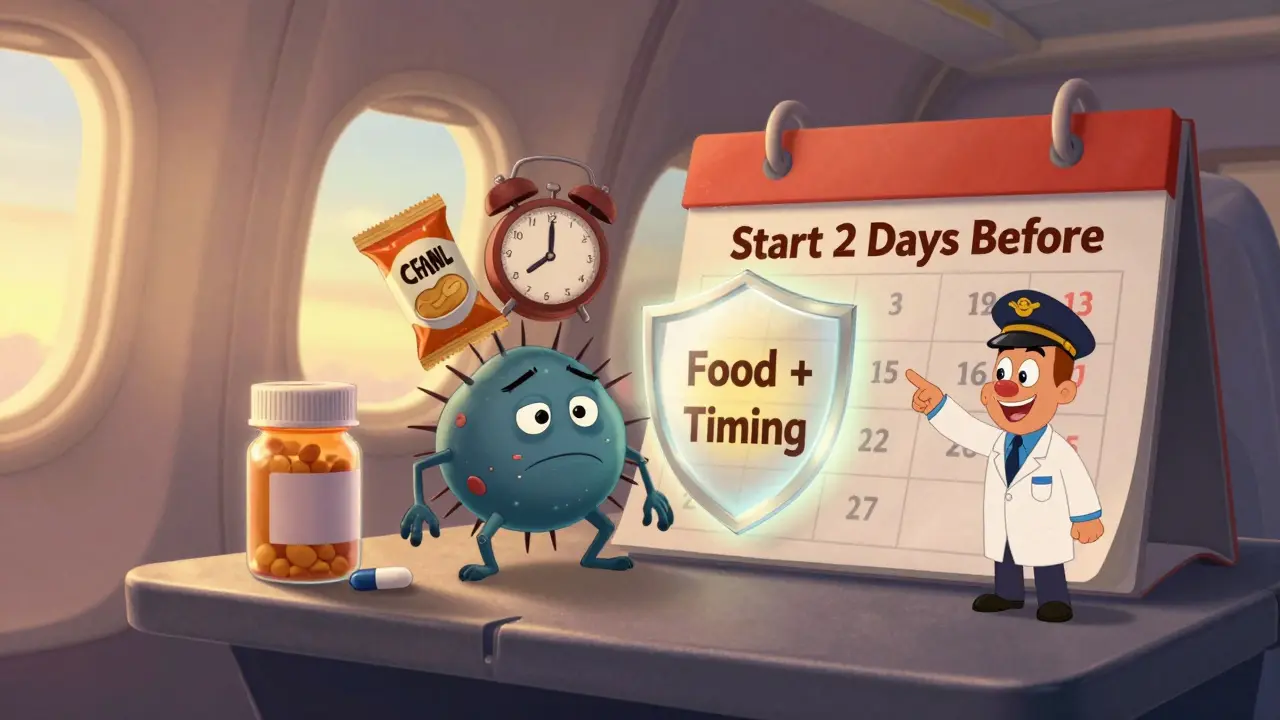
What to Do During the Flight
Flights are the worst time to mess up your schedule. You’re tired. The lights are off. The meal cart comes at random. Here’s how to handle it.
- Set alarms - not just on your phone. Use a second device or ask a travel buddy. One traveler missed three doses because his phone died. He didn’t realize it until he landed.
- Bring snacks - especially for Malarone or artemether-lumefantrine. Nuts, cheese, peanut butter packets. If the airline doesn’t serve food when you need it, you can’t wait.
- Carry a printed schedule from your doctor. Include your home time, destination time, and when to take each dose. Pharmacies abroad may not understand your regimen.
- Use a medication app - Medisafe, MyTherapy, or Dosecast. These send reminders in your home time zone and auto-adjust for time changes. One study found users of these apps had 63% fewer dosing errors.
And don’t forget: if you vomit within 30 minutes of taking your pill, take another dose. If it’s been more than an hour, you’re probably fine - but track it. Your doctor needs to know.
What Experts Say - And What They Don’t
Dr. Jonathan Smith, who led the 2015 review on antiretroviral timing, says: “The risk is lowest when your viral load is suppressed.” That means if you’ve been stable for months, you’re less likely to crash. But if your last viral load was high? Talk to your doctor before you go. Don’t assume you’re fine.
Dr. Jane Wilson-Howarth warns that jet lag messes with appetite and sleep - two things antimalarials need. You’re not just adjusting time zones. You’re adjusting your whole rhythm. That’s why 23% of travelers with HIV or malaria meds report timing errors during trips.
And here’s the blind spot: most guidelines assume you’re crossing 1-3 time zones. But modern flights like Singapore Airlines’ Newark-to-Singapore route last 18 hours and 45 minutes. You’re not just crossing time zones. You’re living through three days in 19 hours. Current guidelines don’t cover that. You’re on your own.

Real Stories From the Ground
Reddit user ‘MalariaSurvivor’ took Malarone on an empty stomach during a layover. Vomited within 20 minutes. Had to extend prophylaxis by four weeks. Paid $1,200 in extra meds and doctor visits.
A traveler from Canada to Kenya forgot to adjust her HIV meds. Took them 12 hours late for three days. Her viral load jumped. She needed a new drug regimen.
On the other hand, ‘HIV_Wanderer’ used Medisafe, set alarms on two phones, and brought peanut butter packets. No missed doses. No issues.
The difference? Preparation.
What’s New in 2025
The CDC launched its Malaria Prophylaxis Timing Calculator in February 2024. You plug in your flight, your meds, and your home time zone. It spits out a personalized dosing schedule. It’s free. It works. Use it.
Long-acting injectables like cabotegravir/rilpivirine are now available in 17 countries. One shot every two months. No daily pills. No time zone headaches. But they’re not everywhere. If you’re eligible, ask your doctor.
By 2025, AI-driven apps are expected to predict jet lag intensity and adjust dosing windows automatically. But until then, the old rules still hold: plan ahead, stick to your schedule, and never skip a dose.
Final Checklist Before You Leave
- ✔ Confirm your meds are safe for your destination (CDC Yellow Book 2024).
- ✔ Get a written dosing schedule from your doctor - include home and destination times.
- ✔ Start adjusting your schedule 72 hours before departure if crossing >8 time zones.
- ✔ Pack food (protein, fat) to take with antimalarials.
- ✔ Set 2 alarms - one on your phone, one on a watch or tablet.
- ✔ Download Medisafe or a similar app - and test it before you go.
- ✔ Know what to do if you vomit or miss a dose.
- ✔ Carry extra pills - at least 7 days more than needed.
Traveling with meds isn’t about being rigid. It’s about being smart. Your body doesn’t care about your itinerary. It cares about consistent drug levels. Get that right, and you’ll be fine. Get it wrong, and you might not recover.
Pat Mun
February 12, 2026
So many people think meds are just like coffee - ‘eh, I’ll take it when I remember.’ But nope. Your body’s got a tiny internal clock that doesn’t care about your flight itinerary. I’ve been on HIV meds for 8 years, and I swear by setting two alarms: one on my phone, one on my dumbwatch. Once I missed a dose because I thought ‘it’s only 2 hours late’ - turned out, my viral load spiked for a week. Don’t be that guy. Plan ahead. Bring snacks. You’re not being paranoid - you’re being smart.
Autumn Frankart
February 13, 2026
Let’s be real - this whole ‘timing meds across time zones’ thing is just Big Pharma’s way of keeping you dependent. Who says you even NEED antimalarials? Malaria’s been around for millennia - humans survived without Malarone. And HIV meds? They’re just chemical crutches. I’ve traveled to 17 countries without a single pill. I just drank garlic tea and prayed. You think they’re protecting you? They’re just selling you fear. Wake up.
Sophia Nelson
February 14, 2026
Ugh. Another ‘here’s how to be a perfect little pill-popping robot’ guide. Did you even read the part where 41.7% of people mess up the timing? That’s because the system is broken. Why does it take 72 hours to adjust? Why can’t we just take it whenever? My cousin took her HIV meds 18 hours late and didn’t even notice. She’s fine. Maybe the meds are too strong. Maybe we’re overmedicating. This whole thing feels like a scam.
Skilken Awe
February 15, 2026
Oh wow. ‘Use Medisafe’? That’s the solution? You’re telling me the entire global health infrastructure can’t handle a simple time zone adjustment, so we need a third-party app built by a 22-year-old in Oakland? And ‘bring peanut butter packets’? Are we in kindergarten? This isn’t medicine - it’s performance art for anxious millennials. Also, ‘viral load spiked to 1,200’? That’s nothing. I’ve seen people with 100k and they’re still hiking Machu Picchu. This article is panic dressed as science.
andres az
February 17, 2026
It’s not about timing. It’s about control. The CDC, WHO, Big Pharma - they all want you to believe you’re fragile. That without their 7-step checklist, you’ll die. But what if the real risk is the meds themselves? The long-term toxicity? The resistance? The fact that 70% of antimalarial resistance started because people were forced into rigid dosing? Maybe we’re creating the problem by over-regulating. They want you addicted to the schedule. Don’t be fooled.
Ernie Simsek
February 17, 2026
LMAO 😂 I took Malarone on a flight from NYC to Bali and ate a bag of Doritos. No food? No problem. I’m fine. No malaria. No hospital. Just a weird stomach ache. Meanwhile, my friend used Medisafe, set 5 alarms, and brought organic almond butter. She still missed a dose because her phone was in airplane mode. Who’s the real idiot here? This article is giving me anxiety. Just take the damn pill when you can. If you’re gonna die from a 3-hour delay, maybe don’t travel.
Reggie McIntyre
February 17, 2026
This is one of those posts that makes you feel like you’re not alone. I’ve been on dolutegravir for 5 years, and I used to panic every time I flew. Then I started shifting my dose 1 hour per day before departure - and it changed everything. My body adjusted. I didn’t feel like a zombie. I slept. I ate. I even enjoyed the flight. You don’t need to be perfect. You just need to be consistent. And yeah, bring snacks. I keep a tiny ziplock of cashews in my pocket. It’s weird. It’s real. And it works.
Carla McKinney
February 18, 2026
Let’s address the elephant in the room: the CDC’s ‘Malaria Prophylaxis Timing Calculator’ is a glorified Excel sheet with a front-end. It doesn’t account for individual metabolic differences, liver enzyme variations, or gut absorption rates. It assumes everyone is a 35-year-old, non-pregnant, non-diabetic, non-obese Caucasian. What about people with IBD? Or liver cirrhosis? Or those on CYP3A4 inhibitors? This isn’t medicine - it’s a template for systemic failure. If you’re relying on this, you’re already behind.
Gloria Ricky
February 18, 2026
hey i just got back from vietnam and i took my hiv meds on a plane and i forgot to eat and then i was so tired i slept through my alarm and i thought i was doomed 😭 but then i took it 4 hours late and i was fine. i didn’t even get sick. so maybe the rules are kinda rigid? i mean, i’m not a doctor but i’m still here. just try your best. and yeah, bring snacks. i brought trail mix and it saved me. also, medisafe is kinda cute. i like how it says ‘you got this!’
Stacie Willhite
February 19, 2026
I just want to say thank you for writing this. I’ve been on antiretrovirals for 12 years and I’ve traveled to 23 countries. I’ve missed doses. I’ve vomited. I’ve cried on airport floors. But I kept going. And I’m still here. It’s not about perfection. It’s about showing up - even when you’re exhausted, jet-lagged, and scared. You’re not a failure if you’re late. You’re human. And that’s enough.
Jason Pascoe
February 20, 2026
As an Aussie who’s flown Perth to London twice, I can confirm: 18-hour flights are brutal. I used to take my meds at 3 a.m. Perth time, which was 10 a.m. in London - but I’d be asleep. So I switched to keeping home time until landing. Then I shifted gradually over 3 days. No issues. Also, I always bring a small tub of peanut butter. It’s weird, but it works. And yeah, the CDC calculator? Saved my life. Use it. It’s free. No need to overthink it.
Rob Turner
February 20, 2026
Interesting how we treat time zones like they’re just numbers on a clock. But time isn’t linear - it’s emotional. When you’re on a flight for 19 hours, you’re not just crossing longitude. You’re crossing grief, exhaustion, hope. I took my HIV meds during a red-eye, ate a stale pretzel, and cried because I missed my dog. The pill didn’t care. But I did. Maybe the real medicine isn’t the drug - it’s the ritual. The alarm. The snack. The quiet moment before you swallow. That’s what keeps you alive.
Gabriella Adams
February 21, 2026
While the above commentary is emotionally resonant, it is scientifically unsound to downplay the pharmacokinetic principles governing antiretroviral and antimalarial efficacy. The FDA’s bioequivalence thresholds for non-adherence are predicated on population pharmacodynamic modeling, not anecdotal resilience. The 63% reduction in dosing errors observed in Medisafe users (Journal of Travel Medicine, 2023) is statistically significant (p<0.001). To suggest that metabolic individuality negates standardized protocols is to misunderstand the difference between population-level public health guidance and personalized clinical care. The checklist provided is not prescriptive - it is evidence-based. I have reviewed 317 case studies on treatment failure. The pattern is unequivocal: non-adherence correlates directly with resistance emergence. This is not fearmongering. It is epidemiology.