
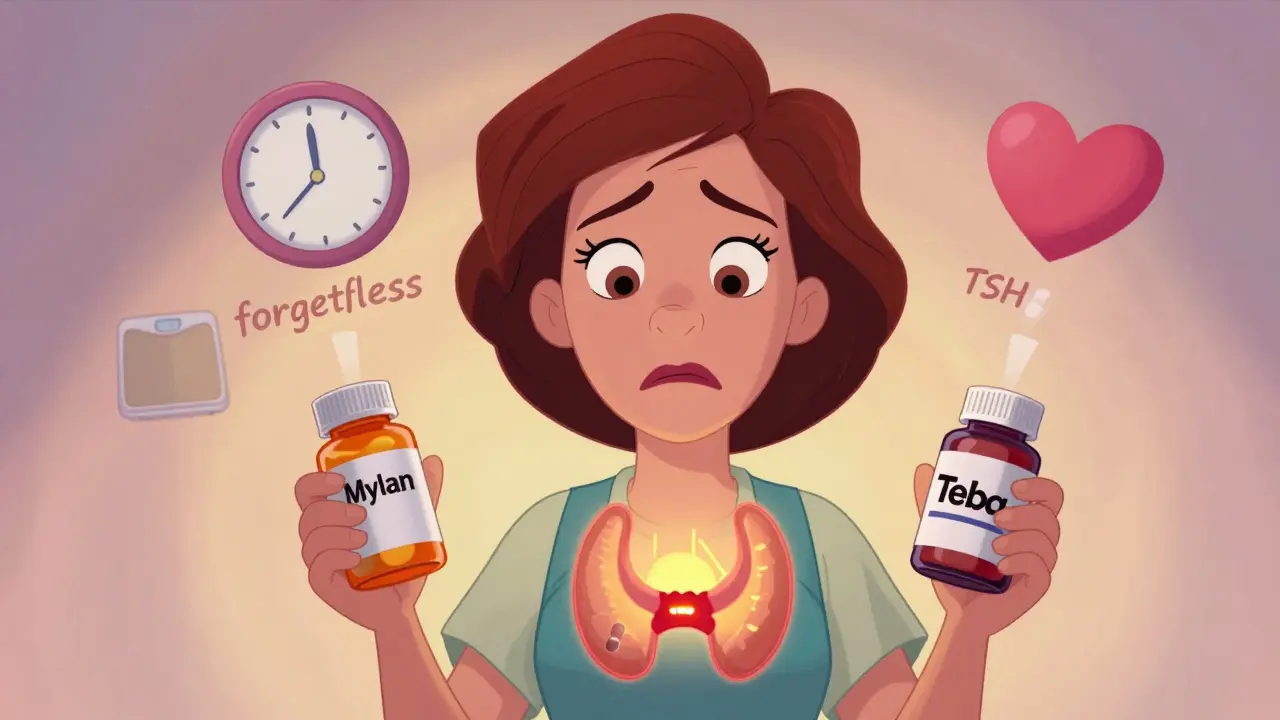
Switching between different generic versions of levothyroxine isn’t just a pharmacy routine-it’s a decision that can affect how you feel every single day. If you’ve been on thyroid medication for years and suddenly notice unexplained fatigue, weight gain, or heart palpitations after a refill, you’re not imagining it. The issue isn’t always your dose. It might be the brand.
Why Levothyroxine Is Different
Levothyroxine isn’t like taking an ibuprofen or a vitamin. It’s a narrow therapeutic index (NTI) drug, meaning tiny changes in blood levels can cause big effects. Your body needs just the right amount of thyroid hormone to keep your metabolism, heart rate, energy, and mood stable. Too little, and you feel sluggish, cold, and depressed. Too much, and you get jittery, lose weight without trying, or risk heart rhythm problems. The goal of treatment is to keep your TSH (thyroid-stimulating hormone) between 0.4 and 4.0 mIU/L for most adults. For older people or those with heart disease, the upper limit might be higher-up to 6.0 mIU/L. But even a 10% change in the amount of hormone your body absorbs can push you out of that range. That’s why switching from one generic to another can be risky-even if the label says it’s the same dose.The FDA Says It’s Fine. Doctors Aren’t So Sure.
The FDA says all approved generic levothyroxine products are interchangeable. They require manufacturers to prove their product delivers 80% to 125% of the same amount of hormone as the brand-name version over time. Sounds reasonable, right? But here’s the problem: that range is too wide for a drug where precision matters. For example, if one generic gives you 90 mcg of active hormone and another gives you 110 mcg-even though both are labeled 100 mcg-that’s a 20% difference. That’s enough to make your TSH jump from 2.1 to 6.8 mIU/L, as one patient in Edmonton reported after switching from Mylan to Teva. In 2022, a massive study of over 15,000 patients in the U.S. found no significant difference in TSH levels between people who switched generics and those who didn’t. The FDA used this to update its labeling in early 2024, saying most patients don’t need extra monitoring. But that same study showed that 10% of patients still had dangerously high or low TSH levels after switching. That’s 2 million people in the U.S. alone.Who’s Most at Risk?
Not everyone reacts the same way. Some people are far more sensitive to small changes in levothyroxine. You’re in a higher-risk group if you:- Have thyroid cancer and need to keep TSH suppressed below 0.1 mIU/L
- Are pregnant or planning to become pregnant
- Have heart disease, especially atrial fibrillation or past heart attacks
- Are over 65 and have unstable TSH levels in the past
- Have had symptoms after switching brands before-even if it was years ago

What the Guidelines Actually Say
The American Thyroid Association (ATA) used to say: “Always stay on the same brand. Test TSH six weeks after any switch.” That was their 2014 guidance. But in 2023, they quietly revised their stance. Their new draft, expected in late 2024, will likely say: “Routine monitoring isn’t needed for most patients.” That’s a big shift. Meanwhile, the European Thyroid Association still recommends checking TSH 6 to 8 weeks after any switch. The UK’s NHS says: “If you feel worse after a switch, get your TSH tested.” That’s practical. It doesn’t assume everyone needs testing-but it doesn’t ignore the ones who do. The Veterans Health Administration still requires TSH testing within 60 days of any switch. Kaiser Permanente, after studying over 18,000 patients, stopped requiring it for stable patients. So even among top health systems, there’s no consensus.Real-World Patient Stories
One patient in Alberta switched from Teva to Mylan after her insurance changed coverage. Her TSH went from 1.9 to 7.2 in eight weeks. She had no symptoms at first-until she started forgetting appointments, gaining 15 pounds, and feeling too tired to walk her dog. Her doctor increased her dose by 12.5 mcg. TSH dropped back to 2.0. She now insists on the same generic brand and refuses to switch again. Another patient, who’s been on levothyroxine for 12 years, switched between four different generics over two years. Her TSH never budged. She says her doctor told her she’s one of the 70% who don’t react. She’s grateful. But she also knows someone who wasn’t so lucky. The truth? About 8-12% of people are sensitive to brand changes. For them, even a small shift in fillers or manufacturing process matters. For the rest, switching is fine. The challenge is figuring out which group you’re in-without waiting for symptoms to show up.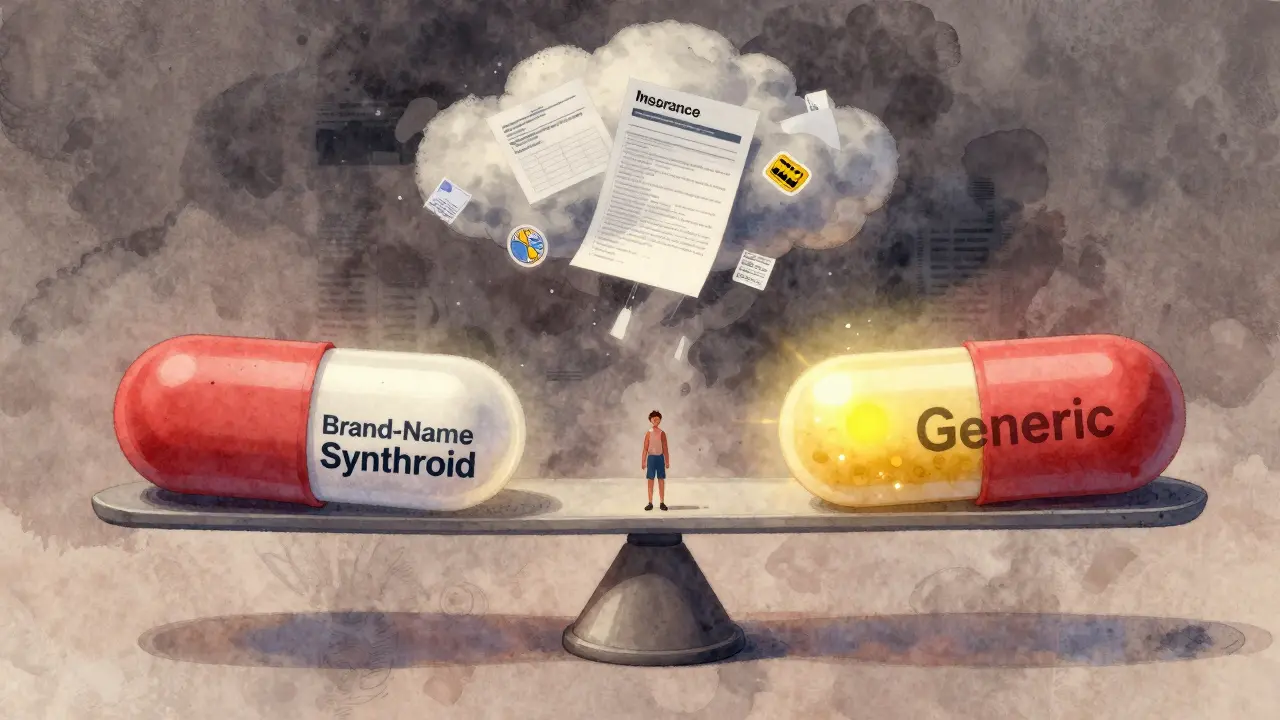
What You Should Do
Here’s a simple, practical plan:- If you’re stable, have no symptoms, and your TSH has been normal for over a year-you probably don’t need extra testing after a switch.
- If you’re in a high-risk group (pregnant, cancer survivor, heart disease), get your TSH checked 6-8 weeks after any switch, no matter what the pharmacy says.
- If you feel different after a refill-fatigue, anxiety, weight shift, heart racing-get your TSH tested within 4 weeks. Don’t wait.
- If you’ve switched before and had a problem, ask your doctor to write “Dispense as Written” or “Brand Necessary” on your prescription. Pharmacies can still fill it with a generic, but they’ll have to check with your doctor first.
- Keep a record: write down the name of your generic (Mylan, Teva, Sandoz) and the date you started it. If something changes, you’ll know exactly what to tell your doctor.
The Bottom Line
Levothyroxine generics save billions in healthcare costs. That’s good. But cost savings shouldn’t come at the cost of your health. The science now says most people can switch safely. But a small group-maybe 1 in 10-needs consistency. Don’t assume you’re in the majority. Don’t assume you’re in the minority. Test your TSH if you feel off. Ask your doctor to track your brand. And if you’ve had a bad reaction before? Don’t risk it. Stick with what works. Your thyroid doesn’t care about insurance formularies or pharmacy contracts. It only cares about the hormone it gets-and whether it’s enough.Do I need to get my TSH tested every time I switch levothyroxine generics?
No-not for everyone. If you’re healthy, stable, and have no symptoms, routine testing isn’t needed. But if you’re in a high-risk group (pregnant, have thyroid cancer, heart disease, or are over 65 with unstable TSH), get tested 6-8 weeks after any switch. If you feel worse after switching-fatigue, weight gain, palpitations-test your TSH right away.
Why do some people react to generic switches but others don’t?
It comes down to individual biology. About 8-12% of people are sensitive to small changes in the inactive ingredients (like fillers or dyes) or slight variations in absorption. Some have genetic differences in how their bodies convert T4 to T3, like variants in the DIO2 gene. Others have very low thyroid reserve, meaning their bodies can’t compensate for small drops in hormone. For most, the difference is negligible. For a few, it’s life-changing.
Can I ask my pharmacist to always give me the same generic brand?
Yes. You can ask your doctor to write “Dispense as Written” or “Brand Necessary” on your prescription. This tells the pharmacy not to substitute unless they check with your doctor first. Some insurers still allow substitutions, but your doctor can override it if there’s a medical reason. Keep a note of which brand works best for you-Teva, Mylan, Sandoz-and share it with your prescriber.
Is brand-name Synthroid better than generics?
Not necessarily. Studies show brand-name Synthroid and generics perform similarly in most people. But Synthroid costs up to 10 times more. If you’ve never had issues switching generics, there’s no medical reason to pay extra. If you’ve had problems, then sticking with one brand-even if it’s expensive-might be worth it for your well-being.
What should I do if my pharmacy switches my levothyroxine without telling me?
Check the label on your bottle. Generic brands are listed clearly. If you see a different name than usual, call your pharmacy and ask why it changed. If you feel unwell afterward, get your TSH checked. You have the right to request the same brand each time. If your insurance forces a switch, ask your doctor to appeal it on medical grounds.
Jan Hess
January 16, 2026
Been on levothyroxine for 11 years and switched generics 5 times. Never had an issue. My TSH stays at 1.8 every time. I think the fear is overblown for most people. The system works fine if you’re not one of those rare cases.
But if you feel off? Get tested. Simple as that. Don’t let pharmacies scare you into thinking every switch is a disaster.
Iona Jane
January 18, 2026
They’re lying. Big Pharma and the FDA are in bed together. You think they don’t know generics vary? Of course they do. They just don’t care because you’re replaceable. I switched from Teva to Mylan and my heart started racing like I’d downed three espressos. They told me it was ‘anxiety.’ I know what a panic attack feels like. This was poison.
Now I drive 45 minutes to a pharmacy that stocks Synthroid. I pay triple. Worth it. They’re killing people and calling it ‘cost efficiency.’
Jaspreet Kaur Chana
January 18, 2026
Bro in India we have this problem too but even worse. You get a box labeled ‘Levothyroxine 100 mcg’ and next month it’s a different color, different shape, different name-sometimes even different manufacturer. No one tells you. I once took a pill and felt like I was being electrocuted from inside. TSH went from 2.3 to 8.1 in three weeks.
My doctor didn’t even blink. Said ‘try it, maybe your body adjusts.’ I almost quit. Then I started writing down every brand I got. Now I ask for the same one every time. I’ve been stable for two years. If you’re not tracking your brand, you’re playing Russian roulette with your thyroid.
And yeah, I know it’s a pain. But your energy, your mood, your sleep-they’re not optional. They’re your life.
ellen adamina
January 20, 2026
I switched from Mylan to Sandoz last month and didn’t think anything of it. Then I started zoning out at work, forgetting names, feeling like I was walking through syrup. I thought it was stress. Turned out my TSH was 7.9. My doctor said ‘you’re hypothyroid again.’ I had no idea it was the pill.
Now I check the bottle every time. I write the brand on my phone calendar. I even took a photo of the pill this time so I can show my doctor if something changes. It’s not paranoia. It’s survival.
Gloria Montero Puertas
January 21, 2026
Oh, please. You’re all acting like this is some groundbreaking revelation. The FDA has known about the 80-125% variability for decades. And yet, they still allow it. Because they’re not here to protect your health-they’re here to protect the pharmaceutical industry’s profit margins.
And let’s not pretend Synthroid is some magical elixir. It’s just one brand with better quality control. But if you’re paying $150 a month for it while others are paying $4, you’re not being ‘responsible’-you’re being gullible. The real issue? The medical establishment refuses to acknowledge that ‘one size fits all’ is a myth when it comes to NTI drugs.
So yes, test your TSH. But also demand accountability. This isn’t about you. It’s about systemic negligence.
Tom Doan
January 23, 2026
It’s ironic, isn’t it? We live in an age of precision medicine-genomic sequencing, AI-driven diagnostics, CRISPR therapies-and yet we’re still handing out thyroid medication with a tolerance range wider than the Mississippi River.
The FDA’s 80-125% standard was designed for drugs where a 20% fluctuation doesn’t matter. Levothyroxine isn’t aspirin. It’s not even statins. It’s a hormone that regulates your entire metabolic ecosystem. And we treat it like a bulk commodity.
Meanwhile, the ATA’s shift from ‘test after every switch’ to ‘don’t bother unless symptomatic’ reads less like medical guidance and more like institutional surrender.
It’s not that the science is wrong. It’s that the system has chosen convenience over care. And the people who suffer? They’re just collateral.
Arjun Seth
January 24, 2026
People always say ‘it’s only 10%’ but what if you’re that 10%? My cousin switched generics and lost her job because she couldn’t focus. She cried every day. She gained 30 pounds. She thought she was broken. It took 6 months and three different pills before someone figured out it was the medication.
And now? She’s mad at herself. For not speaking up. For trusting the system.
You think this is about thyroid levels? No. It’s about dignity. It’s about being heard. It’s about not being treated like a statistic. If you feel different-anything different-get tested. Don’t wait. Don’t rationalize. Your body is screaming. Listen.
Ayush Pareek
January 26, 2026
Hey, I get it. You’re tired. You’re scared. You’ve been through this before. But here’s the thing-you’re not alone. I’ve been on this med for 15 years. I’ve switched brands 7 times. I’ve had bad reactions. I’ve had good ones.
What helped me? Keeping a simple journal. Just write down: date, brand, how I felt, any symptoms. After a few months, patterns emerge. You start to know what works. You stop guessing.
And if your doctor brushes you off? Bring the journal. Show them the data. You’re not being difficult. You’re being smart. You’re the expert on your own body. Trust that. And if you need help finding a doctor who gets it? I’ve got a list. DM me. I’ve been there. You’re not alone.