
When you pick up a generic pill at the pharmacy, you expect it to work just like the brand-name version. But how does the FDA make sure it doesn’t lose potency before the expiration date? The answer lies in stability testing-a rigorous, science-driven process that every generic drug must pass before it reaches patients.
Why Stability Testing Matters for Generics
Generic drugs aren’t just copies. They’re required to be identical in strength, quality, and performance to the original brand-name drug. But drugs aren’t static. Over time, they can break down. Moisture, heat, light, and even the container they’re packed in can change how they behave. If a pill loses 15% of its active ingredient, it might not work. Worse, it could produce harmful impurities. That’s why the FDA requires stability testing. It’s not about proving a generic works-it’s about proving it stays safe and effective from the day it leaves the factory until the day the patient finishes the bottle. Without this data, the FDA can’t approve the drug. And without approval, it can’t be sold in the U.S.What the FDA Actually Requires
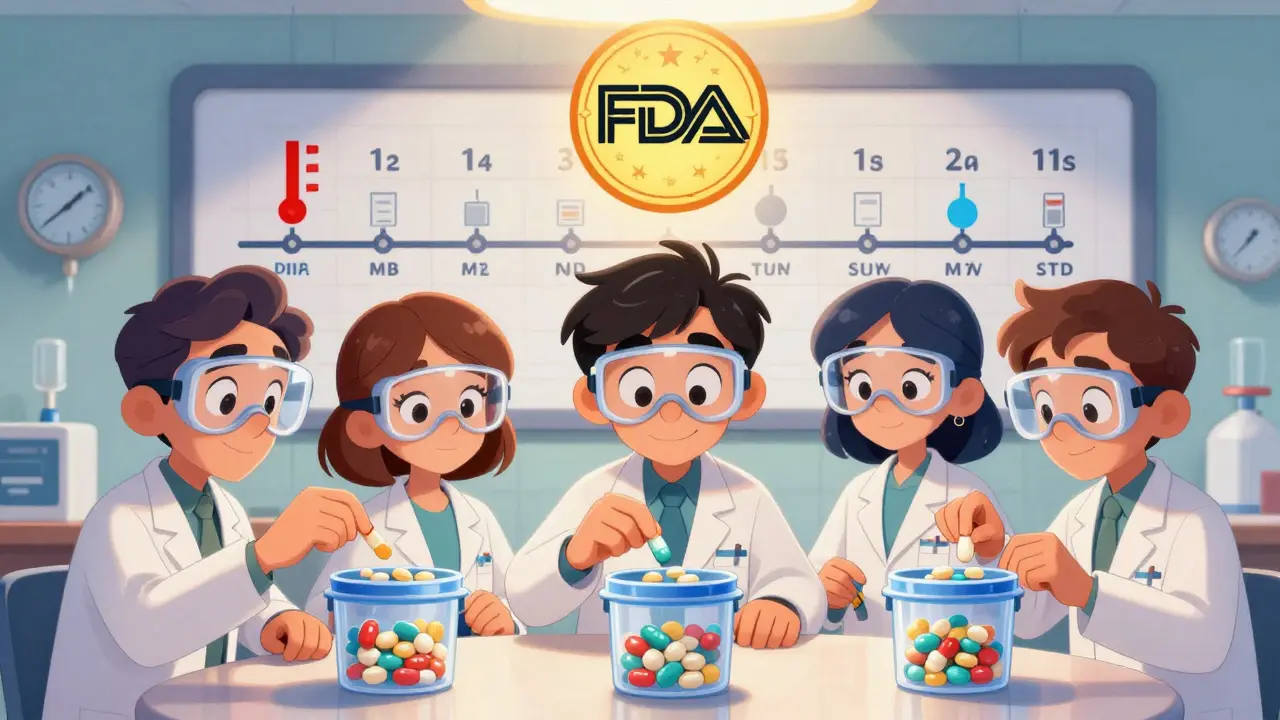
The FDA’s expectations for stability testing are detailed and specific. They’re based on international standards from the International Council for Harmonisation (ICH), especially ICH Q1A(R2). Here’s what generic manufacturers must deliver:- Three primary batches of the drug product, each made at pilot scale under current Good Manufacturing Practices (cGMP). These aren’t lab samples-they’re real production batches that reflect what will be sold to pharmacies.
- Long-term testing at the proposed storage conditions. For most oral solids, that’s 25°C ± 2°C and 60% ± 5% relative humidity. Studies must run for at least 12 months before submission, and continue beyond that to confirm the expiration date.
- Accelerated testing at 40°C ± 2°C and 75% ± 5% humidity. This simulates harsh conditions to predict how the drug will degrade over time. Six months of accelerated data is required for ANDA submission.
- Testing frequency: Every 3 months in the first year, every 6 months in the second year, and annually after that-until the proposed shelf life ends.
- Attributes tested: Not just potency. The FDA looks at physical changes (color, texture, disintegration), chemical degradation (impurities, breakdown products), microbiological safety (for non-sterile products), and even the functionality of delivery systems (like inhalers or injectables).
How Generics Differ from Brand-Name Drugs
You might think generics get a pass because they’re copying an existing drug. They don’t. The testing rules are the same. But there are key differences:- Generics don’t need to re-prove how the drug degrades. The brand-name drug’s degradation pathways are already well-documented. Generics just need to show their version follows the same pattern.
- Generics don’t run forced degradation studies for every possible stress condition. They can rely on the innovator’s data, as long as they demonstrate their product behaves the same way.
- Brands often test more batches (sometimes 6-10) over longer periods before launch. Generics must test at least three-but those three must be flawless.
Why So Many Generics Get Rejected
Stability testing is the #1 reason generic drug applications get delayed. According to the FDA’s own data, 34.6% of Complete Response Letters (the official notice that an application isn’t approved) in 2019 were due to stability issues. Common failures include:- Missing protocols: No written plan for how tests are done. This alone caused 98.3% of completeness assessment failures.
- Insufficient data points: Skipping a 6-month test, or not testing at all during the second year.
- Improper storage: Stability chambers that drift more than ±2°C. FDA inspections found average temperature excursions of 4.7°C, happening over twice a month at some facilities.
- Unvalidated methods: If the lab can’t prove its test accurately measures the drug’s potency over time, the data is useless. This was cited in over 31% of stability-related rejections.
- Wrong container: Testing in a glass vial when the final product will be in a plastic bottle. The FDA won’t accept it.
How Manufacturers Are Adapting
To avoid delays, smart companies are changing how they do stability testing:- Automated monitoring: 78.4% of the top 25 generic manufacturers now use real-time sensors to track temperature and humidity. If a chamber goes out of range, the system alerts staff immediately.
- Protocol reviews with the FDA: Some companies request a pre-submission meeting with the FDA before filing. This cuts deficiency rates by 42.6%.
- Bracketing and matrixing: Instead of testing every strength and size, companies test only the extremes (highest and lowest dose, smallest and largest container) if they can prove the others will behave the same. This saves time and money-and the FDA approved it in 67.3% of cases in 2022.
- Blockchain pilots: Starting in Q2 2025, the FDA will test blockchain systems to verify stability data integrity. This could eliminate fake or altered records.
Costs and Market Pressures
Stability testing isn’t cheap. It averages $487,500 per generic drug application-about 18.7% of total development costs. For a company launching 10 generics a year, that’s nearly $5 million just on stability studies. The pressure is worse for manufacturers in India, which supply 40.3% of U.S. generics. Yet they account for 62.8% of all stability-related rejections. Why? Many smaller labs lack the infrastructure, trained staff, or quality control systems to meet FDA standards. Even worse, the FDA’s new draft guidance (June 2025) will require 24 months of stability data for all new ANDAs-up from 12. That’s a 100% increase in testing time for every new product. Costs are expected to rise 22.4% by 2027.
What’s Coming Next
The future of stability testing is changing fast:- Quality by Design (QbD): The FDA wants manufacturers to build stability into the product from day one-not test it after the fact. This means better formulations, better packaging, and fewer surprises.
- Nanomaterials: New drugs using nanoparticles (like some cancer treatments) need special stability studies. Their behavior under heat and light is unpredictable.
- Climate zones: The ICH is updating guidelines to require testing under conditions specific to where the drug will be sold-hot and humid regions, cold climates, high altitudes.
- Continuous manufacturing: If a drug is made using continuous production (instead of batch processing), the FDA now requires direct comparison of stability between the two methods.
What Patients Should Know
You don’t need to understand the science. But you should know this: every generic you take has been tested to last. The expiration date isn’t a guess. It’s backed by months-if not years-of real-world data. The FDA doesn’t approve drugs based on hope. They approve them based on evidence. And if a generic fails stability testing? It doesn’t hit the shelf. Not even once.FAQ
Do generic drugs need the same stability testing as brand-name drugs?
Yes. Both must follow the same ICH Q1A(R2) guidelines. The difference is that brand-name companies build their stability data from scratch, while generics can reference existing data-but they still must test their own product on their own batches under real-world conditions.
How long does stability testing take before a generic drug is approved?
For submission, manufacturers need at least 6 months of accelerated data and 6 months of long-term data. But full approval often requires 12 months of real-time data. The FDA may approve a product with a 12-month shelf life based on early data, but the manufacturer must continue testing to confirm the date holds up over time.
Can a generic drug be approved without full stability data?
No. The FDA requires at least 6 months of long-term data and 6 months of accelerated data for any ANDA submission. Incomplete data leads to a Complete Response Letter, which delays approval by months or even years.
Why do so many generic drug applications fail stability testing?
The most common reasons are missing or poorly written protocols, inadequate testing frequency, improper storage conditions, and unvalidated analytical methods. Many manufacturers underestimate how precise the FDA’s expectations are. A temperature deviation of just 2°C can invalidate an entire study.
What happens if a generic drug fails stability testing after it’s on the market?
If post-market testing shows degradation beyond acceptable limits, the manufacturer must recall the product, notify the FDA, and halt distribution. The FDA may also issue a public warning. In extreme cases, the drug’s approval can be revoked.
Katy Shamitz
March 11, 2026
Okay but let’s be real - if you’re taking a generic pill and it doesn’t work, you’re not just risking your health, you’re risking your *life*. I’ve seen people on blood thinners switch generics and end up in the ER. The FDA’s rules? Barely enough. They’re playing catch-up while Big Pharma’s laughing all the way to the bank. This isn’t science - it’s a gamble with your heart.
And don’t even get me started on the labs in India. 62.8% of rejections? That’s not incompetence - that’s systemic neglect. We’re outsourcing our safety to places that can’t even keep a fridge at 25°C. What even is this country anymore?
I’m not saying we should ban generics. I’m saying we should ban the people who let this happen.
And yes - I’ve had my own meds fail. I know what I’m talking about.
Nicholas Gama
March 12, 2026
Stability data? More like stability theater. FDA’s just a rubber stamp for corporate greed. They approve drugs based on paperwork, not reality. Temperature logs? Fabricated. Protocols? Ghostwritten. You think they actually test? Nah. They just need the numbers to look clean before the next quarterly report.
And blockchain? Cute. That’s just a shiny new lock on a door that’s already wide open.
Dan Mayer
March 12, 2026
So i read this whole thing and like… 78.4% of top 25 use automaed monitoring? That’s wild. I mean, how do you even miss a temp excusion of 4.7°C? That’s like leaving your milk out for 3 hours and then acting shocked it’s sour. And the FDA just sits there? No wonder so many apps get rejected. It’s not the science - it’s the people. People who think ‘close enough’ is a valid quality control metric. JFC.
Also, why is ‘bracketing’ even a word? Sounds like a yoga pose.
Janelle Pearl
March 13, 2026
I just want to say - thank you for writing this. I’ve been on a generic medication for 8 years. I never knew how much went into making sure it was safe. It’s easy to take for granted. But now I see - behind every pill is months of testing, hundreds of data points, and people who care enough to get it right.
Not everyone does. But the ones who do? They’re the quiet heroes. The ones in the lab at 2 a.m., checking humidity levels, logging temperatures, double-checking every number.
So thank you. For the truth. And for the work.
Stephen Rudd
March 14, 2026
Let me guess - you’re one of those people who thinks the FDA is some kind of saintly guardian. Newsflash: they’re bureaucrats with clipboards. They don’t care if your drug works. They care if the paperwork matches the template. That’s why generics fail - not because they’re unsafe, but because someone didn’t label a vial in the exact font the FDA prefers.
And blockchain? Please. You think a distributed ledger is going to stop a lab from faking data? That’s like putting a lock on a bank vault… that’s already been robbed by the janitor.
Stop romanticizing regulation. It’s not safety. It’s performance art.
Erica Santos
March 16, 2026
Oh wow. A 100% increase in testing time? So now instead of waiting 12 months, we wait 24? That’s not progress - that’s punishment. Who’s paying for this? You? Me? The guy in Ohio who needs his blood pressure meds but can’t afford them because the cost went up 22.4%? Classic. Let’s make the system slower, more expensive, and more opaque - because obviously, that’s what patients need.
Meanwhile, the brand-name guys? They’ve got 15 years of data already locked in. Generics? Now they’ve got to re-invent the wheel. Twice. And get it perfect. Or go broke.
Brilliant. Just brilliant.
George Vou
March 16, 2026
so like… if a generic fails stability testing, does that mean it’s dangerous? or just not as good? like… is it still kinda okay to take? i mean, if it’s only 10% weaker, is that really a big deal? i’ve seen people take expired aspirin and live. maybe we’re overthinking this? also, who even checks the humidity in a storage room? sounds like a job for a robot. or a very bored intern.
Melba Miller
March 16, 2026
Let me tell you something - I’ve worked in FDA compliance for 17 years. I’ve seen the files. I’ve signed the reports. And I’ll tell you this: 90% of the failures? They’re preventable. It’s not about funding. It’s about culture. Companies treat stability testing like a box to check - not a science. They cut corners. They skip runs. They use cheaper containers because ‘it’s the same plastic.’
And then they wonder why the FDA rejects them.
We don’t need more rules. We need people who care enough to follow the ones we have.
And if you’re in India? You’re not failing because you’re poor. You’re failing because you’re not being held accountable. And that’s on us.
Ray Foret Jr.
March 17, 2026
Guys. I just want to say - this is actually kind of amazing. I used to think generics were just cheap knockoffs. But now I get it - they’re not. They’re the unsung heroes of healthcare. People think ‘generic’ means ‘low quality.’ But the truth? It means ‘rigorously tested, cost-efficient, life-saving.’
And yeah - some labs mess up. But the ones that don’t? They’re saving millions. Every single day.
Let’s not punish the good guys because the bad ones exist. Let’s fix the system. And support the ones doing it right. 💪💊
Also - blockchain? I’m here for it. Future is now, baby.
Samantha Fierro
March 18, 2026
Thank you for this detailed and thoughtful breakdown. It’s rare to see a public explanation of the science behind generics that doesn’t devolve into either fear-mongering or blind optimism. What stood out most to me was the distinction between the *process* and the *intent* - generics aren’t trying to cut corners; they’re trying to meet the same standard with fewer resources and greater pressure.
The human cost of these failures is real - delayed access, increased prices, lost trust. But the solution isn’t to abandon generics. It’s to invest in the labs, train the technicians, and hold every facility to the same standard - regardless of location.
Stability testing isn’t bureaucracy. It’s the last line of defense between a patient and harm. And that deserves more than a footnote in a press release.