
How the U.S. Drug Supply Chain Stops Fake Medicines Before They Reach You
Every year, over 5.8 billion prescription drug packages move through the U.S. supply chain. Most arrive safely. But not all. Counterfeit drugs - fake pills, diluted powders, or mislabeled vials - can slip in if the system isn’t locked down. That’s why the U.S. built one of the most complex drug safety systems in the world: the Drug Supply Chain Security Act (DSCSA). It doesn’t just hope to stop fakes. It forces every player in the chain to prove every package is real.
Before DSCSA, tracing a drug from factory to pharmacy was like finding a needle in a haystack. Paper records, mismatched labels, and unverified suppliers made it easy for bad actors to slip in counterfeit painkillers, antibiotics, or even cancer drugs. Today, every box, bottle, or vial carries a digital fingerprint. That fingerprint isn’t just a barcode - it’s a unique code tied to the drug’s name, batch, expiration date, and serial number. And that code is scanned, verified, and logged at every stop.
The Four Pillars of Drug Security
The DSCSA isn’t one rule. It’s four working parts that lock together like puzzle pieces.
- Serialization: Every package gets a unique 2D Data Matrix barcode. This isn’t a generic label. It contains the National Drug Code (NDC), a 20-character serial number, lot number, and expiration date. Over 1.2 million of these unique codes are printed every day in the U.S. alone.
- Traceability: Every time a drug changes hands - from manufacturer to wholesaler to pharmacy - the transaction details (who sent it, who got it, when, and what) are shared electronically. No more handwritten logs. No more lost paperwork. Everything is recorded in real time using GS1’s EPCIS standard.
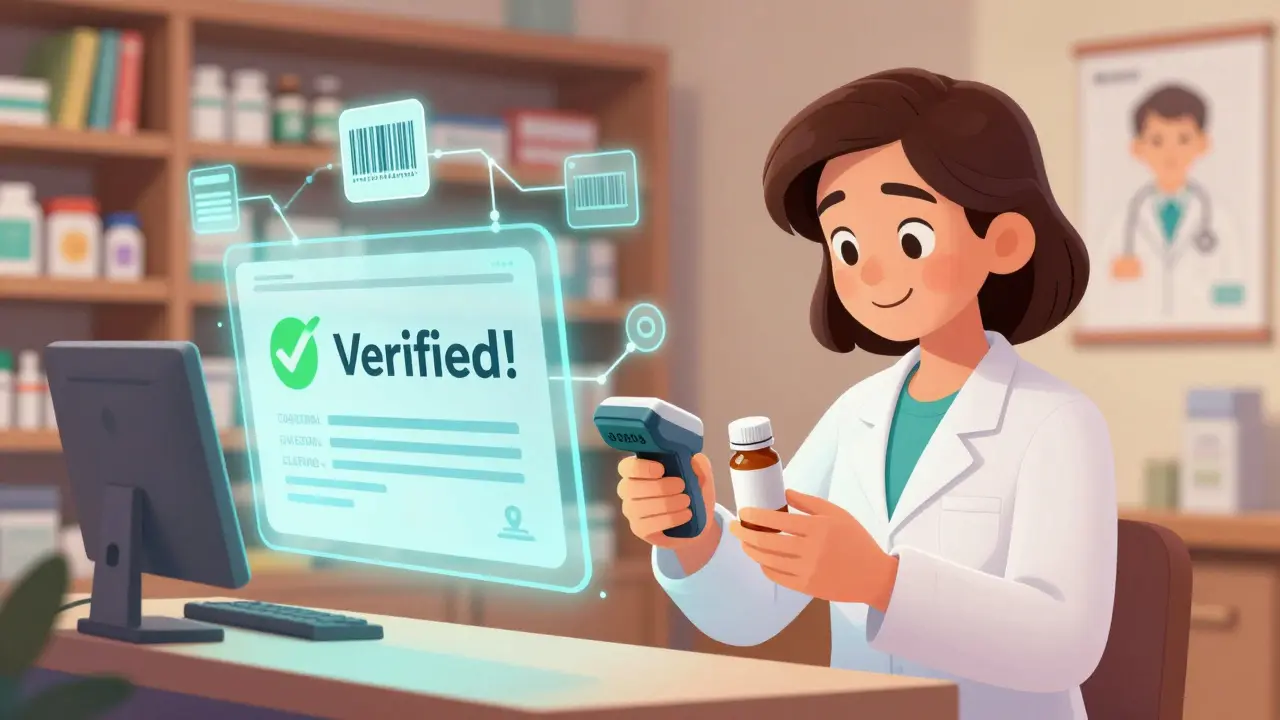
- Verification: If a pharmacy gets a suspicious package, they can scan it and check its serial number against the manufacturer’s database in seconds. The system flags mismatches instantly. In 2022, this caught over 12,000 suspect products before they reached patients.
- Authorized Trading Partners: Only companies verified by the FDA can legally handle prescription drugs. The ATP Verification Router Service checks every new partner daily. Over 50,000 verifications happen each day, with a 99.8% success rate. If a company isn’t on the list, they’re blocked.
Together, these layers turn the supply chain into a digital fortress. Fake drugs don’t just get caught - they’re designed to be impossible to hide.
How It Works in Real Life
Imagine a bottle of metformin leaves a manufacturer in New Jersey. Before it ships, a scanner reads its barcode and uploads the serial number to the system. The wholesaler in Ohio receives it, scans it again, and confirms it matches the shipment record. The pharmacy in Florida gets it, scans it once more before putting it on the shelf, and the system logs the final handoff.
Now, suppose a criminal tries to slip in a fake bottle with a copied barcode. The serial number might look right, but when the pharmacy scans it, the system checks: Is this serial number linked to this exact NDC? Was it ever shipped from this manufacturer? Has it been decommissioned already? If the answer is no - even once - the system flags it. The pharmacist doesn’t even need to guess. The system tells them: This isn’t real.
This isn’t theory. In 2022, during the infant formula crisis, the same system was used to trace and remove unsafe batches within 72 hours. Before DSCSA, that would’ve taken two weeks.
Who’s Complying - and Who’s Struggling
Most big players are in. 98% of brand-name manufacturers, 91% of major wholesalers, and 83% of hospital pharmacies are fully compliant as of late 2023. But smaller pharmacies? They’re falling behind.
Independent pharmacies with fewer than 10 employees spent an average of $18,500 per year on software, scanners, and training. For some, that’s 3% of their net profit. Many still use old systems that can’t talk to modern EPCIS platforms. The FDA found 63% of small pharmacies had trouble meeting the 2023 electronic data exchange deadline.
One pharmacist in Ohio told a forum: “I bought a new scanner, paid for the subscription, and spent 40 hours training my staff. Then the system kept rejecting our own legitimate packages because the barcode was smudged. We lost two days of sales fixing false alarms.”
Barcode readability issues affect nearly 13% of packages. Data mismatches happen in 8% of transactions. These aren’t failures of intent - they’re growing pains in a system that’s still being fine-tuned.
Global Differences: U.S. vs. Europe
The U.S. doesn’t do this the same way as Europe. The EU’s Falsified Medicines Directive (FMD) uses a centralized database. Every prescription drug sold there must be “decommissioned” - meaning the serial number is erased from the system the moment it’s sold at the pharmacy. It’s like checking out a library book: once it’s gone, it’s marked as used.
The U.S. system is decentralized. There’s no single database. Instead, manufacturers, wholesalers, and pharmacies share data directly with each other. It’s more flexible but harder to manage. The EU requires a tamper-proof seal on every package. The U.S. doesn’t. That’s why you’ll see anti-tamper caps on European pills but not always on American ones.
Global companies hate this. They have to run two systems - one for the U.S., one for Europe - and sometimes a third for Brazil or Japan. According to PwC, this doubles their compliance costs compared to companies that only sell in the U.S.
Technology Behind the Scenes
Behind the scenes, this system runs on enterprise software built for speed and accuracy. Companies like TraceLink, SAP, and Movilitas provide platforms that handle millions of daily transactions. These systems must scan 1,200 barcodes per minute with near-zero error rates. They must store data securely, meet cybersecurity standards like HITRUST CSF v11.2, and stay online 24/7.
Even the barcodes themselves are engineered for durability. They’re printed with special ink that resists fading, smudging, and moisture. They’re placed where they won’t be crushed during shipping. If a package’s barcode fails to scan, it’s quarantined until someone manually checks it.
Some companies are now testing AI to spot anomalies - like a sudden spike in returns from one distributor - or blockchain to create tamper-proof logs. But these are still experiments. The core system today is simple: scan, verify, log, repeat.
What’s Next: 2027 and Beyond
The DSCSA isn’t done. The final deadline is November 2027. By then, every single transaction - no exceptions - must be electronic and fully interoperable. Paper records will be banned. That’s a big deal. Right now, 14% of transactions still use paper, mostly in small clinics or rural pharmacies.
By 2027, the system will also switch from XML to JSON for data exchange, making it faster and easier to integrate. The FDA’s 2024 Interoperability Pilot Program is testing this with 12 major companies. Early results show 99.9% accuracy in data sharing.
Experts predict the system will evolve into a predictive tool by 2030. Instead of just reacting to fakes, it might predict where they’ll appear next - based on shipping patterns, supplier behavior, or even weather disruptions that delay shipments. McKinsey estimates this could cut counterfeit incidents by 95% and save $8.7 billion a year in wasted drugs and recalls.
Why This Matters to You
You might never see a barcode on your medicine. You might never think about how it got to your pharmacy. But this system is why you can trust that your insulin, your blood pressure pill, or your antibiotics are what they say they are.
Since DSCSA started in 2015, counterfeit drug seizures have dropped by 63%. In 2014, the FDA seized over 1,100 fake drug cases. In 2022, that number fell to 412. That’s not luck. That’s a system working.
It’s not perfect. Small pharmacies still struggle. False alarms still happen. Global gaps still exist. But for the first time in history, the U.S. has a real, working defense against fake drugs. And it’s not just protecting your health - it’s protecting the entire medical system from chaos.
Frequently Asked Questions
What is the DSCSA and why does it matter?
The Drug Supply Chain Security Act (DSCSA) is a U.S. law passed in 2013 to prevent counterfeit drugs from entering the supply chain. It requires every prescription drug package to have a unique digital identifier and mandates electronic tracking at every step - from manufacturer to pharmacy. It matters because it’s the only system in the U.S. that can reliably catch fake, expired, or stolen drugs before they reach patients.
Can I check if my medicine is real?
Not directly as a patient. The verification system is built for pharmacies and wholesalers to scan and check serial numbers against manufacturer databases. But you can reduce risk by only buying from licensed pharmacies - either in person or those verified by the National Association of Boards of Pharmacy (NABP). Avoid online sellers that don’t require a prescription or don’t list a physical address.
Do all drugs have these barcodes?
Only prescription drugs are required to carry the full DSCSA serial code. Over-the-counter medicines, vitamins, and supplements don’t have to follow the same rules. That’s why counterfeit vitamins and OTC painkillers are still common online - they’re not covered by the same system.
Why do some packages still get rejected by scanners?
Barcodes can be damaged during shipping, printed poorly, or scanned at the wrong angle. Sometimes, the system flags a legitimate package if the serial number was entered wrong in the database. These are called false positives. Pharmacies are trained to manually check these cases, but it slows things down. About 8.3% of scans trigger a verification alert - most are harmless, but each one requires investigation.
Is this system used worldwide?
No. The U.S. DSCSA is unique in its decentralized, electronic traceability model. The EU uses a centralized verification system with mandatory tamper seals. Countries like China, Brazil, and India have their own rules. Global drug companies must comply with multiple systems, which increases cost and complexity. There’s no single global standard yet.
What You Can Do
If you’re a patient: Stick to licensed pharmacies. Don’t buy drugs from websites that don’t ask for a prescription. Check if the pharmacy is verified by NABP’s Vetted Online Pharmacy program.
If you’re in the industry: Start planning for 2027 now. If you’re still using paper records or outdated software, you’re running out of time. Invest in staff training and EPCIS-compatible tools. The cost of non-compliance isn’t just fines - it’s your reputation, your license, and possibly lives.
The system isn’t perfect. But it’s the best defense we have. And for now, that’s enough to keep millions of people safe every day.
Theo Newbold
December 21, 2025
The DSCSA is a masterpiece of regulatory engineering. Every layer-from serialization to ATP verification-is designed to eliminate ambiguity. The fact that 12,000 suspect products were caught in 2022 alone proves it's not just paperwork. This is real-time threat mitigation at scale. No emoticons needed.
Cara C
December 22, 2025
It's impressive how the system works, but I worry about the small pharmacies. They're doing the heavy lifting with minimal resources. The $18,500 cost isn't just a number-it's rent, staff hours, maybe even their ability to stay open. We need better support, not just deadlines.
Michael Ochieng
December 23, 2025
Honestly, this is one of the few U.S. regulatory systems that actually works. I've seen how messy drug supply chains are in Nigeria-no serialization, no traceability, just trust and luck. The U.S. model isn't perfect, but it's the gold standard. Other countries should copy it, not reinvent it.
Dan Adkins
December 24, 2025
The assertion that the DSCSA is a 'digital fortress' is hyperbolic and misleading. The system is riddled with false positives, interoperability failures, and vendor lock-in. The 99.8% success rate cited is statistically meaningless when 13% of barcodes are unreadable and 8% of transactions contain data mismatches. This is not security-it's bureaucratic theater masked as innovation.
Erika Putri Aldana
December 24, 2025
So we spend billions so pharmacists can scan barcodes instead of just trusting people? Cool. Meanwhile, my OTC painkillers are still fake as hell online. This system doesn't even cover half the meds people actually take. Big Pharma wins again.
Adrian Thompson
December 26, 2025
They say 'no paper records' by 2027. But who's really behind this? Big Tech. TraceLink, SAP-they're the ones cashing in. And guess what? The FDA's 'interoperability pilot'? That's just a backdoor to hand over patient data to private contractors. This isn't safety. It's surveillance with a pill bottle on top.
John Hay
December 26, 2025
I've worked in hospital pharmacy for 18 years. The system works. The scanners beep, the data checks out, and we don't give out fake insulin. The false alarms? Annoying, yes. But better than burying someone because we skipped a scan. Don't let the noise drown out the fact that this saves lives.
Meina Taiwo
December 27, 2025
Small pharmacies need subsidized software grants. Not more audits.
Stacey Smith
December 28, 2025
Europe’s system is a centralized mess. Why should we bow to their tamper seals and centralized databases? We built this ourselves. It’s American ingenuity. If you can’t handle the tech, maybe you shouldn’t be in the business.
Ben Warren
December 28, 2025
The structural deficiencies inherent in the current implementation of the DSCSA are not merely technical; they are epistemological. The reliance on fragmented, non-hierarchical data exchange protocols fundamentally undermines the ontological integrity of pharmaceutical traceability. The 2027 transition to JSON, while syntactically expedient, does not resolve the deeper hermeneutic crisis of trust in distributed ledger architectures. One must ask: if the system cannot guarantee semantic consistency across 50,000 daily verifications, can it truly be said to secure the supply chain-or merely simulate security?
Teya Derksen Friesen
December 30, 2025
This is the kind of infrastructure that deserves more public recognition. People don't see the quiet, complex work happening behind the scenes to keep their medicine safe. It's not glamorous, but it's essential. Kudos to everyone building and maintaining it-even the ones dealing with smudged barcodes at 3 a.m.