
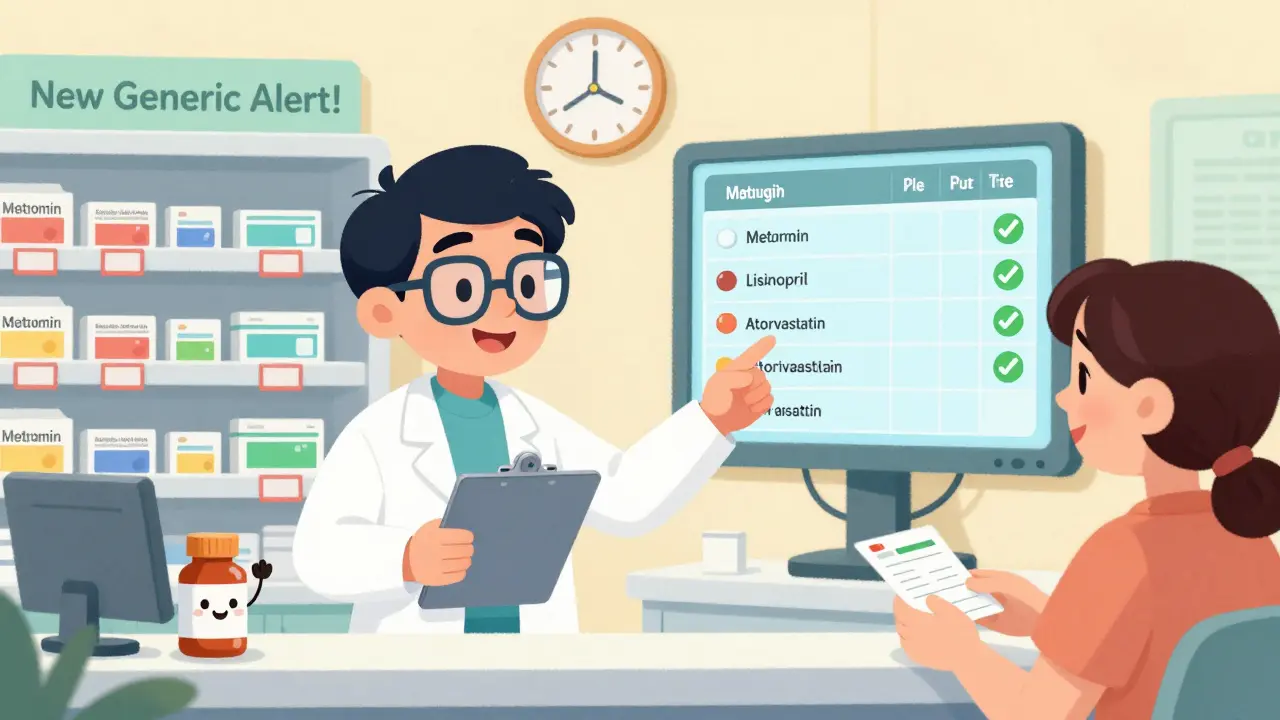
Most pharmacies carry hundreds of medications, but generic drugs are the real money-makers - and the biggest headache. They make up 90% of prescriptions filled in the U.S., yet only 20% of total drug spending. That means if you’re not managing your generic inventory well, you’re either losing money on expired stock or losing sales because you ran out of metformin, lisinopril, or atorvastatin when a patient needed it. This isn’t just about keeping shelves full. It’s about running a pharmacy that stays profitable, reliable, and responsive in a market where new generics drop every week.
Why Generic Stocking Is Different from Brand-Name Inventory
Generic drugs don’t behave like brand-name drugs. A brand-name medication like Humira might sit on your shelf for months because it’s expensive and prescribed to a small group. But a generic like simvastatin? It flies off the shelf. Patients refill it monthly. Prescribers switch to it the moment it becomes available. And if you’re still ordering the brand-name version because your system hasn’t updated, you’re stuck with $3,200 in obsolete inventory - a real story from a pharmacy manager in Edmonton last year. The key difference? Generics have shorter product lifecycles. When a patent expires, multiple manufacturers enter the market. Prices drop fast. Demand spikes. Then, within months, another generic hits the shelves, and the first one starts to fade. Your inventory system has to move just as fast.The 80/20 Rule in Pharmacy Inventory
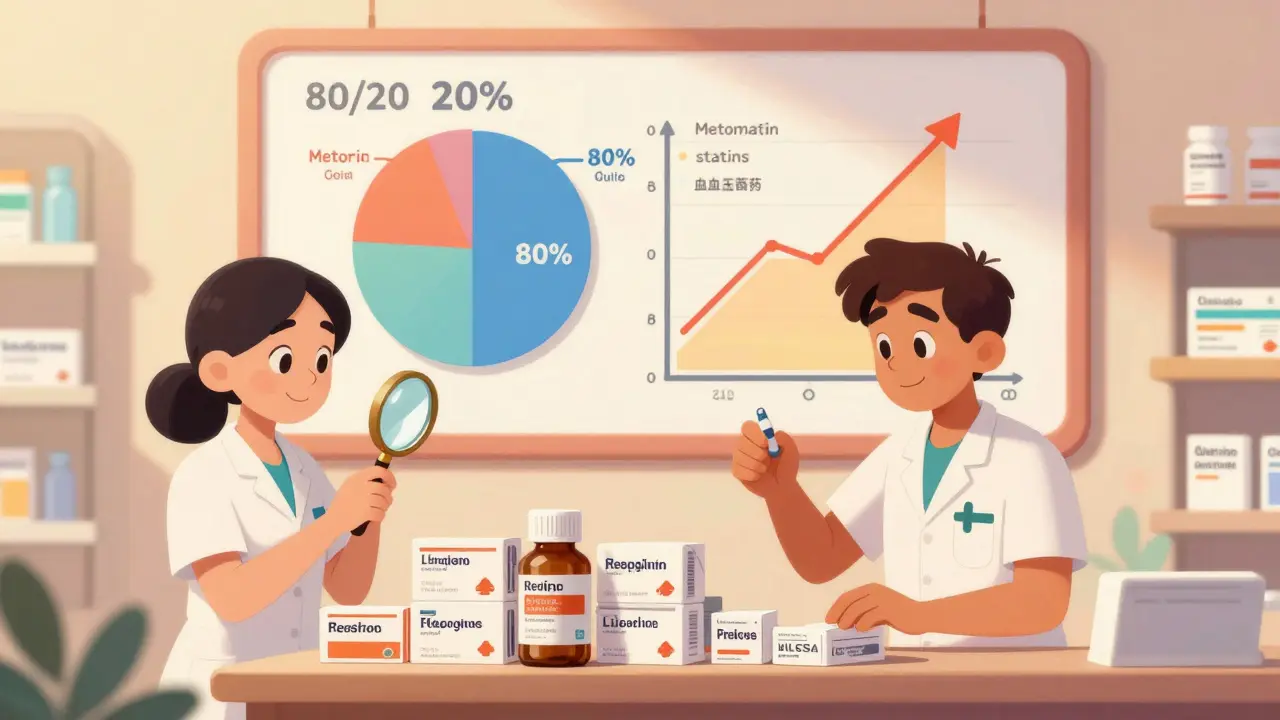
You don’t need to track every single pill. The 80/20 rule applies hard here: 80% of your drug costs come from just 20% of the products you carry. And guess what? Most of that 20% is made up of high-volume generics - blood pressure meds, diabetes drugs, cholesterol pills, pain relievers. That means your focus should be laser-sharp on those top 20 items. Don’t waste time micromanaging low-turnover generics like rare thyroid supplements or niche antibiotics. Instead, build systems that give you real-time visibility into what’s moving fast and what’s not. Use your pharmacy software to flag items with turnover rates below 1.5 per month. Those are candidates for reducing stock or even removing from your permanent inventory.How to Set Your Reorder Points and Quantities
Forget guessing. Use math. Your Reorder Point (ROP) should be: (Average Daily Usage × Lead Time in Days) + Safety Stock. Let’s say you sell 10 bottles of metformin 500mg per day. Your supplier takes 3 days to deliver. You want a 2-day safety buffer because of holidays or delivery delays. That’s: (10 × 3) + 20 = 50 bottles. So when your stock hits 50, your system triggers an order. Simple. But here’s the catch: that number changes every month. If flu season hits and more patients get prescriptions for their statins, your daily usage jumps to 14. If you don’t adjust, you’ll run out. Your Reorder Quantity (ROQ) should follow the Economic Order Quantity (EOQ) model - the sweet spot between ordering too much (wasting cash and risking expiry) and ordering too little (causing stockouts). Most independent pharmacies find that ordering enough for 2-4 weeks of sales works best for fast-moving generics. For slower ones, 6-8 weeks is fine.The Minimum-Maximum Method That Works
Many pharmacies use a minimum-maximum system for generics. Set a floor and a ceiling for each item. For example:- Metformin 500mg: Min = 40 bottles, Max = 80 bottles
- Atorvastatin 20mg: Min = 30 bottles, Max = 60 bottles
Tracking Expiry Dates Is Non-Negotiable
Generics are cheaper, so manufacturers often produce them in large batches. That means shelf life can be shorter - sometimes as little as 12-18 months. A brand-name drug might have a 3-year shelf life. A generic? Maybe 18 months. If your system doesn’t flag items with less than 60 days until expiry, you’re risking waste. One pharmacy in Calgary lost $4,700 last year because they didn’t track expiry dates on their generic gabapentin. The solution? Use your inventory software to auto-sort items by expiry date. Put the oldest stock at the front. Train staff to dispense expiring items first. And if you have a lot of generics nearing expiry, work with your supplier on return policies. Many will take back unopened, non-controlled generics within 90 days of expiry.How to Handle New Generic Entries
When a new generic hits the market - say, a cheaper version of a brand-name blood pressure drug - your inventory system needs to react within 24 hours. Not next week. Not when you get around to it. Here’s what happens: the brand-name version’s sales drop fast - sometimes by 70% in the first month. If you keep ordering the same amount, you’re stuck with dead stock. Meanwhile, the new generic? Demand spikes. If you don’t have enough, patients go elsewhere. Best practice: Set up a trigger in your software that automatically reduces the max stock for the brand-name drug by 50% the day the new generic is approved. Increase the max for the generic by 30%. Then monitor sales for the next 14 days. Adjust again if needed. Pharmacies that do this reduce transition waste by up to 28%.Why Automation Alone Isn’t Enough
AI-powered systems can predict demand, auto-reorder, and flag trends. But they can’t read a patient’s chart. They don’t know if someone can’t afford the generic, or if their doctor refuses to switch. If your system blindly follows algorithms, you might run out of the brand-name version - even when the patient needs it. That’s why human oversight matters. Train your staff to flag patients who:- Have had multiple stockouts in the past 3 months
- Ask for a specific brand because of side effects
- Are on a fixed income and can’t afford even the cheapest generic
Staff Training and SOPs That Make a Difference
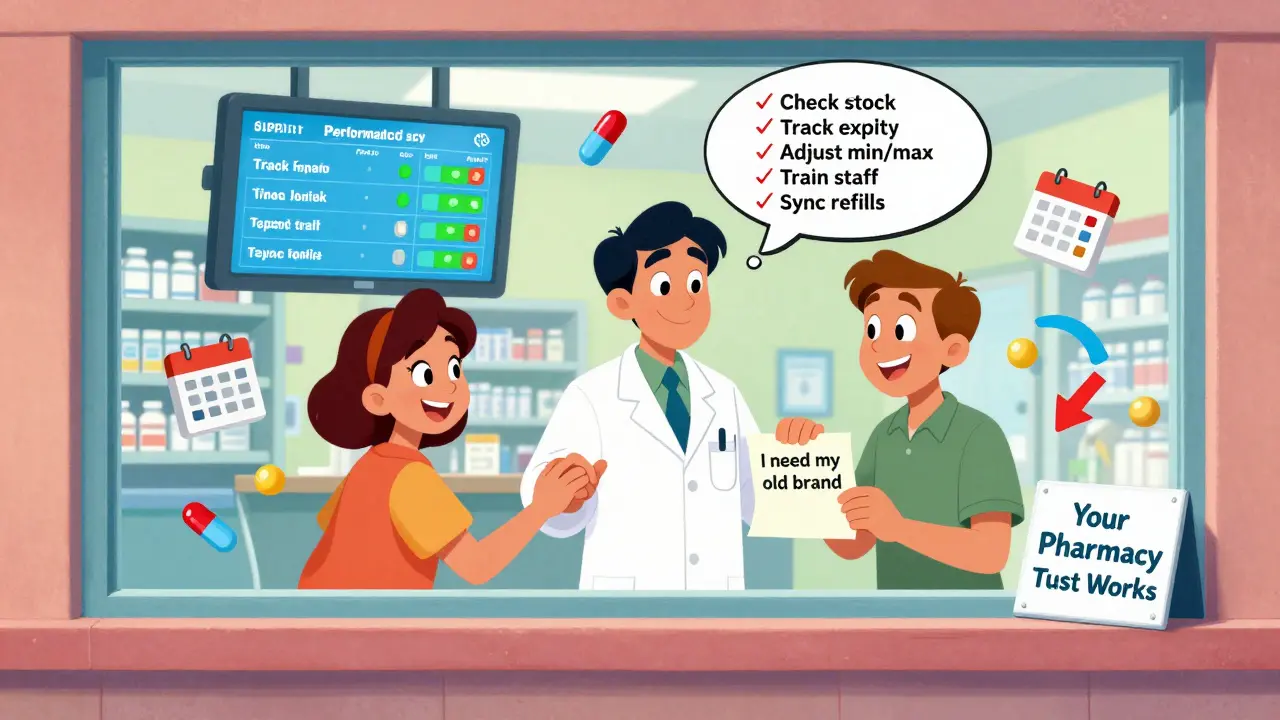
You can have the best software in the world, but if your techs don’t know how to enter receipts correctly or return unclaimed prescriptions, your inventory numbers will be wrong. Create simple, written procedures for:- Receiving generic shipments - check lot numbers and expiry dates
- Returning unclaimed prescriptions - do it within 24 hours to keep stock accurate
- Handling therapeutic interchange - if your state allows it, have a protocol for switching patients to generics without waiting for a new prescription
What the Best Pharmacies Do Differently
The top-performing pharmacies don’t just manage inventory - they use it to build patient loyalty. Here’s what they do:- They sync refills for maintenance generics - so patients get all their meds on the same day each month.
- They keep 3-4 versions of popular generics on the shelf (e.g., different manufacturers of metformin) so patients don’t feel like they’re being forced into one option.
- They track supplier performance - not just price, but how fast they deliver and how often they’re out of stock.
- They collaborate with prescribers. In 17 states, pharmacists can legally switch a brand to a generic under a collaborative practice agreement. Use that power.
What to Avoid
Don’t make these mistakes:- Using the same inventory settings for all generics - fast movers need different rules than slow ones.
- Ignoring expiry dates - expired generics are a liability and a waste of cash.
- Waiting to adjust after a new generic launches - delay costs you sales and money.
- Not training staff on inventory SOPs - your system is only as good as the people using it.
- Overstocking generics just because they’re cheap - you can’t afford to tie up capital in pills that sit for 6 months.
Final Thought: It’s Not About Inventory - It’s About Trust
Patients don’t care about your inventory system. They care that their medication is there when they need it. That they don’t have to wait. That they’re not being overcharged. When you manage generics well, you’re not just saving money. You’re building a reputation as the pharmacy that just works. The market is changing fast. More generics. More competition. More pressure. The pharmacies that thrive won’t be the ones with the biggest budgets. They’ll be the ones who know their numbers, adjust quickly, and treat inventory like a patient care tool - not just a cost center.How often should I review my generic inventory levels?
Review your top 20 generic medications every 30 days. Check sales trends, expiry dates, and stock levels. If a generic’s turnover drops below 1.5 per month, consider reducing your max stock. For fast-moving items like metformin or lisinopril, review weekly during seasonal spikes or after a new generic enters the market.
What’s the ideal percentage of generics in my pharmacy inventory?
For independent pharmacies, aim for 65-75% of your total inventory value to be generic medications. This balances cost savings with the need to carry some brand-name drugs for patients who require them. Don’t focus on the number of items - focus on the dollar value. Generics should make up most of your spending, but not necessarily most of your SKUs.
How do I know if my inventory software supports good generic management?
Look for these features: automatic reorder triggers based on usage (not fixed dates), expiry date tracking with alerts, ability to set different min/max levels per product, and integration with supplier data for lead times. Software that lets you compare brand-to-generic transition impact is a big plus. Avoid systems that treat all drugs the same - generics need special handling.
Can I return expired generic medications?
Many wholesalers allow returns of unopened, non-controlled generic medications within 90 days of expiry, but policies vary. Always confirm with your supplier before ordering large quantities. Some will take back expired stock for credit if you’re a consistent customer. Keep records of your supplier’s return policy - it’s part of your inventory strategy.
What’s the biggest mistake pharmacies make with generic inventory?
The biggest mistake is setting it and forgetting it. Generics change faster than any other drug category. If you use the same reorder points from last year, you’re likely overstocking some items and understocking others. Constant adjustment - based on real sales data - is the only way to stay ahead.
Should I stock multiple brands of the same generic?
Yes, for fast-moving generics. Patients often prefer one manufacturer over another due to size, color, or past experience. Keeping 3-4 versions of popular generics like metformin or atorvastatin reduces the chance of a patient leaving because their preferred version is out of stock. Just make sure you track each SKU separately in your system.
John Rose
January 27, 2026
This is one of the most practical guides I’ve read on pharmacy inventory in years. The 80/20 rule breakdown alone is worth the read. I’ve been using the min-max method for my top 15 generics, and it’s cut our waste by nearly 30%. The key is consistency-reviewing every 30 days like you said, not just when the boss asks.
Lexi Karuzis
January 27, 2026
Wait-so you’re telling me the government didn’t force pharmacies to stock generics? That’s a lie. Big Pharma owns the software companies, the wholesalers, the FDA-it’s all rigged. You think those ‘expiry date alerts’ are for patient safety? No. They’re to make you buy more from the same suppliers. I’ve seen the emails. They’re tracking your reorder habits. They know when you’re desperate.
Brittany Fiddes
January 28, 2026
Oh, please. You Americans treat inventory like it’s a spreadsheet game. In the UK, we’ve had this figured out since the 90s. We don’t ‘adjust based on data’-we use clinical judgment. We don’t stock four versions of metformin because some patient ‘prefers the blue pill.’ We stock what works. And if the patient complains? We tell them to stop being dramatic. The NHS doesn’t coddle demand. You’re drowning in choice because you’ve forgotten that medicine is science, not a supermarket.
Amber Daugs
January 30, 2026
Y’all are missing the point. This isn’t about math. It’s about ethics. If you’re cutting corners on stock to save a few bucks, you’re putting lives at risk. I had a diabetic patient cry because her metformin was out-again. She had to drive 40 miles because her ‘efficient’ pharmacy didn’t want to tie up capital in pills. That’s not management. That’s neglect. And if your software doesn’t flag that, it’s broken. Fix your heart before you fix your inventory.
Robert Cardoso
February 1, 2026
Let’s deconstruct the EOQ model here. The formula assumes constant demand, linear lead time, and zero variability in patient behavior-all of which are false in community pharmacy. You’re using a manufacturing model on a service environment. The ‘2-4 week’ reorder quantity is statistically unsound without confidence intervals. Also, your ‘safety stock’ calculation ignores seasonality, weather events, and prescriber behavior shifts. You’re optimizing for a ghost.
matthew martin
February 2, 2026
Man, I love how this post doesn’t just throw numbers at you-it tells you how to think. I run a small shop in rural Ohio, and the ‘keep 3-4 versions of metformin’ tip? Game-changer. One guy comes in every month for the green tablet because ‘it doesn’t give me the belly ache.’ I used to say ‘take the blue one.’ Now I keep both. He’s been coming back for two years. That’s not inventory-that’s loyalty. And yeah, the software’s gotta help, but the real magic’s in the little things. Like remembering Mrs. Jenkins’ blood pressure med is always the 20mg, not the 40mg.
Chris Urdilas
February 2, 2026
So… you’re saying we should actually *do* work instead of just hoping the software fixes everything? Revolutionary. I’ve been waiting for someone to say this out loud. My last manager thought ‘automation’ meant ‘set it and forget it until the fire alarm goes off.’ Turns out, fire alarms are what happen when you ignore the fact that people still use paper prescriptions and suppliers still deliver on Tuesdays only. Who knew?
Jeffrey Carroll
February 4, 2026
Excellent framework. I’ve implemented the ROP formula exactly as described, with a 2-day safety buffer for holidays and weather delays. Our stockout rate for top 10 generics dropped from 11% to 2.3% in six weeks. The only adjustment I made was increasing lead time by one day during flu season-based on historical data, not guesswork. This is the kind of disciplined, evidence-based practice that separates sustainable pharmacies from those that burn out.
Rhiannon Bosse
February 5, 2026
Okay, but what about the *real* problem? The suppliers. They’re the ones who flood the market with generics, then suddenly stop making them. I had 17 bottles of a generic lisinopril that vanished overnight. No warning. No backorder. Just… gone. And now I’m stuck with patients asking why their ‘same pill’ is suddenly $12 more. Meanwhile, my software says ‘order more’-but there’s nothing to order. Who’s holding *them* accountable? Not you. Not me. The system’s rigged.
Bryan Fracchia
February 6, 2026
There’s something beautiful about treating inventory like a living thing. It breathes with patient needs. It changes with seasons, with new prescribers, with economic pressure. I don’t just track pills-I track stories. The guy who needs his atorvastatin because his wife just passed. The teen who’s on metformin because her mom can’t afford insulin. That’s why I keep extra stock. Not because the math says so. Because people matter more than spreadsheets. And yeah, it costs more. But the peace of mind? Priceless.
Lance Long
February 7, 2026
YOU DID IT. You actually did it. I’ve been screaming this from the rooftops since 2021: TRAIN YOUR STAFF. I had a tech once who entered a return as a new receipt. We had 147 bottles of simvastatin ‘appear’ out of nowhere. Two weeks later, we ran out. I nearly cried. After we implemented the SOPs you listed? Our inventory accuracy jumped from 78% to 96%. It’s not magic. It’s discipline. And it’s the most underappreciated part of this whole thing. Thank you.
Timothy Davis
February 7, 2026
Let’s be honest: 65-75% generic inventory value? That’s the bare minimum. The top-performing chains are at 82%. You’re already behind if you’re not pushing 80%. And why are you still using min-max? You need predictive analytics. Your ‘30-day review’ is a relic. AI models can forecast demand down to the day with 92% accuracy. If you’re not using them, you’re not a pharmacy-you’re a relic with a cash register.
fiona vaz
February 7, 2026
Just make sure your staff checks expiry dates before they put anything on the shelf. One mistake, one expired bottle, and you’re liable.