
Valerian & Sedative Interaction Checker
Check Your Medication Risks
This tool helps you understand potential dangerous interactions between valerian root and sedating medications. Always consult your healthcare provider before taking any new supplement.
This tool is for informational purposes only and does not replace professional medical advice. Always consult your healthcare provider before making changes to your medication regimen.
Many people turn to valerian root to help them sleep better. It’s natural, widely available, and feels safer than prescription pills. But what happens when you take valerian along with your sleep aid, anxiety medication, or even a glass of wine at night? The risk isn’t theoretical-it’s real, and it can be dangerous.
How Valerian Actually Works
Valerian root doesn’t just make you drowsy. It changes how your brain handles a key calming chemical called GABA. GABA slows down nerve signals, which helps you relax and fall asleep. Valerian does two things: it helps GABA stay longer in the spaces between brain cells, and it blocks the enzyme that breaks GABA down. The main compound responsible for this is valerenic acid-but not all valerian supplements contain the same amount. Some have very little. Others are strong. And because supplements aren’t tightly regulated, you never really know what you’re getting.
Studies from the 1980s showed valerian improved sleep quality in humans. More recent reviews from the NIH and Mayo Clinic confirm it’s commonly used for insomnia. But here’s the catch: the same mechanism that helps you sleep can also dangerously amplify the effects of other sedatives.
The Real Danger: Additive CNS Depression
Central nervous system (CNS) depression means your brain and spinal cord are slowing down too much. That’s exactly what happens when you mix valerian with alcohol, benzodiazepines like Xanax, barbiturates, opioids, or even some antihistamines. The result? Excessive drowsiness, slow breathing, confusion, and in extreme cases, respiratory failure or coma.
WebMD classifies the interaction between valerian and alcohol or alprazolam as major-meaning you should not take them together. The Mayo Clinic warns that valerian “may increase the effects of other sleep aids” and “increases the sedative effect of depressants.” These aren’t vague warnings. They’re based on how these substances work at the molecular level.
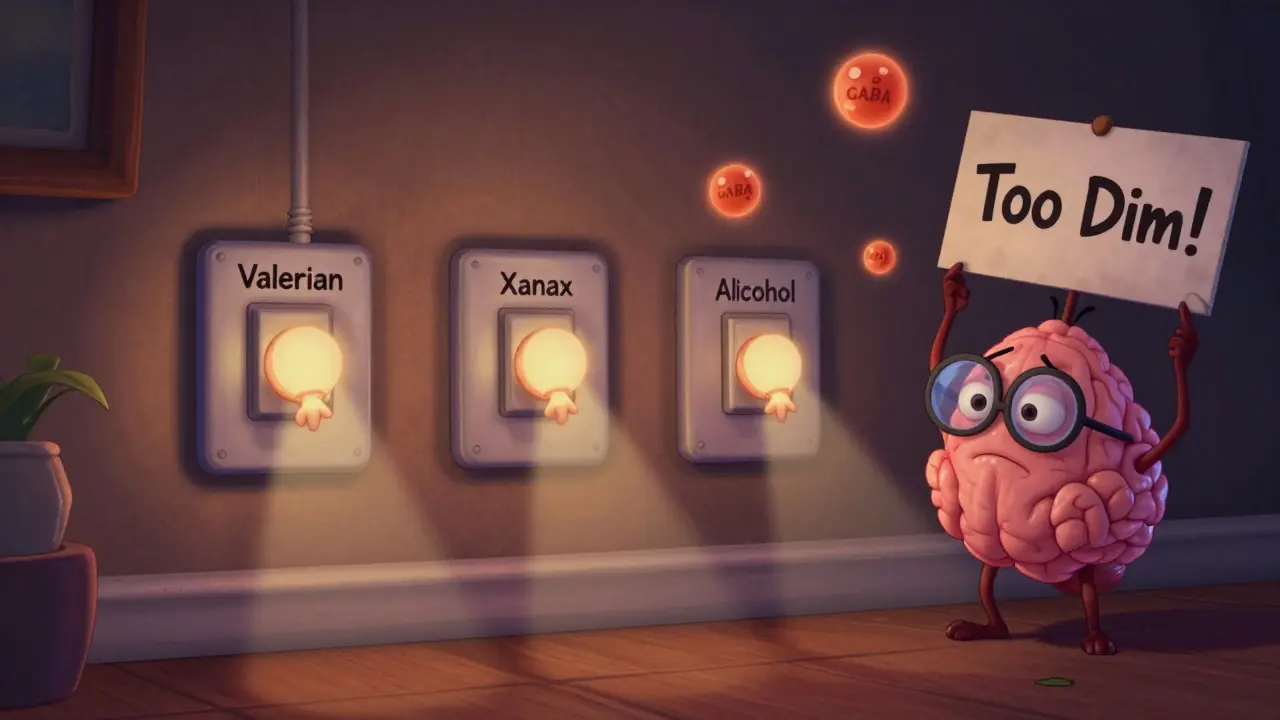
Imagine your brain is a dimmer switch. Valerian turns it down. So does alcohol. So does Xanax. Now, if you turn all three down at once, the light doesn’t just go dim-it goes out. That’s what additive CNS depression looks like.
What Medications Should You Avoid With Valerian?
Here’s a clear list of medications that can become dangerous when mixed with valerian:
- Alcohol - Even one drink can multiply drowsiness and slow breathing.
- Benzodiazepines - Xanax, Klonopin, Ativan, Valium. These are designed to enhance GABA. Valerian does the same. Together, they’re a recipe for overdose.
- Barbiturates - Older sedatives like phenobarbital. Rare today, but still used in some cases.
- Opioids - Oxycodone, hydrocodone, morphine. These already carry a high risk of respiratory depression. Add valerian, and the risk spikes.
- Sleep medications - Ambien, Lunesta, Sonata. Taking valerian with these is like doubling your dose.
- Some antidepressants and antipsychotics - Especially those with sedating side effects, like trazodone or quetiapine.
- Over-the-counter sleep aids - Products with diphenhydramine (Benadryl) or doxylamine (Unisom). These are CNS depressants too.
Even if you’re taking just one of these, adding valerian can push you over the edge. And many people don’t realize they’re already on a depressant. A common cold medicine with diphenhydramine? That counts.
The Contradictory Study: Why Some Say It’s Safe
You might have heard that valerian doesn’t really interact with sedatives. That comes from a 2005 mouse study using a different species of valerian (Valeriana edulis) and testing it with six CNS depressants. The researchers found no increased sedation. That sounds reassuring-until you dig deeper.
First, it was mice. Second, it was a different plant. Third, the doses and delivery methods don’t match how humans use valerian supplements. Fourth, no follow-up human studies have confirmed these findings. Meanwhile, multiple clinical guidelines from the NIH, Mayo Clinic, and WebMD continue to warn against combining them.
Just because one animal study didn’t find an effect doesn’t mean it’s safe. It means we need more research. Until then, the burden of proof is on the user-not the doctor-to prove it’s harmless. And that’s not how medicine works.
Why Regulation Makes This Risk Worse
The FDA doesn’t regulate herbal supplements the same way it regulates prescription drugs. That means:
- A bottle labeled “Valerian Root Extract” might contain 50 mg of active compounds-or 500 mg. You won’t know.
- Some products contain fillers, other herbs, or even hidden pharmaceuticals.
- There’s no standard for valerenic acid content. One brand might be weak. Another might be strong enough to cause serious interactions.
That’s why two people taking the same “dose” of valerian can have completely different reactions. One feels relaxed. The other can’t stay awake. And if they’re also on a sedative? The second person could end up in the ER.
Real-World Consequences
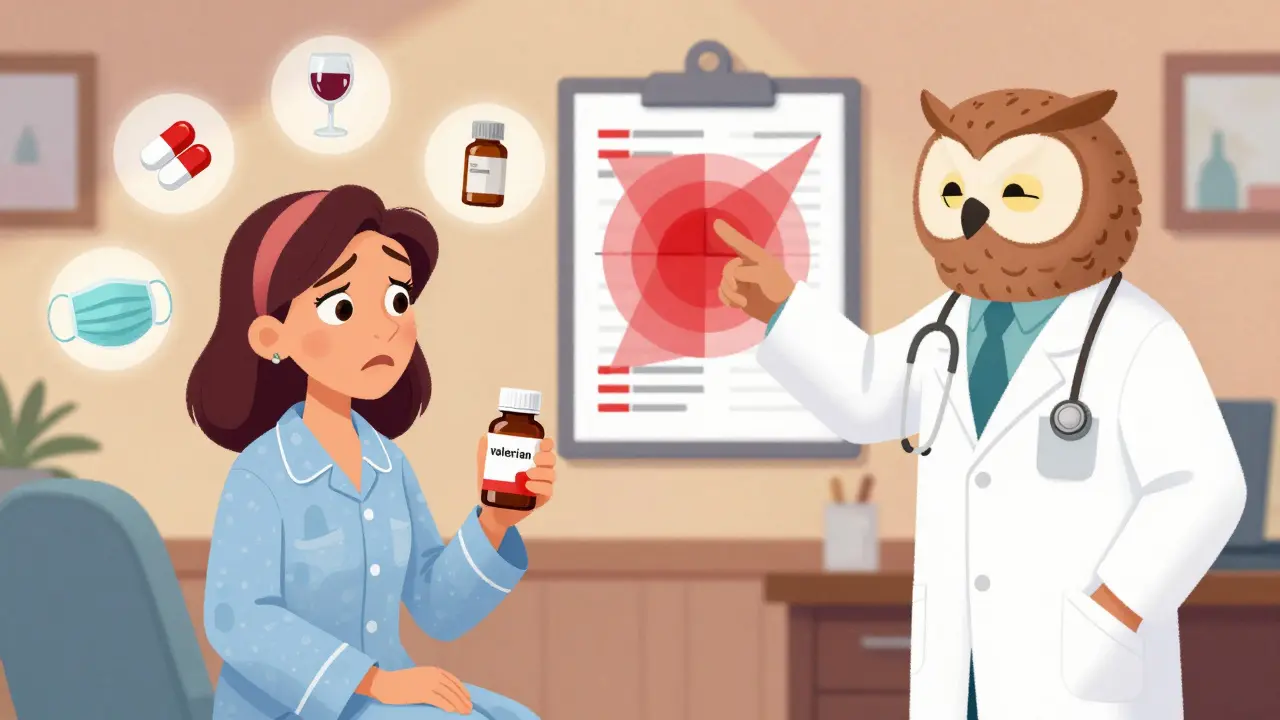
Doctors don’t always ask about supplements. Patients don’t always mention them. A 2021 clinical blog noted that many people take valerian before dental visits because they’re anxious. They think it’s harmless. Then they show up groggy, slow to respond, and their dentist has to adjust the anesthesia plan on the fly.
One patient took valerian with Xanax before a flight. He fell asleep and didn’t wake up until hours after landing. He was disoriented, had trouble breathing, and needed medical attention. He didn’t tell his doctor he was taking valerian-because he didn’t think it counted as a “drug.”
These aren’t rare cases. They’re preventable.
What Should You Do?
If you’re taking any sedating medication-prescription or over-the-counter-here’s what you need to do:
- Stop taking valerian until you talk to your doctor or pharmacist.
- List everything you take-including vitamins, herbs, and supplements. Don’t assume they’re “too natural” to matter.
- Ask specifically: “Could valerian interact with my current meds?” Don’t settle for “probably not.”
- If you’re using valerian for sleep, ask your doctor why you’re having trouble sleeping. Is it stress? Sleep apnea? Anxiety? Treating the cause is better than masking it with a risky combo.
- Never use valerian before surgery or dental work without telling your provider. Even if it’s “just a supplement.”
There are safer alternatives for sleep: cognitive behavioral therapy for insomnia (CBT-I), consistent sleep schedules, reducing screen time before bed, or melatonin (with doctor approval). Valerian isn’t the only option-and it’s not worth the risk if you’re already on a sedative.
Bottom Line
Valerian isn’t evil. It’s not a poison. But it’s not harmless either. When you mix it with sedating medications, you’re playing with fire. The science says the risk is real. The warnings from top medical sources are clear. And the consequences-slowed breathing, unconsciousness, even death-are too serious to ignore.
If you’re taking any medication that makes you drowsy, don’t add valerian. Not even “just a little.” Talk to your doctor first. Your brain-and your lungs-will thank you.
McCarthy Halverson
January 9, 2026
Valerian’s a sneaky one. I’ve seen patients mix it with benzos and wake up in the ER. No joke. Just stop. Talk to your pharmacist first.
Paul Bear
January 9, 2026
Let’s be clear: the 2005 mouse study is irrelevant. Mice metabolize GABA differently. Their blood-brain barrier isn’t human. And the dose-response curve? Completely untranslatable. This isn’t ‘some study says it’s safe’-it’s bad science being weaponized by supplement marketers. The NIH, Mayo, WebMD? They’re not guessing. They’re citing pharmacokinetic data. Stop cherry-picking.
Ian Cheung
January 10, 2026
Man I used to take valerian with wine like it was tea. Thought I was just ‘chill’ until I blacked out on the couch and woke up with my cat licking my face at 3am. No alarms. No memory. Just a weird metallic taste and my wife screaming ‘you’re not breathing!’
Now I use melatonin. And sleep. Like a normal person.
lisa Bajram
January 11, 2026
Y’all need to stop treating herbs like they’re harmless candy. Just because it’s ‘natural’ doesn’t mean it’s safe-it means it’s unregulated. I’m a pharmacist. I’ve seen 3 cases this year alone where people mixed valerian with trazodone or Unisom. One guy went into respiratory arrest. He didn’t even realize his cold medicine was a depressant.
Always ask. Always list everything. Your doctor isn’t judging you-they’re trying to keep you alive.
Christine Milne
January 12, 2026
Of course the FDA doesn’t regulate it. That’s because America is a nation of gullible idiots who think ‘organic’ means ‘safe.’ Meanwhile, Europe bans valerian in combination products. Germany has strict dosing guidelines. We let people self-experiment like it’s a TikTok trend. Pathetic.
Jake Kelly
January 12, 2026
I get why people use it. Sleep is brutal. But you’re right-there are better ways. CBT-I changed my life. No pills. No supplements. Just habits. It takes work. But it actually works.
Ashlee Montgomery
January 13, 2026
What if the real issue isn’t valerian but our cultural obsession with quick fixes? We want a pill for anxiety, a herb for sleep, a drink for stress. We’ve outsourced our nervous system to chemistry. Maybe the question isn’t ‘is valerian dangerous?’ but ‘why are we so desperate to numb ourselves?’
anthony martinez
January 14, 2026
So let me get this straight. You’re telling me I can’t take my ‘natural’ sleep aid with my ‘natural’ glass of wine because science says it might kill me… but I can take Xanax with whiskey and it’s fine because it’s prescription? That’s not logic. That’s capitalism.
neeraj maor
January 16, 2026
Did you know the FDA allows supplements to contain up to 30% fillers? And that valerian is often laced with hidden benzodiazepines to make it ‘work better’? Big Pharma doesn’t want you to know this. They profit off your ignorance. The real danger isn’t valerian-it’s the black market herbal industry.
Jake Nunez
January 18, 2026
My dad in India takes valerian with his blood pressure meds. No problems. He’s 78 and still hikes. Maybe this is a Western overreaction? We overmedicalize everything.
Ritwik Bose
January 19, 2026
Thank you for this. 🙏 I’ve been taking valerian with my antidepressant for months. I didn’t think it mattered because it’s ‘herbal.’ Now I’ve stopped. I’ll talk to my doctor tomorrow. You saved me from a mistake I didn’t even know I was making. 💙
Mario Bros
January 21, 2026
Bro I used to take valerian before yoga. Thought it helped me chill. Then I passed out mid-savasana. My instructor had to shake me awake. Now I just breathe. And drink chamomile tea. No drama. Just peace. 🌿
Michael Marchio
January 22, 2026
People act like this is news. It’s not. The mechanism is textbook. GABA potentiation + CNS depressants = additive effect. You don’t need a fancy study to understand that stacking depressants is like adding logs to a fire. You’re not ‘being cautious’-you’re being reckless. And if you think your ‘natural’ supplement is somehow exempt from pharmacology, you’re not just uninformed-you’re dangerous.
Bradford Beardall
January 22, 2026
My cousin took valerian with Ambien. Ended up in a coma for 36 hours. They had to intubate him. He didn’t tell anyone because he thought ‘it’s just a herb.’ Now he’s fine. But he doesn’t touch anything herbal anymore. If it’s not FDA-approved, don’t mix it. Period.