

When you feel like the room is spinning, you might say you’re dizzy. But if you’re actually feeling like you’re on a merry-go-round that won’t stop-even when you’re lying still-that’s not just dizziness. That’s vertigo. And the difference between the two isn’t just semantics. It’s the difference between a simple fix and a serious warning sign.
What Exactly Is Dizziness?
Dizziness is the catch-all term people use when they feel off. It could be lightheadedness, like you’re about to pass out. Or it might feel like you’re floating, unsteady, or just not quite grounded. You don’t feel spinning. You don’t feel like the world is tilting. You just feel… off. This kind of dizziness often comes from things outside your inner ear. Low blood pressure when you stand up too fast-orthostatic hypotension-is a common cause. If your systolic pressure drops more than 20 mmHg when you rise, you might get that dizzy spell. Anemia, low blood sugar, dehydration, or even anxiety can trigger it too. Medications like blood pressure pills or sedatives can make it worse. The key? No spinning. No illusion of movement. Just a general sense of imbalance or faintness. It’s frustrating, but usually not dangerous.What Is Vertigo?
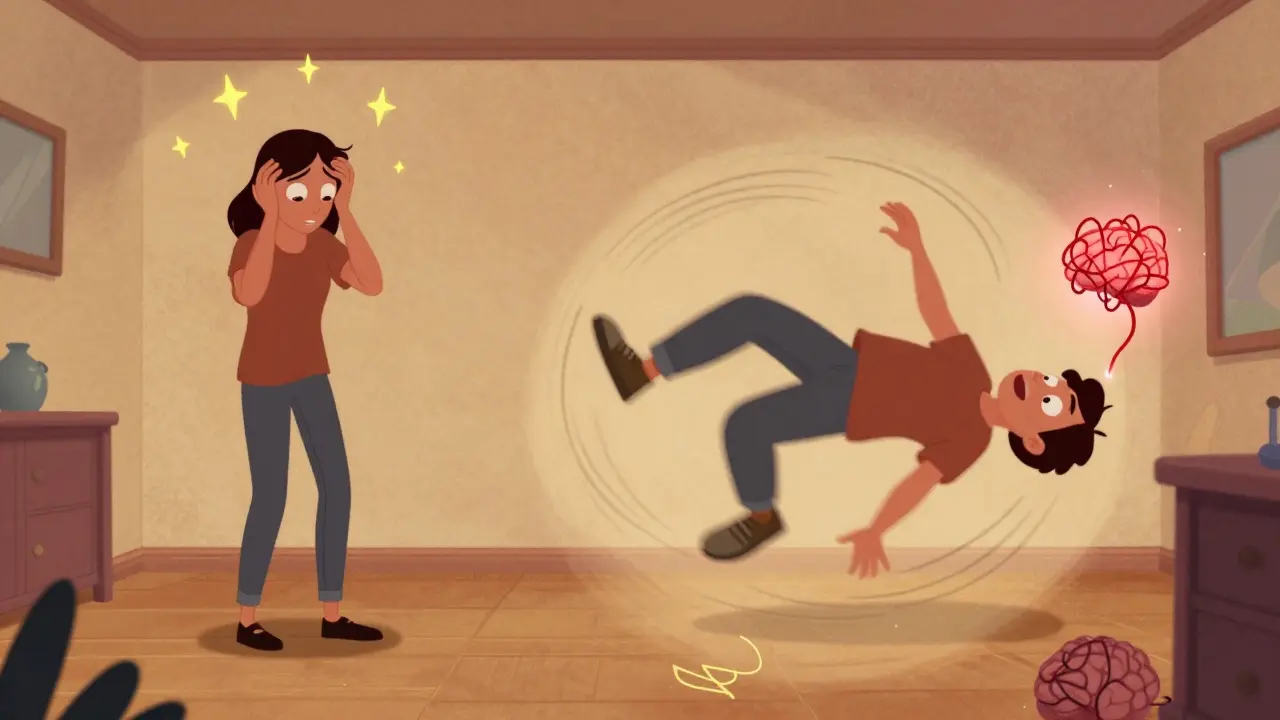
Vertigo is different. It’s not just feeling unsteady. It’s feeling like you-or the world around you-is moving, even when you’re completely still. It’s the sensation of spinning, rotating, or swaying. You might feel like you’re on a boat in a storm, even though you’re sitting in your living room. This isn’t just in your head. It’s your vestibular system-the part of your inner ear and brain that tells you where your body is in space-sending wrong signals. When that system gets messed up, your brain gets confused. Your eyes start moving involuntarily (a sign called nystagmus), your balance goes haywire, and nausea often follows. Vertigo isn’t one condition. It’s a symptom with two main causes: peripheral (inner ear) and central (brain).Peripheral Vertigo: The Inner Ear Is the Culprit
Most vertigo cases-about 70-80%-come from the inner ear. The most common cause? Benign Paroxysmal Positional Vertigo (BPPV). It happens when tiny calcium crystals (otoconia) in your inner ear break loose and float into the wrong canal. When you move your head-like rolling over in bed or looking up-they shift, sending false signals to your brain. BPPV is common. About 2.4% of people get it every year. Half of those are over 50. It’s not dangerous, but it’s terrifying. One patient in Edmonton described it as “like being kicked in the head every time I turned my head.” The good news? BPPV can often be fixed in minutes with the Epley maneuver. It’s a series of head movements that guide the crystals back to where they belong. Success rates? 80-90% after one or two sessions. Other inner ear causes:- Ménière’s disease: Causes vertigo attacks lasting 20 minutes to hours, along with ringing in the ear, hearing loss, and fullness. Affects about 615,000 Americans.
- Vestibular neuritis or labyrinthitis: Usually follows a virus. Causes sudden, severe vertigo without hearing loss (neuritis) or with hearing loss (labyrinthitis). Often lasts days to weeks.
Central Vertigo: When the Brain Is the Problem
Less common-but far more serious-is central vertigo. This comes from the brainstem, cerebellum, or thalamus. These areas process balance signals from the inner ear. If something goes wrong here, the result is vertigo… but with red flags. Central vertigo is often linked to:- Stroke: Especially in the brainstem or cerebellum. This is the big one. If vertigo comes with double vision, slurred speech, weakness on one side, or trouble walking, it could be a stroke-even if you feel fine otherwise.
- Multiple sclerosis: Can cause vertigo as an early sign, often with numbness or vision changes.
- Vestibular migraine: This one trips up doctors. You get vertigo attacks (5 minutes to 72 hours) with nausea, light sensitivity, and sometimes a headache. But not always. About 7-10% of vertigo cases are this. Many get misdiagnosed as sinusitis or anxiety.
How Doctors Tell the Difference
Most primary care doctors aren’t trained to spot the difference. A 2023 survey found only 12% of them feel “very confident” diagnosing vertigo. Here’s what they look for:- Head impulse test: Quick head movement. If your eyes can’t stay locked on a target, your inner ear nerve might be damaged.
- Videonystagmography (VNG): Goggles with cameras track your eye movements while you’re exposed to warm and cold air in your ear canal. This shows if the problem is in the inner ear or brain.
- Observing nystagmus: In peripheral vertigo, the eye jerking is horizontal and gets worse with gaze. In central vertigo, the jerking can be vertical, twisting, or change direction.
- Neurological exam: Can you touch your nose? Walk heel-to-toe? Is your strength equal on both sides?
What Treatment Actually Works
Treatment depends entirely on the cause.- BPPV: Epley maneuver. Done in a clinic. Takes 15 minutes. Often cures it.
- Vestibular neuritis: Rest for a few days, then vestibular rehab. Medications like meclizine help with nausea but don’t fix the problem.
- Ménière’s disease: Low-salt diet, diuretics, and in severe cases, gentamicin injections into the middle ear (approved in 2023) to quiet the inner ear.
- Vestibular migraine: Avoid triggers (stress, caffeine, lack of sleep). Preventive meds like beta-blockers or topiramate may help.
- Central causes: Stroke? Immediate hospital care. MS? Neurologist management. No quick fix.

Why Misdiagnosis Is So Common
Patients wait months-or years-to get the right diagnosis. On Reddit’s r/vertigo forum, people report average delays of 8.2 months. Those with Ménière’s wait nearly 15 months. Why?- Doctors mistake vestibular migraine for anxiety.
- Vertigo from a minor stroke is dismissed as “just old age.”
- People assume dizziness = stress.
What You Should Do Next
If you’re dizzy:- Write down what it feels like. Is it spinning? Or just lightheaded?
- When does it happen? After turning your head? When standing? At night?
- Any other symptoms? Ringing in ears? Numbness? Double vision?
- Don’t wait. See a doctor. Ask specifically: “Could this be vertigo? Could it be neurological?”
When to Go to the ER
Vertigo isn’t always an emergency. But these signs are:- New, sudden vertigo with headache or vomiting
- Difficulty speaking or swallowing
- Weakness in an arm or leg
- Double vision or trouble focusing
- Loss of consciousness
- Severe hearing loss with vertigo
Is vertigo the same as dizziness?
No. Dizziness is a general feeling of lightheadedness or unsteadiness. Vertigo is a specific sensation of spinning or movement-even when you’re still. Vertigo is a type of dizziness, but not all dizziness is vertigo.
Can stress cause vertigo?
Stress doesn’t directly cause vertigo, but it can trigger vestibular migraine or make existing vertigo worse. Many people with chronic dizziness are misdiagnosed with anxiety when the real issue is a vestibular disorder.
How long does vertigo last?
It depends on the cause. BPPV episodes last seconds to minutes, often triggered by head movement. Vestibular neuritis can last days to weeks. Ménière’s attacks last 20 minutes to hours. Vestibular migraine can last minutes to days. Chronic vertigo (like PPPD) can last months or years if untreated.
Can I treat vertigo at home?
For BPPV, yes-the Epley maneuver can be done at home after being shown by a professional. But don’t try it without knowing if it’s BPPV. For other causes, home remedies won’t help. Vestibular rehab exercises can be done at home, but they need to be personalized. Always get diagnosed first.
Do I need an MRI for vertigo?
Most people don’t. Only about 1-2% of vertigo cases need imaging. If you have red flags-like weakness, double vision, slurred speech, or sudden hearing loss-an MRI is needed to rule out stroke or MS. Otherwise, tests like VNG and head impulse tests are more useful and less expensive.
What’s the best specialist to see for vertigo?
An ENT (otolaryngologist) with vestibular training or a neurologist who specializes in dizziness and balance disorders. General doctors often miss the signs. Look for someone who uses VNG or head impulse testing-not just a quick exam.
Aysha Siera
January 17, 2026
The government is hiding the real cause of vertigo-it’s the 5G towers messing with your inner ear crystals. They’ve been doing it since the 90s. You think BPPV is random? Nah. It’s targeted. They want you off balance so you don’t notice the drones overhead. Try turning off your Wi-Fi for 72 hours. I did. My spinning stopped. They don’t want you to know this.
rachel bellet
January 18, 2026
Let’s be clear: attributing vertigo to BPPV without ruling out subclinical cerebellar dysfunction is a catastrophic diagnostic failure. The vestibular-ocular reflex integrity must be assessed via high-resolution video-oculography, not some amateur Epley maneuver performed by a chiropractor with a YouTube tutorial. If you’re not undergoing VNG with caloric testing, you’re not being evaluated-you’re being gaslit by primary care’s outdated heuristics.
Selina Warren
January 18, 2026
Stop waiting for doctors to save you. Your body is screaming for balance-literally. Your inner ear is a compass, and if it’s broken, you’re not broken-you’re just disconnected from your truth. Do the Epley. Do the Brandt-Daroff. Walk barefoot on grass every morning. Drink water. Sleep like your life depends on it-because it does. You don’t need an MRI. You need to stop trusting systems that profit from your confusion. Rise. Move. Feel. You’re not dizzy. You’re awakening.
Robert Davis
January 18, 2026
I had this for six months. Went to three doctors. One said ‘stress.’ One said ‘old age.’ The third just sighed and gave me meclizine. I didn’t even know what vestibular meant until I found this thread. Turns out it was BPPV. Did the Epley myself after watching a TikTok. One try. Gone. I’m not saying you should trust TikTok-but maybe don’t trust your doctor either. They’re busy.
Eric Gebeke
January 19, 2026
People still think vertigo is just ‘dizziness’? That’s why America’s falling apart. You don’t treat symptoms-you treat the root. And the root is this: we’ve lost touch with natural rhythms. The earth’s magnetic field, circadian lighting, even the quality of our water-all disrupted. Your inner ear is a quantum sensor. Modern life is noise. You’re not sick. You’re out of sync. And no pill will fix that. Only silence. Only stillness. Only truth.
Ryan Otto
January 21, 2026
It is both lamentable and unsurprising that the medical establishment continues to conflate peripheral vestibular pathology with central etiologies. The prevalence of misdiagnosis is not incidental-it is systemic. The absence of standardized vestibular screening protocols within primary care reflects a profound epistemological failure. One must question the integrity of a profession that relies on heuristics rather than neurophysiological diagnostics. The Epley maneuver, while efficacious for BPPV, is no panacea for a decaying diagnostic paradigm.
Praseetha Pn
January 21, 2026
Y’all are missing the point. It’s not just the inner ear or the brain-it’s the toxins. Glyphosate in your food. Mercury in your fillings. EMF frying your vestibular nerves. I had vertigo for two years. Then I quit sugar, started taking magnesium glycinate, and wore a silver foil hat while sleeping. Poof. Gone. The doctors? They’re paid by Big Pharma to keep you confused. They don’t want you to know your body can heal itself if you stop poisoning it. I’m not crazy. I’m just the only one who’s woke.
Robert Cassidy
January 23, 2026
They say vertigo’s treatable. But what about the ones who’ve been told it’s anxiety for ten years? Who lost their jobs, their relationships, their sanity? Who cried in waiting rooms while doctors scrolled through their phones? This isn’t just medicine. It’s betrayal. And the worst part? You’ll never get back the time you lost. So go ahead. Try the Epley. Take the pills. But know this-you were already broken before you ever felt the spin.