
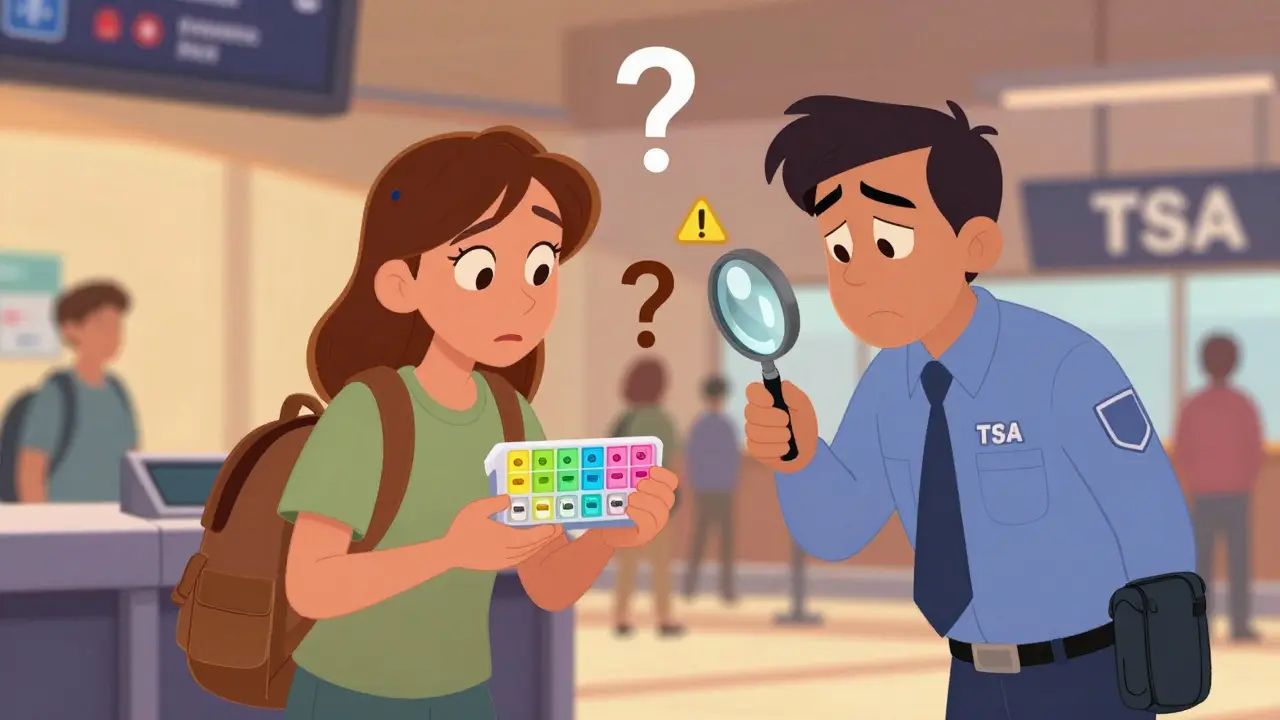
Imagine this: you’re at the airport, security line moving fast, and the officer asks about your pills. You pull out a small plastic case with 10 different tablets inside. No labels. No names. Just colors and shapes. That’s when things get messy. Even if you’re not doing anything wrong, you’ve just turned a 30-second check into a 10-minute interrogation. And if you’re flying internationally? You could be turned away at customs - not because you’re breaking the law, but because your meds don’t look like they’re supposed to.
Why Original Containers Matter More Than You Think
The TSA doesn’t legally require you to keep your pills in their original bottles. That’s right. Federal rules say you can use a pill organizer, a ziplock bag, or even a little box from your kitchen drawer. But here’s the catch: just because you can doesn’t mean you should. Most pharmacies label your meds with your name, the drug name, strength, dosage, prescribing doctor, and pharmacy info. That’s not just for show. That’s your proof that these aren’t illegal substances, counterfeit drugs, or something suspicious. When you remove that label, you remove your credibility. The Cleveland Clinic says it plainly: "Ideally, your prescription medications should be kept in their original containers, complete with the pharmacy label still intact." Why? Because airport staff and customs officers aren’t pharmacists. They don’t know what a blue oval pill is. But they know what a pharmacy label looks like - and they trust it.What Happens When You Skip the Original Bottle?
Let’s say you’re flying from Edmonton to New York. You’ve got your daily meds in a travel pill case. You’re not breaking any federal rules. But New York State law requires prescription meds to be in original containers when transported. You’re fine - until you get pulled aside. Now you have to explain why your 50 mg metoprolol isn’t in the bottle from Shoppers Drug Mart. You don’t have a prescription copy. You don’t have a doctor’s note. You’re stuck. Now imagine you’re heading to Japan. Pseudoephedrine (found in Sudafed) is illegal there. Codeine is tightly controlled. Adderall? Banned. If your pills are unlabeled, customs officials have no way to tell if you’re carrying a legal U.S. prescription or something prohibited. In 2023, the U.S. Embassy in Mexico reported a 68% drop in medication-related entry denials when travelers used original containers with documentation. A 2023 study of 1,247 international travelers found that those using original containers had 73% fewer delays at customs. That’s not luck. That’s efficiency. Labels save time. Labels save stress. Labels save trips.Liquid Meds, Ice Packs, and the 3.4-Ounce Rule
If you’re on insulin, liquid antibiotics, or seizure meds, you’re not bound by the 3.4-ounce liquid limit. TSA allows reasonable amounts of medically necessary liquids - even if it’s a full 100ml bottle. But you must tell the officer at the start of screening. Don’t wait for them to ask. Say it upfront: "I have medically necessary liquid medication." And yes, ice packs are allowed. But they must be declared too. Frozen gel packs, wet packs, even those little reusable cooling cubes - if they’re keeping your meds cold, you need to say so. Unannounced cold packs can trigger alarms or get mistaken for suspicious items. Declare them. It’s that simple. Never check your meds. Ever. United Airlines, the CDC, and the International Air Transport Association all agree: checked baggage can sit in uncontrolled temperatures for hours. Medications like insulin, epinephrine pens, and certain antidepressants can degrade or become ineffective. In 2023, 23% of travelers reported medication damage from being stored in checked luggage. That’s not a risk worth taking.
International Travel? It’s a Different World
The U.S. may be relaxed. Other countries aren’t. Over 187 countries have specific rules about bringing in medications. Thirty-two ban ADHD meds like Adderall and Ritalin. Forty-seven require special permits for opioids or benzodiazepines. Thailand restricts codeine. The UAE bans anything with pseudoephedrine. Singapore treats unapproved meds like contraband. The European Union’s Medicines Verification System, launched in 2020, requires all medications to be traceable. If your bottle doesn’t have a European-compliant label or you’re bringing more than a 30-day supply, you could be flagged. The UK allows only 30 days’ worth without prior approval. Japan limits most meds to a one-month supply. If you’re traveling outside North America, assume your meds aren’t automatically legal. Check the U.S. Department of State’s travel advisory page for your destination. Don’t rely on Google. Don’t ask your friend who went to Bali last year. Go to the official source. It takes five minutes. It could save your trip.What to Bring: The Minimalist Travel Medication Kit
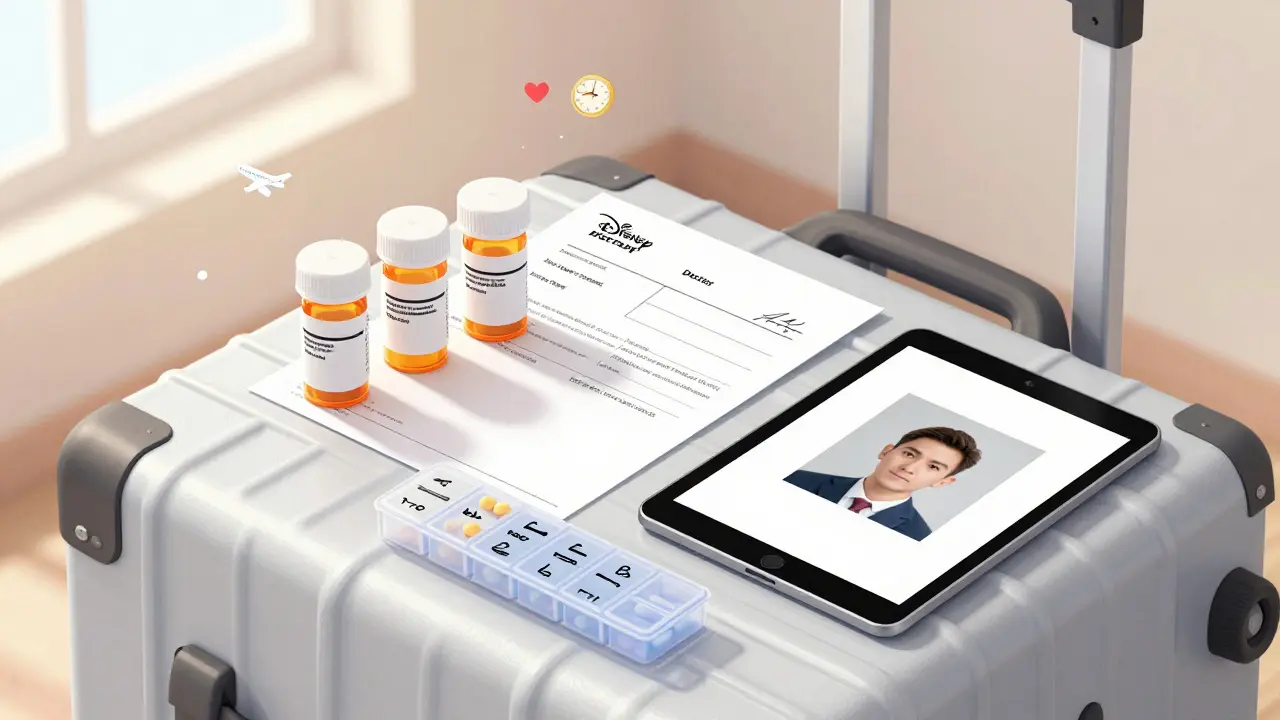
You don’t need a suitcase full of paperwork. But you do need these five things:- Original containers - with pharmacy labels still on. No exceptions.
- A copy of your prescription - printed, not just a photo on your phone. Include the generic name, dose, and prescriber’s info.
- A doctor’s letter - on official letterhead, signed, with license number and contact info. State your condition and list all medications.
- Extra supply - at least 3-5 days beyond your trip length. Delays happen. Flights get canceled. Don’t risk running out.
- Digital backup - take clear photos of each original bottle and your prescription. Save them in your email or cloud drive. If your physical copies get lost, you’ve got a fallback.
What Not to Do
Here’s what gets people into trouble:- Don’t bring meds from another country. The FDA warns that 11.7% of medications bought abroad are counterfeit or substandard. That number jumps to 28.4% in Southeast Asia.
- Don’t rely on your pharmacy’s online refill system to send you meds overseas. It won’t work. And it’s not legal.
- Don’t assume your insurance covers you abroad. Most don’t. Carry enough cash or a credit card for emergency refills.
- Don’t hide meds. If you’re nervous, that makes you look guilty. Be open. Be calm. Be prepared.
What’s Changing in 2025?
The TSA and DHS are testing a pilot program at 12 major U.S. airports to let travelers verify medications using a smartphone app. Expected to launch in late 2024, it will let you upload your prescription and ID, then scan your bottle at security. It’s not here yet - but it’s coming. The International Air Transport Association is also developing a global digital health pass for meds, with field tests starting in 2025. But until then, the old-school method still works best: original bottle + label + doctor’s note.Final Rule: When in Doubt, Keep It Original
TSA doesn’t require it. State laws sometimes do. Other countries definitely do. Your doctor and pharmacist recommend it. Your peace of mind demands it. There’s no downside to carrying your meds in their original containers. There’s a huge risk in not doing it. One unlabeled pill could mean missed flights, denied entry, or a long night in a customs holding room. So before you pack your bag, grab each bottle. Check the label. Make sure it’s clear. Take a photo. Print your prescription. Pack your extra supply. And when you get to the airport? Walk up to security like you own the place - because you do. You’re a responsible traveler. And you’ve got your meds where they belong.Can I carry my pills in a pill organizer instead of the original bottle?
Yes, the TSA allows it. But only if you’re flying domestically and you have backup documentation - like a printed prescription or a doctor’s note. If you’re flying internationally, many countries require original containers. A pill organizer without labels can trigger delays, searches, or even denial of entry. If you must use one, label it clearly with the drug name, dose, and frequency - and always carry the original bottles as backup.
Do I need a doctor’s note to fly with prescription meds?
Not always - but you should. A doctor’s letter on official letterhead, signed and with contact info, makes screening faster and smoother. It’s especially critical for controlled substances (like opioids, stimulants, or benzodiazepines) or if you’re traveling internationally. Customs officers in countries like Japan, UAE, or Singapore often require it. Even in the U.S., having one reduces the chance of being pulled aside for extra screening.
Can I bring liquid medications on a plane?
Yes - and there’s no size limit for medically necessary liquids like insulin, liquid antibiotics, or seizure meds. But you must tell the TSA officer at the start of screening. Don’t wait to be asked. Declare them clearly. You can also bring ice packs to keep them cold, but you must declare those too. Never pack liquids in checked baggage - temperature changes can ruin them.
Are there medications that are banned in other countries?
Yes. Many common U.S. meds are illegal abroad. Pseudoephedrine (in Sudafed) is banned in Japan, UAE, and South Korea. Codeine is restricted in Thailand and Singapore. Adderall and Ritalin are prohibited in multiple European and Middle Eastern countries. The UK limits most meds to a 30-day supply. Always check the U.S. Department of State’s travel advisory for your destination before you go.
What if I run out of my medication while traveling?
Don’t buy meds overseas. The FDA says 11.7% of medications bought abroad are fake or substandard - and that number is much higher in some regions. If you run out, contact your embassy. They can help you find a local pharmacy that can fill your prescription with a U.S.-approved version. Always carry extra pills - at least 3-5 days beyond your trip - to avoid this situation entirely.
Should I keep my meds in my carry-on or checked bag?
Always keep them in your carry-on. Checked luggage can be exposed to extreme heat or cold, which can destroy medications like insulin, epinephrine, or certain antidepressants. In 2023, 17.3% of medications in checked bags experienced temperature changes that compromised their effectiveness. Never risk it. Keep your meds with you - even if you don’t plan to use them during the flight.
Michael Burgess
January 4, 2026
I used to keep all my meds in a little pill case until I got pulled aside in Frankfurt. Turned out they thought my 'blue oval' was a street drug. Took 45 minutes to prove I wasn't smuggling Adderall. Now? Every bottle, every label, every damn thing. Worth the extra space in my carry-on.
Liam Tanner
January 6, 2026
This is the kind of info that should be in every airline's pre-flight email. Seriously, why do we have to learn this the hard way? I'm printing this out and taping it to my toiletry bag.
Palesa Makuru
January 7, 2026
Honestly, if you can't be bothered to keep your meds in the original bottles, maybe you shouldn't be traveling? Like, is your life really that chaotic? I mean, come on. 🙄
Hank Pannell
January 9, 2026
There's an epistemological tension here: the state's need for verifiable pharmaceutical provenance versus the individual's autonomy over bodily management. The original container becomes a semiotic anchor-its label a performative utterance of legitimacy in a bureaucratic landscape where trust is algorithmically mediated. We're not just carrying pills-we're carrying documentation of our medical personhood.
Lori Jackson
January 10, 2026
I can't believe people still think TSA is 'just being cautious.' This is institutionalized medical gaslighting. They treat you like a criminal until you prove you're not. And don't even get me started on how they treat women's meds-like we're hiding contraband in our birth control packs.
Wren Hamley
January 11, 2026
Pro tip: If you're on SSRIs or anything psychotropic, always carry the original bottle with the pharmacy sticker. I once had a TSA agent pull me aside because my 20mg Lexapro looked 'too clean.' Turns out he'd never seen a generic label before. I had to explain what 'escitalopram oxalate' meant. He still didn't believe me.
Sarah Little
January 11, 2026
I just don't get why people think they can bypass this. You're not saving space, you're risking your entire trip. I saw someone get detained in Heathrow because their insulin pen wasn't labeled. They had to call the embassy. It was a mess.
innocent massawe
January 13, 2026
In Nigeria, we don't always have original bottles. Sometimes we get meds from local clinics with just a slip of paper. I hope the global system gets better for people like us. 🙏
veronica guillen giles
January 14, 2026
Oh honey, you think this is bad? Try flying with thyroid meds in the UAE. They asked me if I was 'a witch.' I swear to god. I had to show them my prescription like it was a magic spell.
Ian Ring
January 15, 2026
I always carry my meds in original containers, plus a printed copy of my prescription, a doctor's letter, and a photo of the bottle on my phone. I also have the pharmacy's phone number written down. Yes, it's overkill. No, I don't care. I've been through this too many times.
Tru Vista
January 17, 2026
Original bottles? Pfft. I just put everything in a ziplock and say 'medical.' They always let me through. 🤷♀️
JUNE OHM
January 17, 2026
This is all part of the government's big pharma control scheme. They don't want you to have your meds without their permission. That's why they make it so hard. Next they'll be scanning your DNA to see if you're 'authorized' to take aspirin.
Philip Leth
January 18, 2026
I'm from the U.S. but live in Thailand now. I had to get a special permit for my blood pressure med. Took 3 weeks. But now? I carry the permit, the original bottle, and a Thai translation. No drama. Just be cool, be prepared, and don't act like you're hiding something. It goes a long way.