
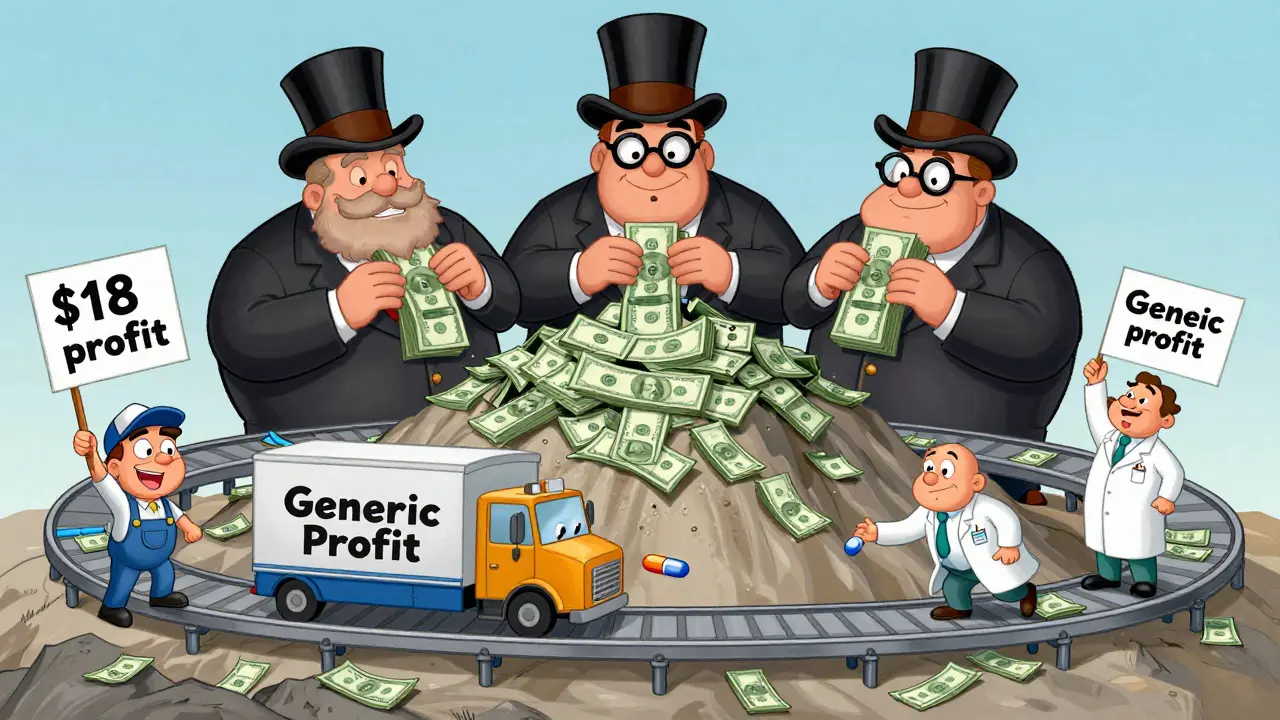
When you pick up a prescription for a generic drug at your local pharmacy, you probably don’t think about the long chain of middlemen between the factory and your hands. But the economics behind that pill are anything but simple. In fact, the system that moves generic drugs from manufacturers to pharmacies is one of the most misunderstood-and most profitable-parts of the entire healthcare system. And here’s the twist: the cheaper the drug, the more money some players make.
How Generic Drugs Turn Into Big Profits
Generic drugs are supposed to be cheap. They’re copies of brand-name medications, no longer under patent, so dozens of manufacturers can make them. You’d think that means low prices all around. But the numbers tell a different story. In 2009, generic drugs made up only about 9% of the total revenue for the three biggest pharmaceutical wholesalers in the U.S.-AmerisourceBergen, Cardinal Health, and McKesson. Yet they generated 56% of those wholesalers’ total gross profits. That’s not a typo. Nine percent of sales, over half the profit. Why? Because manufacturers of generic drugs are forced to slash prices to win contracts. With so many companies making the same pill, they compete on price alone. The result? A manufacturer might make only $18 in gross profit per unit of a generic drug, compared to $58 for a brand-name version. But here’s where it gets strange: the wholesaler selling that same generic drug makes eleven times more profit per unit than it does on a brand-name drug. For generics, that’s $32 per unit. For branded? Just $3. It’s not magic. It’s math. Wholesalers buy generics in massive quantities-thousands of pills at once-and pay pennies per unit. Then they sell them to pharmacies at a markup that looks tiny on paper but adds up fast when you’re moving millions of pills. Pharmacies, in turn, make nearly twelve times more profit on generics than on branded drugs. So while manufacturers are fighting over pennies, the middlemen are cashing in.The Three-Tier System That Controls Everything
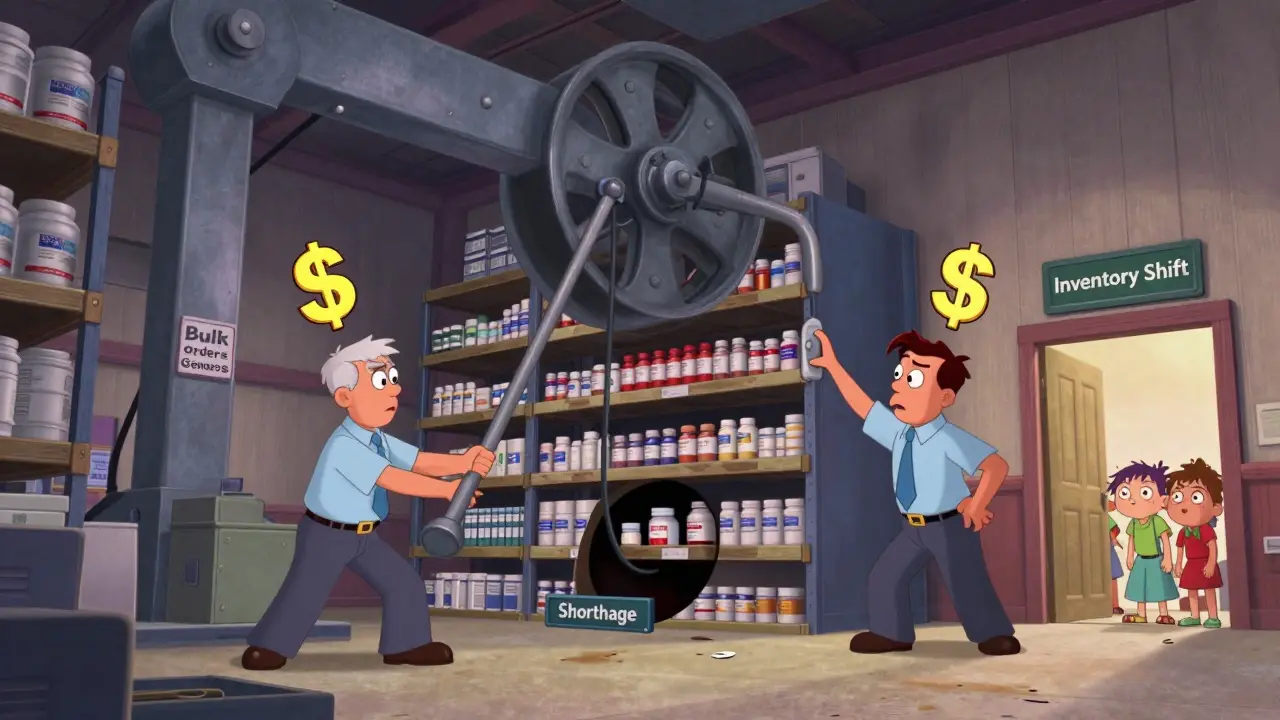
The U.S. pharmaceutical distribution system runs on a three-tier structure: manufacturers, wholesalers, and pharmacies. This wasn’t always the case. Before 1987, distribution was messy. The Prescription Drug Marketing Act cleaned it up, formalizing the roles. Today, the Big Three wholesalers control roughly 85% of the market. That’s not competition-it’s a cartel. And because they’re so big, they hold all the power. Think of it like this: if you’re a small generic drug maker trying to get your product into pharmacies, you don’t go door to door. You go to one of these three giants. They decide who gets shelf space, how much they’ll pay, and when they’ll pay it. And because they’re the only game in town, they can demand deeper discounts. Manufacturers have no choice. If they don’t accept the price, their drug doesn’t reach patients. This power doesn’t stop at pricing. Wholesalers also influence drug shortages. When a manufacturer can’t keep up with demand-or when a wholesaler decides to prioritize a more profitable drug-supply chains break. The Commonwealth Fund found that wholesalers play a direct role in creating and worsening shortages by shifting inventory to higher-margin products. So when your doctor says a generic drug is “unavailable,” it’s rarely because no one can make it. It’s because the wholesaler decided it wasn’t worth the shelf space.How Pricing Actually Works (It’s Not What You Think)
You might assume wholesalers just add a fixed percentage to the cost of goods. But it’s more complicated. There are four main pricing strategies used in generic drug distribution:- Cost-plus pricing: Add a fixed margin to production and shipping costs. Simple, but ignores competition.
- Market-based pricing: Match what competitors charge. Keeps you in the game, but kills margins.
- Value-based pricing: Charge based on perceived need. Rare for generics, but used in specialty drugs.
- Tiered pricing: The real winner. Offer discounts for bulk orders. This is how wholesalers make their money.
Why Generic Drugs Are More Profitable Than Branded Ones
It sounds backwards, but it’s true. Branded drugs have higher prices, higher margins for manufacturers, and more marketing. So why do wholesalers make eleven times more profit on generics? Because of volume, control, and leverage. Branded drug manufacturers have patents. They’re the only ones who can make the drug. That gives them power. They set the price. Wholesalers have to take it. Generic drug manufacturers? They’re in a race to the bottom. With 20 companies making the same drug, the only way to win is to undercut everyone. So they offer insane discounts to the Big Three. The wholesalers know this. They wait. They hold off on orders. They demand deeper cuts. And when a manufacturer finally says yes, the wholesaler buys massive quantities at rock-bottom prices. Then they sell those same pills to pharmacies at prices that look low but still leave them with huge margins. The pharmacy doesn’t care. They’re buying cheap and selling at a 42.7% gross margin. The patient pays less. The wholesaler makes more.The Volatile Market: Inflation, Deflation, and Shortages
The generic drug market doesn’t move in straight lines. It’s a rollercoaster. In 2020, during the pandemic, demand spiked. Prices rose. Inflation hit. Then in 2021 and 2022, the market flipped. Prices plunged. A wave of new manufacturers entered the market. Competition exploded. Deflation took over. But in 2023, everything changed again. Drug shortages returned. Not because no one could make the pills. Because manufacturers stopped making them. Why? Because the wholesalers stopped buying enough to make it worth it. Or because the raw materials were too expensive. Or because the factory in India had a power outage. Whatever the reason, when supply drops and demand stays high, prices jump. The Drug Channels Institute called this “pockets of inflation.” A few drugs-like insulin, antibiotics, or heart medications-saw price spikes of 30%, 50%, even 100%. But only those with limited suppliers. For the rest? Still cheap. This volatility is built into the system. Wholesalers don’t want to hold too much inventory. They don’t want to be stuck with $10 million in pills that no one wants. So they order just enough. That means when a shortage hits, they scramble. And when they scramble, prices rise.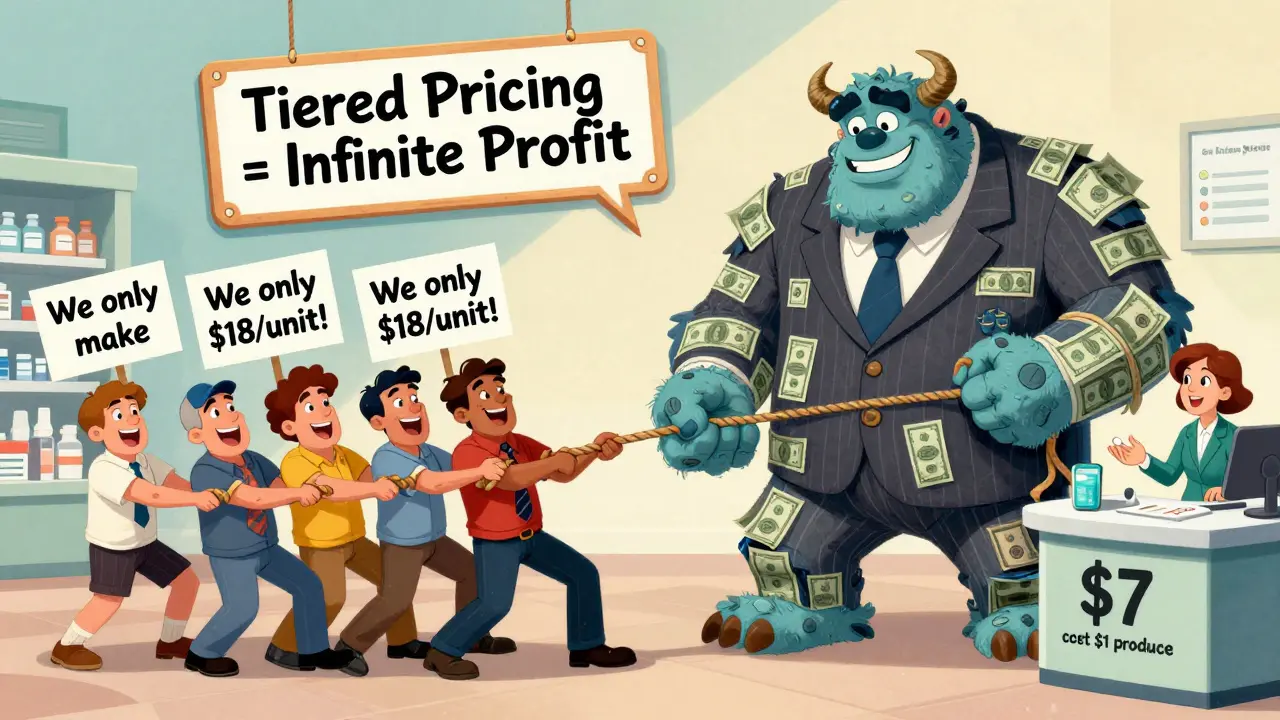
Linda Franchock
February 17, 2026
So let me get this straight-we’re paying less for pills but the people in the middle are raking in cash like it’s a casino? Classic. I mean, I get it, capitalism, but when your life depends on a $0.50 pill and it disappears because some dude in Ohio decided to stock more weight loss meds instead? Yeah. That’s not a market. That’s a game of musical chairs with our health.
Prateek Nalwaya
February 19, 2026
This whole thing reminds me of how chai is sold in Mumbai-same tea leaves, same milk, same sugar, but the guy on the corner charges 10 rupees while the chain store charges 60. The difference? Packaging, branding, and middlemen. Here, it’s the same pill, same factory, same chemistry-but now it’s got three layers of guys taking a cut before it hits your hand. The real tragedy? The manufacturers are just trying to survive. The wholesalers? They’re playing chess while the patients are pawns.
Oliver Calvert
February 20, 2026
Tiered pricing is the real villain here not the manufacturers or even the pharmacies. They’re just reacting to the system. The wholesalers have created a structure where volume is king and reliability is irrelevant. When you optimize for profit per pallet instead of patient access you get shortages. And no amount of transparency will fix that if the business model is built on scarcity. The fix? Break the oligopoly. Or nationalize distribution. Or both.
Kancharla Pavan
February 22, 2026
You people talk about capitalism like it’s some noble experiment. It’s not. It’s a feeding frenzy. Manufacturers beg for scraps. Pharmacies mark up like they’re selling gold. And the wholesalers? They sit on mountains of pills like dragons hoarding treasure and then decide who lives and who doesn’t based on quarterly reports. This isn’t healthcare. This is feudalism with a barcode. And the fact that we accept this as normal? That’s the real crime. We’ve normalized exploitation because it’s convenient.
PRITAM BIJAPUR
February 22, 2026
I find it fascinating how we’ve built a system where the cheapest goods become the most profitable. It’s like the economy has inverted itself. The more essential something is, the more it gets exploited. 🤔💊 The generic drug isn’t just medicine-it’s a mirror. It shows us what we value: profit over people. And yet we’re surprised when people die because insulin got 'unprofitable'? We knew this was coming. We just didn’t want to look. 💔
Philip Blankenship
February 24, 2026
Honestly I didn’t even think about this stuff until my grandma couldn’t get her blood pressure med for three weeks last year. She’s 78, lives in rural Kentucky, no insurance, just on Medicare. The pharmacy said it was ‘out of stock.’ Turns out the wholesaler had shifted inventory to a newer, more profitable generic. She ended up driving 45 minutes to a different town. I mean, how is this even legal? It’s not about greed-it’s about systemic indifference. We treat health like a commodity instead of a right. And now we’re shocked when it breaks? Nah. We built this.
Dennis Santarinala
February 24, 2026
I mean… I get the outrage. But let’s not forget: without this system, generics wouldn’t exist at all. The fact that we have $0.10 pills for life-saving meds? That’s a win. Yes, the middlemen are profiting. But they’re also ensuring that 300 million Americans can get their meds on time. It’s messy. It’s unfair. But it’s functional. Maybe we need reform-not revolution. Less cartels. More oversight. More transparency. Not less distribution.
Tony Shuman
February 25, 2026
You’re all acting like this is some American scandal. Newsflash: this is how capitalism works. In Europe they ration. In China they control. Here? We let the market decide. If a drug isn’t profitable? It gets pulled. That’s not evil. That’s economics. Stop crying about your $1.50 pill and start building a business that can compete. Or move to Canada. They’ve got socialism. I hear it’s lovely. 🇺🇸