
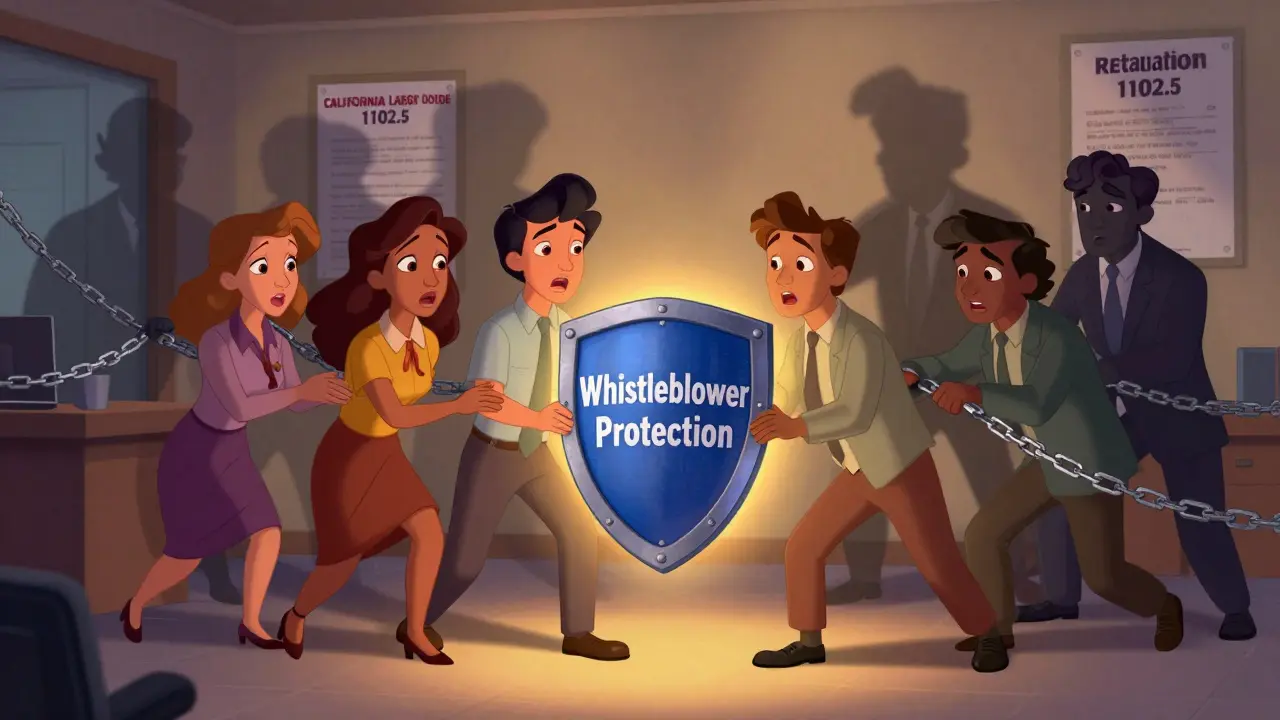
When you see something wrong at work-unsafe conditions, fraud, cover-ups, or illegal practices-speaking up shouldn’t cost you your job. Yet, too many people who report violations face retaliation: demotions, hostile environments, sudden performance reviews, or even termination. That’s where whistleblower laws come in. These aren’t just moral guidelines; they’re legal shields designed to protect you when you do the right thing.
What Counts as Protected Reporting?
Whistleblower protections don’t just cover grand exposes to the media. In California, under Labor Code Section 1102.5 a state law that protects employees who report violations of state or federal law to supervisors or government agencies, protected activity includes telling your manager about unsafe equipment, emailing HR about financial fraud, or calling a state agency about environmental violations. You don’t need proof-just a reasonable belief that something illegal is happening.
This applies to anyone: full-time employees, part-timers, job applicants, and even people who are just suspected of planning to report. If your boss thinks you might blow the whistle and punishes you for it, that’s still illegal. The law doesn’t care if your report turns out to be wrong. If you acted in good faith, you’re covered.
What Kind of Retaliation Is Illegal?
Retaliation isn’t always obvious. It’s not just getting fired. It can be:
- Being moved to night shifts after reporting safety issues
- Having your hours cut or pay reduced
- Being passed over for promotions without reason
- Receiving unfair performance evaluations
- Being isolated, mocked, or pressured to quit
- Being denied training or benefits
California’s Division of Labor Standards Enforcement (DLSE) has seen a 34% rise in retaliation claims since 2022. One nurse in Los Angeles was terminated after reporting understaffing that endangered patients. She later won $287,000 in back wages and reinstatement. But she spent 18 months fighting it. That’s the reality: the law says you’re protected, but proving retaliation is hard.
Federal vs. State Protections: What’s Different?
Federal whistleblower laws are scattered. Each one covers a specific industry or violation. The Sarbanes-Oxley Act protects employees of publicly traded companies who report financial fraud. The False Claims Act covers fraud against government programs like Medicare. The Dodd-Frank Act offers financial rewards-10% to 30% of recovered funds-if your tip leads to a $1 million+ penalty.
California’s law is broader. It doesn’t limit you to fraud or safety. If you report a violation of any state or federal law-whether it’s wage theft, discrimination, environmental dumping, or data misuse-you’re protected. That’s why California has become a leader in whistleblower rights.
But federal law gives you one big advantage: access to federal courts. California employees can’t file whistleblower claims directly in federal court under Section 1102.5. You’re stuck in state court or through the DLSE. And while California now imposes up to $10,000 in civil penalties per retaliation violation, federal agencies like OSHA often miss their own deadlines. In 2024, OSHA failed to meet investigation timelines in 63% of cases.

New California Rules Starting January 1, 2025
Starting next year, every employer in California-no matter how small-must post a clear, visible notice about whistleblower rights. The notice must include the California Attorney General’s Whistleblower Hotline 1-800-952-5225, in at least 14-point font. It can’t be tucked in a drawer or hidden behind a coffee machine. It must be in a common area: break room, bathroom, near time clocks.
This comes from Assembly Bill 2299 a 2024 law signed by Governor Newsom that strengthens enforcement and transparency. Employers who ignore it face fines up to $10,000 per violation. This isn’t just paperwork-it’s a signal. The state is saying: if you’re going to hire people, you’re responsible for knowing their rights.
But here’s the catch: 65% of small business owners didn’t even know about this requirement as of October 2024. And remote workers? The law lets you email the notice, but doesn’t say how to report violations if you’re not in the office. That’s a gray area many are still figuring out.
What You Should Do Before Reporting
Don’t just walk into HR and say, “I’m reporting this.” Document everything. Save emails. Write down dates, names, what was said. If you’re told to stop reporting, get it in writing-or record it if legal in your state.
Most successful whistleblower cases involve lawyers. The National Whistleblower Center found that 78% of people who won their cases had legal help. You don’t need to hire a big firm. Organizations like the National Whistleblower Center a nonprofit that provided free legal aid to 1,247 people in 2024 offer free consultations.
Time matters. Federal laws have strict deadlines. For example:
- 30 days: Clean Air Act, CERCLA
- 90 days: Anti-Money Laundering Act
- 180 days: Consumer Financial Protection Act
Miss the window, and your case is dead. California doesn’t have a strict deadline for filing under Section 1102.5, but delays weaken your case. Don’t wait.
Why This Matters Beyond the Workplace
Whistleblowers aren’t just employees. They’re public safety nets. In 2023, the SEC paid out $637 million to 131 whistleblowers. Most of those tips prevented fraud that would’ve cost taxpayers millions. The Congressional Budget Office estimates that stronger protections could save $12.7 billion a year in fraud alone.
But the system is still broken. A 2024 survey of 500 whistleblowers found that 68% still faced retaliation. HR departments often dismiss reports as “not meeting the legal threshold.” Employees report being told, “You’re not a whistleblower unless you go to the government.” That’s false. Reporting internally is protected.
And now, new frontiers are emerging. In May 2025, Senator Grassley introduced the AI Whistleblower Protection Act a proposed law to protect tech workers reporting unethical AI practices. Imagine an engineer who finds out their company is using biased algorithms to deny loans. Right now, they have no federal protection. That’s changing.
Where to Get Help
If you’re thinking about reporting:
- Call the California Attorney General’s Whistleblower Hotline 1-800-952-5225-free, confidential, and staffed by legal advisors.
- Contact OSHA’s Whistleblower Protection Program 1-800-321-6742 for federal claims.
- Visit the National Whistleblower Center a nonprofit offering free legal resources and advocacy for templates, guides, and referrals.
- Consult an employment lawyer who specializes in whistleblower cases. Many offer free initial consultations.
Don’t go it alone. The system is stacked against you, but you’re not powerless. The law is on your side-if you know how to use it.
Can I be fired for reporting my employer’s illegal activity?
No. Under California Labor Code Section 1102.5 and multiple federal laws, firing someone for reporting illegal activity is illegal retaliation. Even if your report turns out to be mistaken, as long as you had a reasonable belief something was wrong, you’re protected. Employers who retaliate can face fines, reinstatement orders, and back pay.
What if I report something internally but never go to the government?
You’re still protected. Many people think whistleblower laws only apply if you go public or contact regulators. That’s false. Reporting to your supervisor, HR, or a compliance officer counts as protected activity under both California law and federal statutes like Sarbanes-Oxley and Dodd-Frank. The law recognizes that internal reporting is often the first-and safest-step.
How long do I have to file a whistleblower claim?
It depends on the law. For federal claims, deadlines range from 30 to 180 days depending on the statute-for example, 90 days for the Anti-Money Laundering Act, 180 days for the Consumer Financial Protection Act. California’s Labor Code Section 1102.5 doesn’t have a strict deadline, but delays hurt your case. Evidence fades, witnesses leave, and employers use time to argue your claim is invalid. File as soon as possible.
Can remote workers be protected under California law?
Yes. California’s whistleblower protections apply to employees working remotely if they’re employed by a company based in California or if their work is primarily connected to California operations. However, the law doesn’t clearly define how remote workers should receive the required whistleblower notice. Employers must still comply with posting requirements, but enforcement in remote settings is still evolving. Legal experts recommend sending the notice via email and keeping proof of receipt.
Are there rewards for whistleblowers?
Yes, but only under specific federal laws. The Dodd-Frank Act offers 10% to 30% of the money recovered if your information leads to a successful enforcement action over $1 million. The False Claims Act also allows for rewards, typically 15% to 30%. California law does not offer financial rewards, but it does allow for reinstatement, back pay, and civil penalties against the employer. Rewards are rare and only apply to financial fraud cases.
David McKie
February 24, 2026
Let me tell you something-this whole whistleblower thing is a circus. People think they’re heroes just because they tattled on their boss for using the wrong stapler. Meanwhile, companies are drowning in paperwork because some dude emailed HR about ‘unsafe coffee machine placement.’ You don’t need a law to tell you not to be a jerk, but apparently, we’ve turned workplaces into courtroom battlegrounds. And don’t get me started on the ‘reasonable belief’ loophole. That’s just legal cover for people who can’t take a hint.
California’s law is a joke. It’s like they’re trying to turn every office into a union hall with a lawyer on speed dial. I’ve seen this before. First, it’s a poster on the wall. Next thing you know, someone’s filing a claim because their manager said ‘hey’ too loudly. This isn’t protection-it’s litigation tourism.
And let’s not pretend the ‘10% reward’ under Dodd-Frank is some moral victory. It’s a bounty hunter system. People aren’t reporting fraud-they’re hunting for paydays. You think that nurse who got $287k really cared about patient safety? Or did she just finally get tired of night shifts?
The system’s broken because we stopped trusting adults to behave ethically and started rewarding snitches. And now we’re training kids to think reporting is a career path. What happened to just… being a decent human being?
Oh, and that AI whistleblower bill? Next they’ll be protecting people who complain about ChatGPT giving them bad dating advice. We’re not fixing problems. We’re just creating new ones with more paperwork.
God help us all if this keeps going.
Southern Indiana Paleontology Institute
February 25, 2026
yo california be crazy. they got posters everywhere like its a public service announcement. my cousin work at a 7-eleven in sacramento and they had to put a big sign by the soda machine. like bro, its a convenience store. who’s gonna report the manager for not stocking enough nacho cheese? 😂
also i heard a guy got fired for telling his boss the copier was broken. not for fraud. just broke. and now the company got fined $10k. what the hell. we need common sense here. not more laws. more common sense.
Anil bhardwaj
February 27, 2026
honestly, this post made me think. i work in a small tech firm in bangalore and we’ve had a few quiet whispers about data handling. never went public, never filed anything. just talked to the team lead. no drama. no lawyers. just… fixed it.
maybe the real lesson isn’t about laws-it’s about culture. if people feel safe talking, you don’t need posters or hotlines. just good leadership.
still, i’ll admit, california’s rules are kinda overkill. but hey, at least they’re trying.
lela izzani
February 28, 2026
I’ve worked in HR for 12 years, and I can tell you-most whistleblowers aren’t looking for fame or money. They’re scared. They’re tired. They’ve watched people get pushed out, ignored, or gaslit. And they finally snapped.
Yes, some cases are messy. Yes, some people misuse the system. But the ones who get crushed? The ones who lose sleep, get passed over for promotions, or are suddenly ‘restructured’ out of existence? They don’t get headlines.
The law exists because the system fails. Not because people are greedy. Because managers are lazy. Because HR departments are terrified of liability.
That poster requirement? It’s not about bureaucracy. It’s about visibility. If you’re a remote worker in Iowa, working for a California company-you deserve to know your rights. Even if you’re not loud. Even if you’re quiet. Even if you don’t know the law yet.
It’s not about making work a courtroom. It’s about making work safe.
And honestly? We’ve had too many people lose too much. Let’s not pretend this is about drama. It’s about dignity.
Steven Pam
March 2, 2026
Look, I get the cynicism. But let’s flip this. What if every single time someone spoke up, the company didn’t treat them like a traitor? What if instead of hiding the whistleblower notice behind the coffee machine, we made it the first thing new hires saw?
Imagine a culture where reporting a problem was celebrated, not punished. Where managers didn’t panic because someone said, ‘Hey, this isn’t right.’
That’s not fantasy. It’s what happens in companies that actually care. Not the ones with lawyers on standby. The ones with leaders who say, ‘Thank you for telling me.’
California’s rules are clunky, sure. But they’re a start. And if we keep pretending whistleblowers are the problem, we’ll keep creating the very toxicity we say we hate.
Let’s stop calling them snitches. Let’s start calling them early-warning systems.
And yeah-I’m gonna post that notice on my team’s Slack channel today. No joke. Because someone out there needs to know they’re not alone.
Timothy Haroutunian
March 3, 2026
This whole thing is just another example of how America has turned every minor workplace disagreement into a constitutional crisis. You report your manager for ‘not washing the coffee mugs’ and suddenly you’re a national hero? No. You’re just someone who can’t handle being told to clean up after yourself.
The fact that California now requires employers to post notices like they’re public health advisories is absurd. Who’s reading these? The janitor? The intern who’s too busy scrolling TikTok to notice? This isn’t enforcement-it’s performative compliance.
And don’t get me started on the ‘reasonable belief’ clause. That’s a loophole wide enough to drive a truck through. One guy thought his coworker was stealing pens. Filed a report. Got paid $12k in back wages. The company had to reinstate him. He didn’t even work in the office anymore-he was fired for ‘attitude.’
Meanwhile, the real problems? The ones where people are being exploited? Those get buried under 17 pages of legal jargon and HR forms.
And now we’re talking about protecting people who report ‘unethical AI’? What’s next? Whistleblower rights for people who think their smart fridge is judging them? This isn’t progress. It’s madness dressed up as justice.
And the worst part? No one’s actually fixing the root issue. We’re just layering more rules on top of a system that’s already broken. Someone’s gonna get rich off this. Probably a lawyer in San Francisco who doesn’t even have to work anymore.
It’s pathetic.
Erin Pinheiro
March 4, 2026
ok but like… the law says you’re protected if you have a ‘reasonable belief’ but what if you’re just paranoid? like i had a coworker who thought the printer was spying on her because it ‘made weird noises’ and she emailed the whole company about it. then she filed a whistleblower claim. under section 1102.5. because she thought the printer was violating ‘data privacy laws.’
they had to pay her $8k in back wages. she got reinstated. and now the company has to put up a poster that says ‘if you think your stapler is racist, call this number.’
im serious. this is what happens when you give people a tool without teaching them how to use it.
also the ‘no deadline’ thing in california? that’s a disaster. people wait 2 years then show up with a 300-page email chain and expect you to remember who said what in 2022.
we need less law. more common sense. and maybe a filter. just one. for the crazies.
Michael FItzpatrick
March 5, 2026
Let me say this: whistleblowers aren’t the enemy. They’re the canaries in the coal mine. And if you’re rolling your eyes at this, you’re probably the one who’s been ignoring the smell for years.
I’ve seen good managers turn toxic overnight because someone spoke up. Not because they were wrong. But because they were scared. Scared of losing control. Scared of being exposed.
But here’s the thing-you can’t fix a broken culture with more posters. You fix it with trust. With accountability. With leaders who say, ‘I’m glad you told me,’ not ‘Who else knows about this?’
California’s rules? Yeah, they’re messy. But they’re a wake-up call. A loud, clunky, over-the-top wake-up call.
And if you think this is about lawyers getting rich? Look at the numbers. The National Whistleblower Center helped 1,247 people last year. Most of them didn’t even have a lawyer. They had a phone call. A few emails. A little courage.
So next time you roll your eyes at a whistleblower… ask yourself: what’s the cost of silence?
tia novialiswati
March 6, 2026
Hey, I just wanted to say-thank you for writing this. I’ve been thinking about reporting something at my job for months. I’m scared. But this gave me a roadmap. I’m gonna call the hotline tomorrow. And I’m saving all my emails.
You’re right. You don’t have to go public. You don’t have to be a hero. You just have to be brave enough to say, ‘This isn’t right.’
And if you’re reading this and you’re scared too? You’re not alone. I’ve got your back. 💪❤️
One step at a time.
Maranda Najar
March 8, 2026
It is with profound moral gravity that I address the systemic erosion of workplace integrity as precipitated by the unchecked proliferation of whistleblower legislation in the State of California. While ostensibly framed as protective, these statutes have, in practice, functioned as instruments of institutional destabilization, incentivizing opportunistic litigation under the veneer of ethical rectitude.
The notion of ‘reasonable belief’ constitutes not a safeguard, but a jurisprudential vacuum-one into which the most capricious, emotionally volatile, and legally unsophisticated individuals are permitted to hurl unsubstantiated allegations with impunity. The resultant administrative burden on employers, particularly small enterprises, is not merely onerous-it is existential.
Moreover, the requirement to conspicuously display legal notices in break rooms, restrooms, and near time clocks is not an act of empowerment, but an act of public shaming. It implies, by its very visibility, that the employer is presumed guilty until proven innocent. This is not due process. This is trial by poster.
And let us not overlook the grotesque irony of the AI whistleblower bill. We are now extending legal protection to those who perceive algorithmic bias in predictive models… while simultaneously abandoning the foundational principle of human agency. One cannot simultaneously champion the sanctity of individual conscience and outsource moral judgment to machine learning.
The law, in its current iteration, does not protect the honest. It protects the litigious. And in doing so, it corrodes the very trust upon which professional relationships must rest.
One must ask: Is this justice? Or is it merely the commodification of grievance?